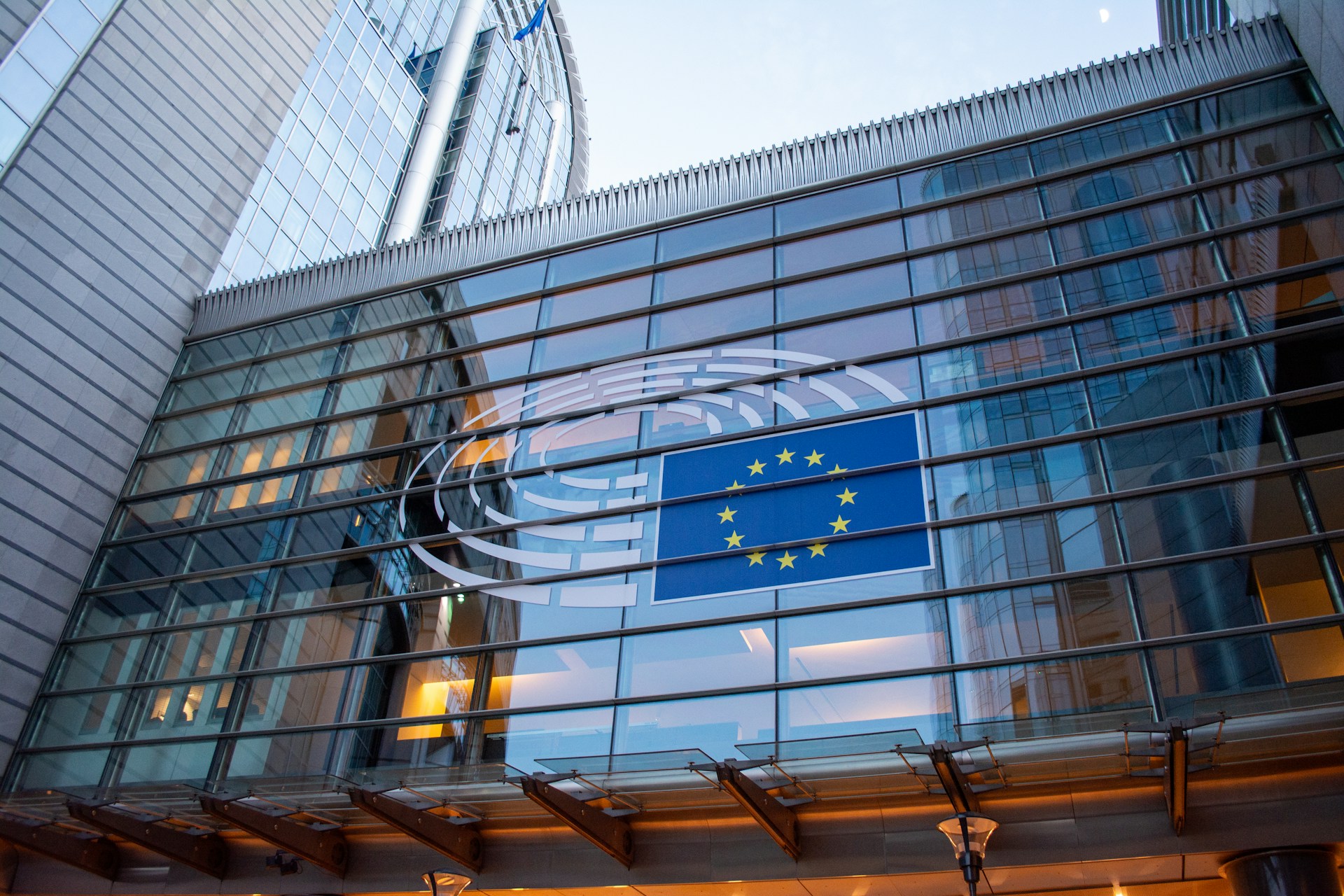
Author: Jean-Philippe

  • E. U. Parliament

    E. U. Parliament

    314 Voted No. 276 Voted Yes. It Passed Anyway.

    Taken one at a time, they’re modernisation, child safety, consumer protection, progress. Taken together, they’re a question nobody in Brussels particularly enjoys being asked: who wrote this, who profits from it, and who pays?

    Last winter I spent a Sunday evening at my kitchen table, logged into a government portal, registering my one-person salon for something. I no longer remember which something — there have been several. What I remember is the format: a login I’d forgotten, a form that assumed I had a compliance department, and a helpful note explaining that the deadline had been communicated well in advance, which was true, in a document I had not read, because it was three hundred pages long and I cut hair for a living.

    It took me most of the evening. For a company with a legal department, the same rule takes one email to a consultant and disappears into a budget line. That is not a scandal. It is just arithmetic, and it is the arithmetic underneath everything that follows.

    [Switches to serious face.] Because there is a set of things happening in Europe right now that, individually, all sound perfectly reasonable, and collectively, add up to something I think deserves a much harder look.

    €382 m record annual spend by the biggest corporate lobby operations in Brussels, per Corporate Europe Observatory’s 2026 count

    €151 m the tech industry’s share of that, up from €113 million in 2023

    890 full-time tech lobbyists working Brussels — 437 of them holding Parliament access badges

    449 m people the European Union represents, most of whom employ zero lobbyists

    The Vote That Explains Everything

    Start with the clearest example, because it happened last month and it is a matter of public record.

    Chat Control — the family of proposals that would have communication services scanning private messages for child sexual abuse material — has been fought over since 2022. The permanent version is still stuck: the fifth round of closed-door negotiations collapsed at the end of June, and talks resume in September under the Irish presidency.

    But the temporary version, the one allowing voluntary scanning, expired in April. In March, the European Parliament refused to extend it, 311 votes to 228. The Council reinstated it anyway, unchanged, through April 2028. Parliament got one more shot at rejecting it on 9 July, under emergency procedure, and voted like this:

    314 against. 276 in favour.

    More MEPs voted to kill it than to keep it. It survived, because at second reading you need an absolute majority of all members — 361 — and not merely a majority of the people who actually turned up and voted. So it stands until 2028.

    I want to be fair here: that threshold exists for real reasons, it applies to everyone, and nobody broke a rule. This is not corruption. It is procedure working exactly as designed.

    It is also a sentence you should sit with for a moment. On the question of whether private messages get scanned, the elected chamber said no by thirty-eight votes, and the answer was yes.
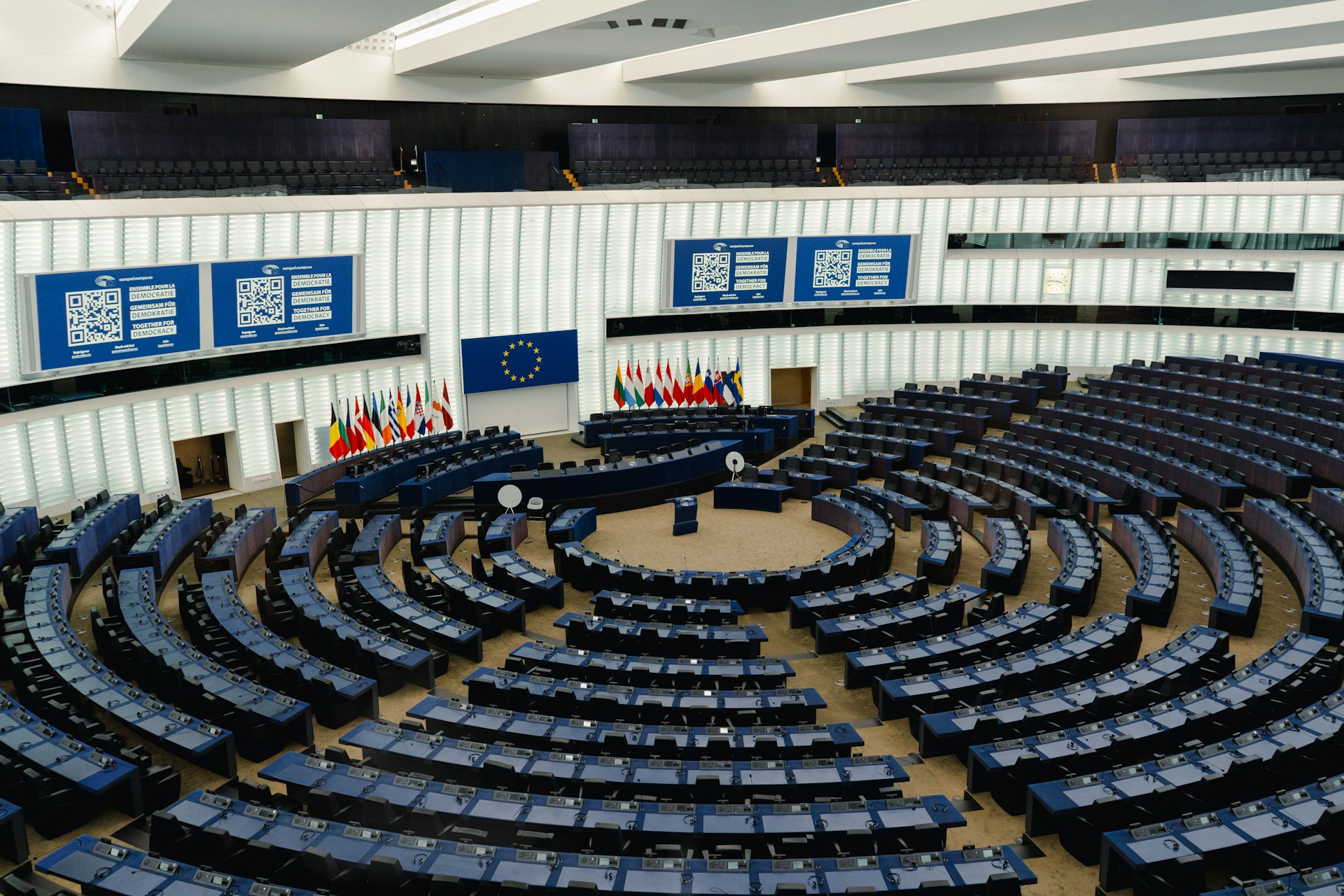
    eu01

    Photos: Unsplash

    Nobody Has to Conspire

    Here is where I part company with the version of this argument that gets shouted on the internet.

    There is no smoke-filled room. There doesn’t need to be one. A conspiracy would honestly be cheaper than what actually happens, which is entirely legal, fully documented, and published in a public register.

    The biggest corporate lobby operations in Brussels now spend a record €382 million a year. The tech industry alone accounts for €151 million of it, up from €113 million in 2023, fielding around 890 full-time lobbyists, of whom 437 hold badges that let them walk into the European Parliament. Meta alone runs a budget north of €10 million.

    Against that, picture the ordinary citizen the regulation is theoretically written for. She has a job, two children, and a PDF. She has roughly forty minutes of civic energy per month, and the document is three hundred pages of cross-references to four other documents.

    Nobody is lying to her. Everything is technically available to her. The consultation was genuinely open. It is simply that one side of this conversation has 890 people whose entire job is this, and the other side has a Tuesday evening.

    When an institution needs technical expertise to regulate an industry, and that expertise mostly lives inside the industry, the line between regulating a market and designing a market gets very thin. Not through malice. Through proximity, deadlines, and the fact that the industry always shows up with the better slide deck.

    eu05

    Photos: Unsplash

    The Money and the Wallet

    The digital euro is the piece I’ve written about before, in the context of Germany’s quiet refusal to give up cash, so I’ll be brief and I’ll be accurate, because accuracy is what this argument usually lacks.

    The proposed regulation states explicitly that the digital euro shall not be programmable money. No expiry dates, no approved-purchase lists. If you’ve been sharing the version where that’s already been decided, you’ve been handing the other side a free win, and I’d rather you didn’t.

    What the proposal does include is conditional payments — automation where you set the condition, such as releasing funds when a parcel arrives. The Eurosystem’s defence is that the citizen holds the switch. That distinction is real. It is also a distinction about who holds the switch rather than about whether one exists. The EU’s own privacy watchdogs looked at programmability and warned it would create unacceptably high data protection risks — that is the EDPB and the EDPS, not a militia.

    Meanwhile the European Digital Identity Wallet arrives on a converging timetable, with member states due to offer one to every citizen. Two systems, built separately, for good reasons, by different people. Nothing in either proposal links your identity to your grocery shopping.

    The concern was never that today’s draft does that. It is that the prohibition lives in a regulation and the capability lives in the wiring, and only one of those two things is easy to amend in a bad year.

    “A capability built for an excellent reason does not stay attached to the reason. The reason retires. The capability doesn’t.” — Which is why “but we’d never use it that way” is a statement about intentions, and intentions are not a form of infrastructure.

    eu09 eu10

    Photos: Unsplash

    The Children Argument

    Chat Control deserves its own paragraph on the merits, because the usual framing of it is unfair to everybody.

    Protecting children from exploitation is not a pretext. It is an urgent, real, morally serious objective, and the people pushing hardest for these powers are, in the main, pushing for them because the material is genuinely out there and the current tools are genuinely inadequate. Anyone who waves that away to score a point about privacy has lost the argument before starting.

    The question is narrower, and harder. Does achieving it require building a scanning architecture that touches the private messages of several hundred million people who have done nothing? Because that architecture, once it exists, is a general-purpose capability with a child-protection label on it, and labels are the easiest part of any system to change.

    You can hold both thoughts. Most people do. It’s the institutions that keep insisting you must pick one.

    eu12

    Your Tomato Now Has a Secret

    Which brings me to food, and to the cleanest illustration of the pattern I can offer, because this one is finished. It is not a proposal or a fear. It is law.

    The EU’s new genomic techniques regulation entered into force in July and applies from 2028. Plants in the lower-risk category — edits that could in principle have happened through conventional breeding — are released from GMO-style rules. Seeds and reproductive material still have to be labelled. The food on the supermarket shelf does not.

    Read that again, slowly, because the asymmetry is the whole point. The seed merchant gets told. The farmer gets told. You, standing in the vegetable aisle, do not.

    There are respectable scientific arguments for this. Gene editing is not the boogeyman it was sold as in the nineties, the safety case for many of these edits is decent, and European agriculture has genuine problems that this technology might genuinely help with.

    But notice the distribution. The company gets the patent, the proprietary seed line, and the commercial advantage. The consumer gets less information than she had before. Whatever the scientific merits, that particular split — intellectual property protected upward, information withdrawn downward — is the shape that keeps recurring, in file after file, and it is reasonable to notice a shape.

    eu07 eu08

    Photos: Unsplash

    And the Speech Part

    The last thread is the one where I have to be most careful, because it is the one where reasonable people most often talk past each other.

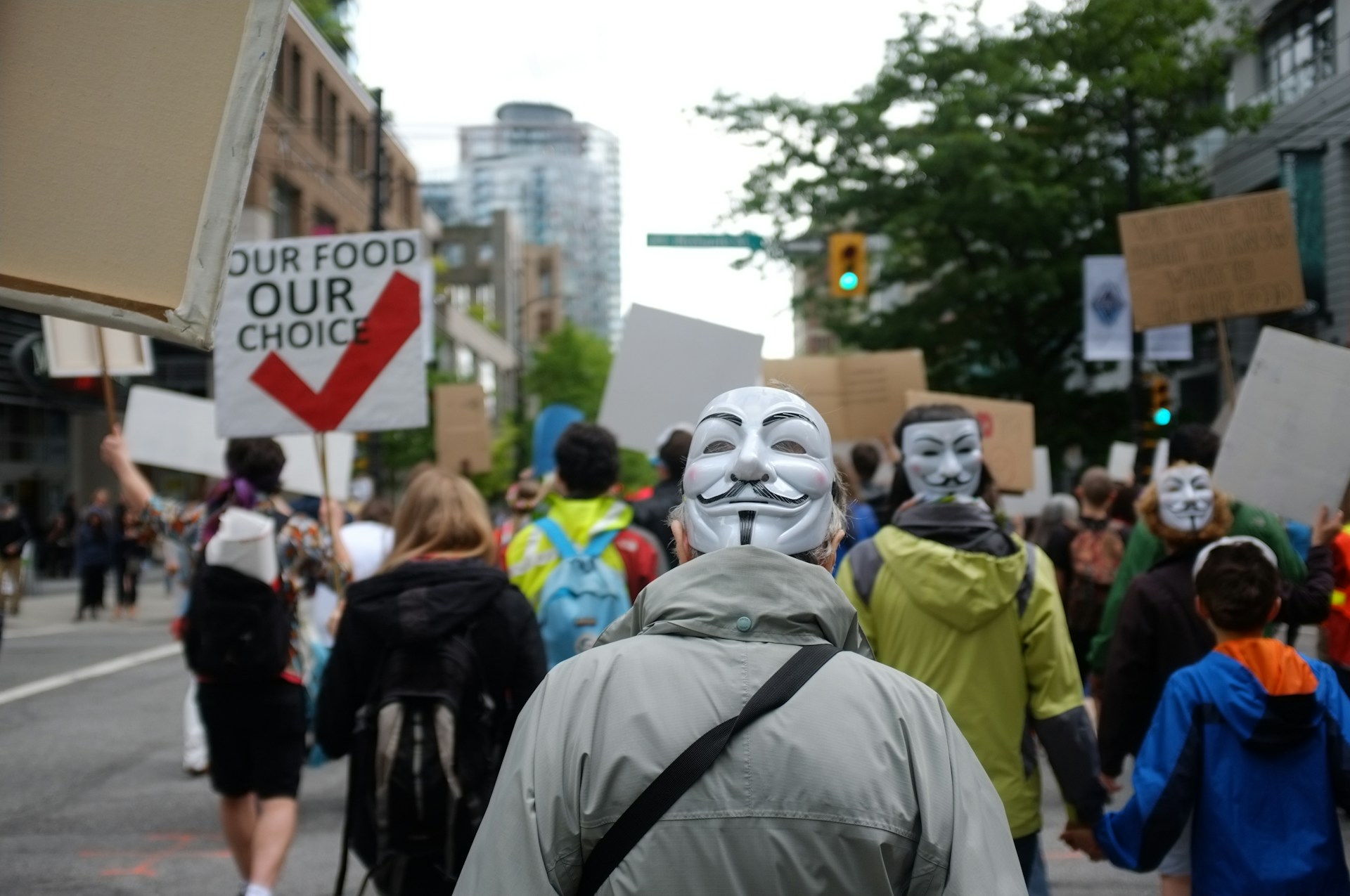
    Governments have real obligations to act against incitement to violence, criminal coordination, and the deliberate industrial-scale manipulation of elections. Those are not invented problems, and “free speech” is not a magic phrase that dissolves them.

    But misinformation, hate speech and harmful content are categories with soft edges, and soft edges move. They move with the government of the day, with public mood, with whoever is currently in the room defining them. A democracy in decent health has to leave room for a citizen to call a minister incompetent, to be wrong in public, and to hold an opinion that the sensible people find embarrassing — without that citizen becoming, administratively, a case.

    Free speech was never designed to protect opinions everyone already agrees with. Those opinions are doing fine. They have never needed a single line of law. The whole apparatus exists for the uncomfortable, unpopular, inconvenient ones, and a protection that only covers the agreeable is not a protection. It’s a compliment.
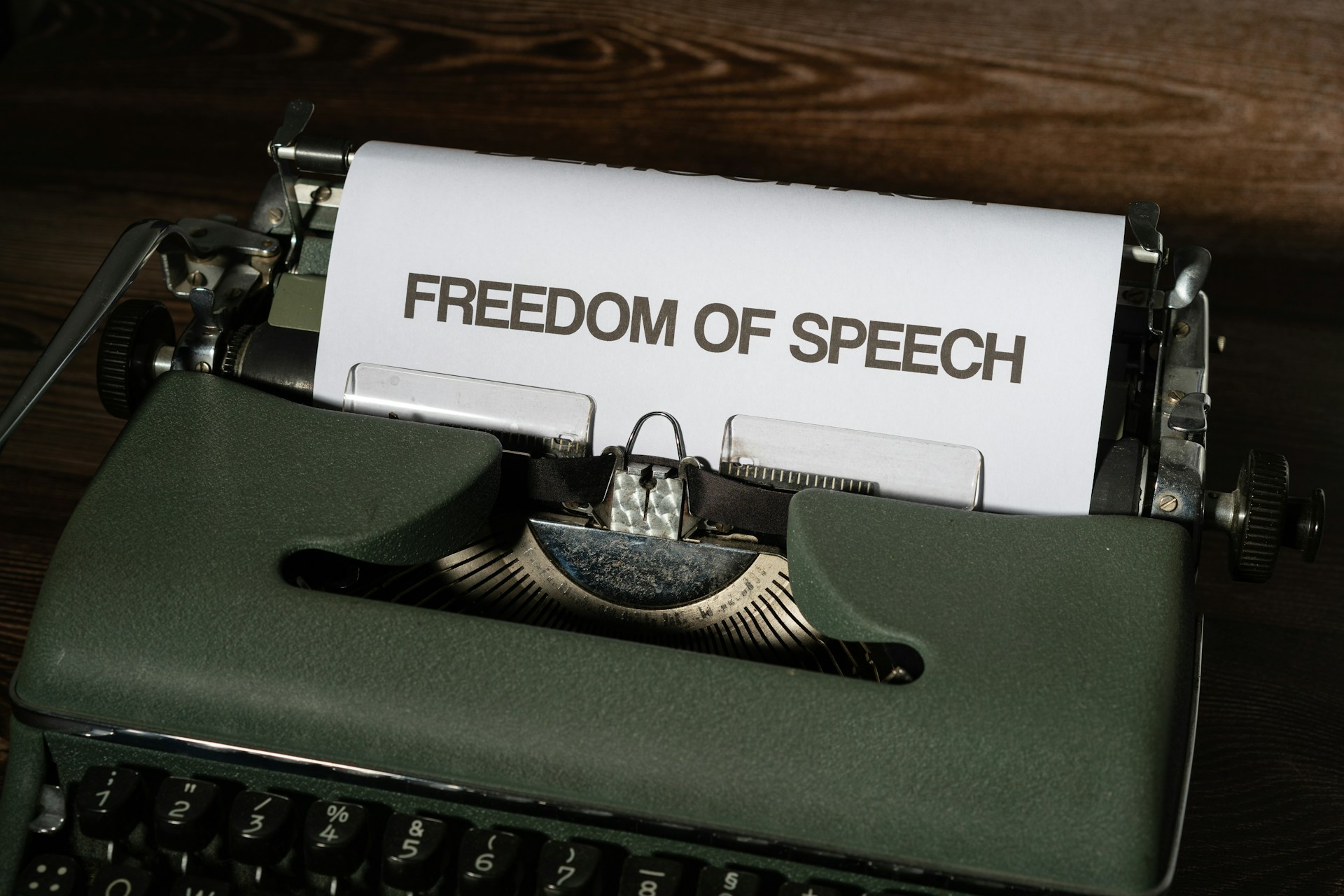

      eu03 eu04

    Photos: Unsplash

    Six Questions Worth Asking About Any of It

    Who wrote the regulation?

    Which companies lobbied for it, and for what wording?

    Who stands to make money from it, and how much?

    Who ends up owning the resulting data, patents and infrastructure?

    What concrete protections exist for an ordinary person — not principles, protections?

    And what happens to all of it if a government fifteen years from now is less careful than this one?

    Every one of these has a findable answer. The EU Transparency Register is public, Corporate Europe Observatory and LobbyFacts do the counting, and your own MEP has an email address and a legal obligation to read it.

    Back to the Chair

    None of this makes me anti-European. I have lived on both sides of the Atlantic, I have run a business under two very different systems, and I would choose this one again without much hesitation. The alternative to European regulation is not freedom; it is somebody else’s regulation, written further away, by people who will never take my call either.

    And most of the individual pieces are defensible — or are at least presented by people who have worked very hard on the presentation. Europe probably should not depend on two American card networks to move its own money. Child protection is not a smokescreen, though it would make an outstanding one, and I am not naive enough to believe that has occurred to nobody in the building. Gene editing is not poison, except in the cases where it turns out to be, which we will establish somewhere around 2050, at which point everyone responsible will have retired comfortably. Every file here has a real argument behind it, made by real people. Most of them believe it. Some of them are selling.

    What I cannot get comfortable with is the direction of travel across all of them at once. In each case, capability accumulates upward and information flows downward a little less freely than before. In each case the answer to the obvious question is a variation of trust us. And trust us is not a governance model. It is a mood, and moods change with elections.

    I wrote once about the authoritarian streak sitting quietly inside perfectly democratic systems, and about the house nobody is repairing. This is the same house. The roof isn’t leaking yet. The work being done in the attic is simply hard to see from the ground, and the people doing it keep saying it’s fine.

    So I’ve settled on something small and entirely unheroic. When a client brings one of these subjects up in my chair — and they do, more than they used to — I’ve stopped saying what can you do. I look up the actual document, badly, in the wrong language, at eleven at night, and I get about a third of the way through it.

    A third is not nothing. A third is more than the version I would otherwise have received secondhand from someone with an excellent slide deck.

    The Salon California Journal is a space for ideas, culture, and conversation from my chair in Brasschaat, Belgium. I write about beauty, technology, society, and the intersections between them.


  • Intelligence

    Intelligence

    There Are Many Ways to Be Intelligent. School Measured Two of Them.

    In 1983, a Harvard psychologist argued that intelligence isn’t one fixed thing you either have or don’t. Billions of people have spent their lives believing a number that was only ever measuring one direction.

    A mother sat in my chair this spring and told me, somewhere between the wash and the first section, that her son was good with his hands but not academic. She said it warmly. She said it the way you’d mention the weather. Two minutes later she was telling me he’d taken a dead scooter engine apart on the kitchen floor, found the fault, and put it back together with one part left over that apparently didn’t matter — and she said that the way you’d apologise for a mess.

    I have been hearing that sentence, in three languages, for thirty years. It is never said cruelly. It is a small verdict, delivered gently, usually by someone who loves the person it lands on. And it lasts a lifetime.

    I was fourteen when I started sweeping a salon floor between school days, and I already knew which of the two rooms I understood better. Nobody was handing out marks for the one I was good at.

    [Switches to serious face.] So let’s talk about what a test score is actually measuring, and what it very confidently is not.

    Frames of Mind

    In 1983, Harvard developmental psychologist Howard Gardner published Frames of Mind and made an argument that sounds obvious now and was heresy at the time: intelligence is not a single, fixed quantity that can be captured by one number. There are several relatively independent kinds, and a person can be extraordinary in one while entirely ordinary in the next.

    He proposed seven. Two more were added later. Other researchers, working in adjacent traditions, have made the case for several more. The list below is the full modern spread of twelve — and because who proposed what turns out to be part of the story, I’ve kept the origins straight rather than pretending they all arrived in one box.

    1983 the year Gardner published Frames of Mind and broke intelligence into pieces

    7 how many kinds he originally proposed — the number has been moving ever since

    8½ his own count once he’d added a ninth he was never quite willing to fully commit to

    1 the number of figures a school report reduces all of it to, before anyone turns eighteen

    The Original Seven

    Intelligenceo1

    1. Linguistic intelligence

    Using language with precision — finding the exact word that carries the exact weight. Writers, poets, storytellers, journalists, and anyone who can turn a vague feeling into a sentence that makes everyone else say that’s exactly it.

    Intelligenceo2

    2. Logical-mathematical intelligence

    Pattern recognition and abstract reasoning. Seeing the system operating underneath the visible data. These are the minds that look at chaos and think, there’s a structure in here somewhere.

    Musical_intelligence

    3. Musical intelligence 

    Not simply playing an instrument. Perceiving rhythm, harmony, pitch, structure, and emotional resonance through sound. Some people hear music. Others hear the scaffolding holding it up.

    spatial_intelligence

    4. Spatial intelligence 

    Thinking in three dimensions — mentally rotating objects, distances, shapes, environments. Architects, surgeons, sculptors, engineers, designers, and anyone who can assemble IKEA furniture without entering a spiritual crisis.

    bodily-kinesthetic_int…

    5. Bodily-kinesthetic intelligence 

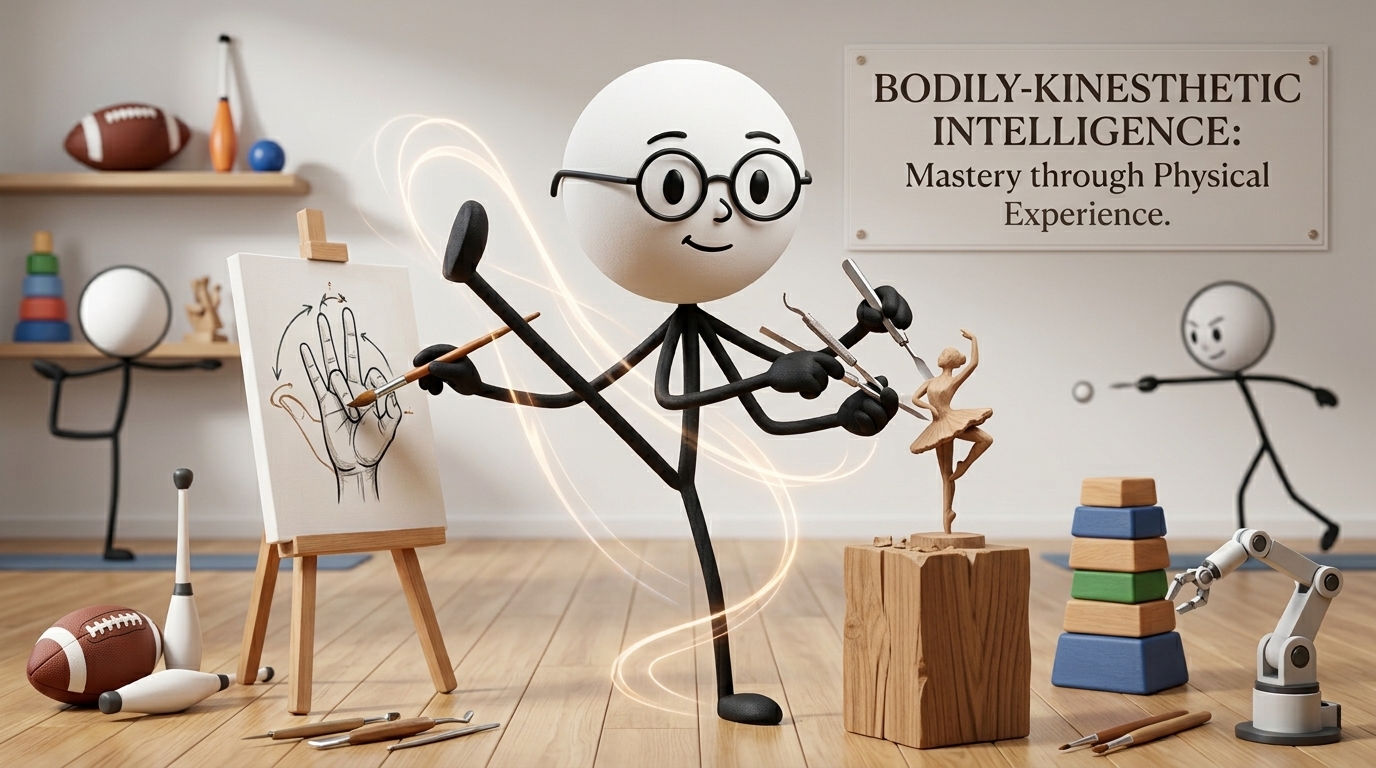
    The intelligence of the body itself. The athlete who has read the game before the analyst has finished explaining it. The dancer who knows exactly where their body needs to be. The craftsman whose hands understand something several seconds before his mind finds the words for it.

    Interpersonal_intelligence

    6. Interpersonal intelligence 

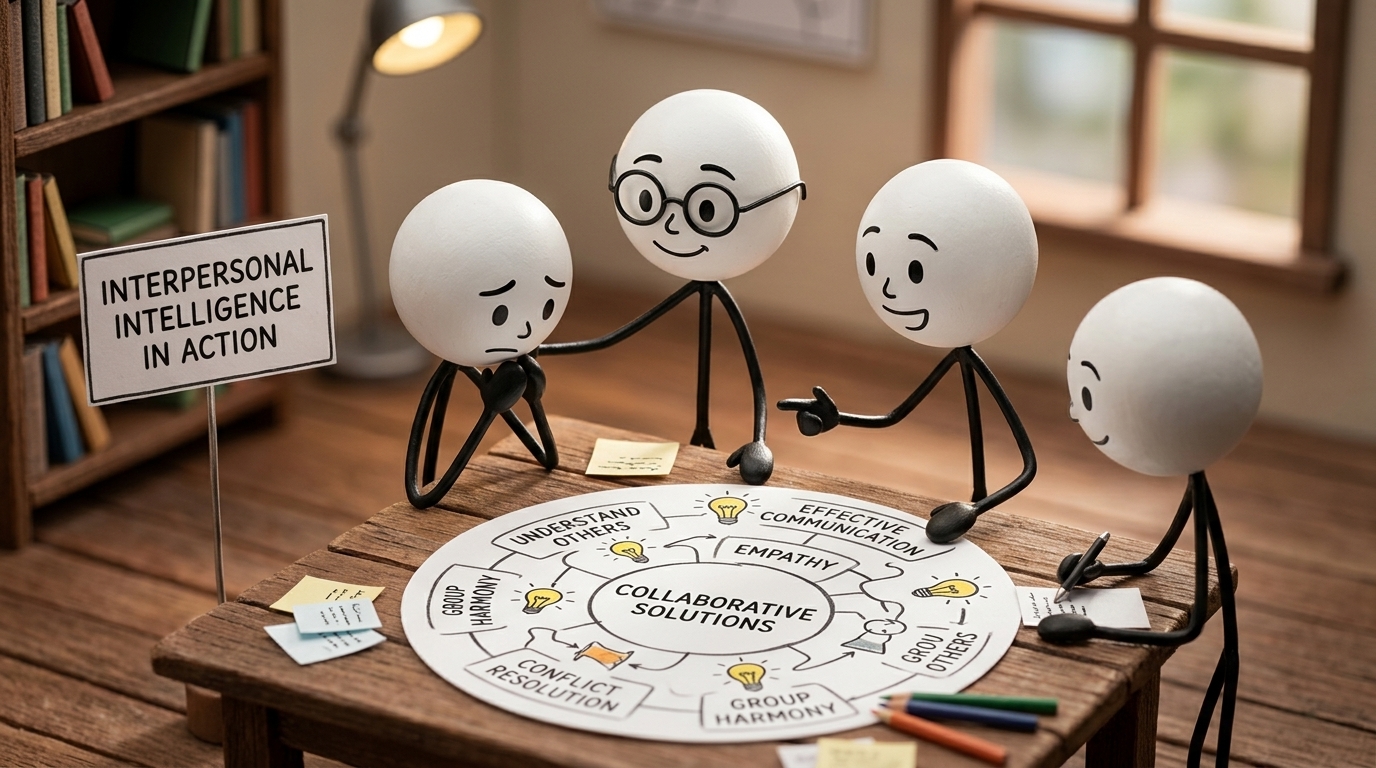
    Reading other people. Sensing what is happening beneath the surface of a conversation — the hesitation, the shift in tone, the thing someone is very deliberately not saying.

    intrapersonal_intellig

    7. Intrapersonal intelligence 

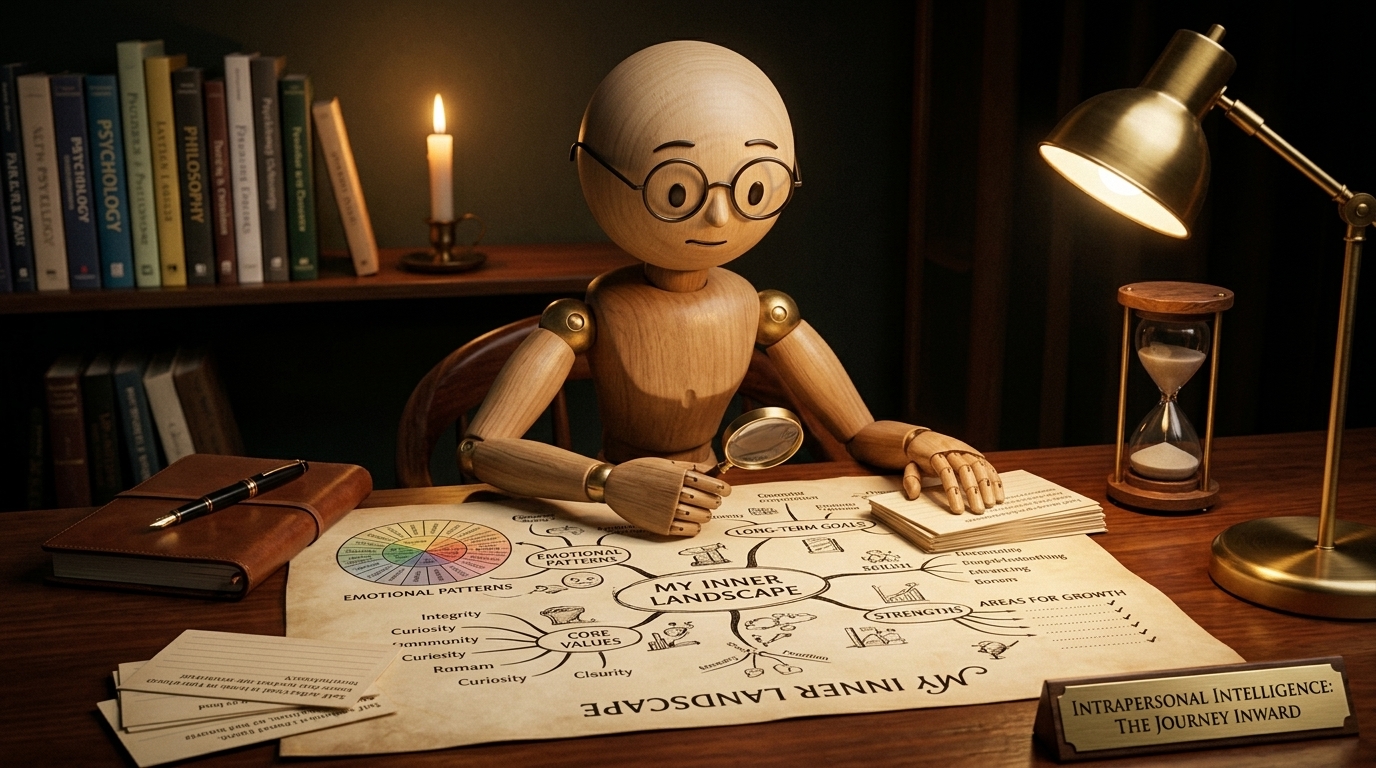
    Understanding yourself: your patterns, your motivations, your fears, your contradictions, and the uncomfortable distance between who you perform as and who you actually are. It may be the most valuable one on the list, because knowing everyone else while remaining a complete mystery to yourself is a rather impressive form of incompetence.

    The Two That Came Later

    naturalistic_intelligence

    8. Naturalistic intelligence 

    Recognising and understanding patterns in the living world: plants, animals, ecosystems, geology, weather, systems that behave. Gardner added this one in the nineties. It is worth noting that indigenous peoples have held sophisticated, tested ecological knowledge for millennia that Western science has, in many cases, only recently got around to documenting and calling a discovery.

    existen…

    9. Existential intelligence 

    The capacity to sit with the largest questions — consciousness, meaning, mortality, purpose — not necessarily to solve them, but to stay in the room with them without immediately inventing a comforting answer. Gardner never fully committed to this one. He called it the “eight and a half,” which makes it the only intelligence on the list that arrived with a fraction attached.

    Three That Came From Somewhere Else

    Moral_intelligence

    10. Moral intelligence 

    Navigating ethical complexity when there is no usable rulebook — recognising competing values, consequences and responsibilities, and holding the grey when everyone in the room would strongly prefer black and white. Gardner considered this one and declined to include it, arguing that morality is a matter of values and character rather than a computational capacity. Reasonable people have disagreed with him ever since, loudly.

    Creative_intelligence

    11. Creative intelligence 

    Connecting things that have never been connected, seeing a possibility that doesn’t exist yet and then dragging it into existence. This comes from Robert Sternberg’s work rather than Gardner’s. Creativity is not merely having ideas — ideas are cheap and everyone has them in the shower. It is making the unexpected connection and then doing the unglamorous work of making it real.

    emotional_intelligence

    12. Emotional intelligence 

    Understanding and regulating your own emotions while reading and responding intelligently to everyone else’s: self-awareness, self-regulation, empathy, social awareness, relationship management. This is Salovey and Mayer’s work from 1990, which Daniel Goleman turned into a global bestseller five years later. Gardner has pointed out, fairly, that it lives mostly on top of his interpersonal and intrapersonal pair.

    “The question was never are you intelligent? The better question is in which direction does your intelligence flow?— One of those questions has an answer you can be failed on. The other one doesn’t.

    The Argument Nobody Has Won

    Here is the part that usually gets left out, and leaving it out does the idea no favours.

    Psychometricians — the people who build and validate the tests — have never accepted Gardner’s framework, and they have a real case. When you measure a large group of people on a wide spread of mental tasks, the scores tend to correlate positively: people who do well on one generally do better than average on the others. That stubborn pattern is what the single-number view of intelligence is built on, and Gardner’s independent intelligences have never produced the direct evidence to dislodge it. The standard objection is that most of his list describes talents and abilities rather than intelligences, and that he won the argument by redefining the word.

    Gardner’s answer is roughly: yes, and the word needed redefining. He has also spent decades trying to kill the “learning styles” industry that attached itself to his name, which was never his claim and which the evidence does not support. Whatever you do with this list, do not let anyone tell you a child is a “visual learner” and should therefore be taught differently. That is not what any of this says.

    So the science is genuinely unsettled. What isn’t unsettled is the damage. Whether or not spatial reasoning deserves the word intelligence, a system that grades two abilities and reports one number will produce millions of people who believe they were weighed in full. Every school report is essentially a Rotten Tomatoes score for a film nobody has finished making, and we hand it to fifteen-year-olds as though the reviews are in.

    intelligence03

    The room measures certain abilities, under certain conditions, using certain methods — and then delivers the result like a verdict. Photo: Unsplash

    Read It

    Gardner is still writing, still revising, and still refusing to sign off on the ninth one — his work is collected at howardgardner.com, and the research group he co-founded at Harvard, Project Zero, has published on this for over fifty years. Frames of Mind is the original, and it is more careful and more hedged than the version of it that escaped into the world.

    Back to the Chair

    I have written before about what happens when education is optimised for throughput, and about what the classroom might look like once the machines arrive properly. This is the quieter half of the same problem. You can reform the curriculum, the timetable, the technology and the teacher training, and none of it matters much if the exit document is still a single number that a sixteen-year-old will carry around for forty years like a diagnosis.

    Cutting hair, for what it’s worth, is four of these at once. Spatial, because you are working on a moving three-dimensional object you can only ever see two sides of at a time. Kinesthetic, because your hands make about two hundred decisions your mouth never hears about. Interpersonal, because half the job is noticing what someone means rather than what they asked for. And intrapersonal, because the other half is knowing when your own opinion about their fringe is not actually relevant. None of that appeared on a report card. All of it has paid a mortgage since 1993.

    I did not say any of this to the mother in my chair. It would have been a lecture, and nobody comes to a salon for a lecture about developmental psychology, however strongly the hairdresser may feel about it. I said the boy sounded like someone who should be doing something with his hands, and that if he wanted a Saturday job to find out, I could use one.

    He starts in September. We’ll see which direction it flows.

    The Salon California Journal is a space for ideas, culture, and conversation from my chair in Brasschaat, Belgium. I write about beauty, technology, society, and the intersections between them.

  • Ice

    Ice

    They Made Ice in a 40°C Desert. Two Thousand Four Hundred Years Ago.

    No electricity. No refrigerant. No compressor humming in the corner. Just shallow pools, a clear night sky, an eighteen-metre mud dome, and an impressive refusal to accept that the desert was going to win.

    The freezer at the back of my salon holds exactly one ice tray, and every August it becomes the most important piece of equipment in the building. Clients arrive from the Bus stop looking personally betrayed by the weather, sit down, and ask for water — and what they mean is ice. I twist the tray, the cubes crack loose with that sound everyone in the world recognises, and nobody thinks about it for another second. Where I come from, ice in a glass was something you noticed. Here it arrives before the conversation does.

    [Switches to serious face.] Let me ruin the ice tray for you.

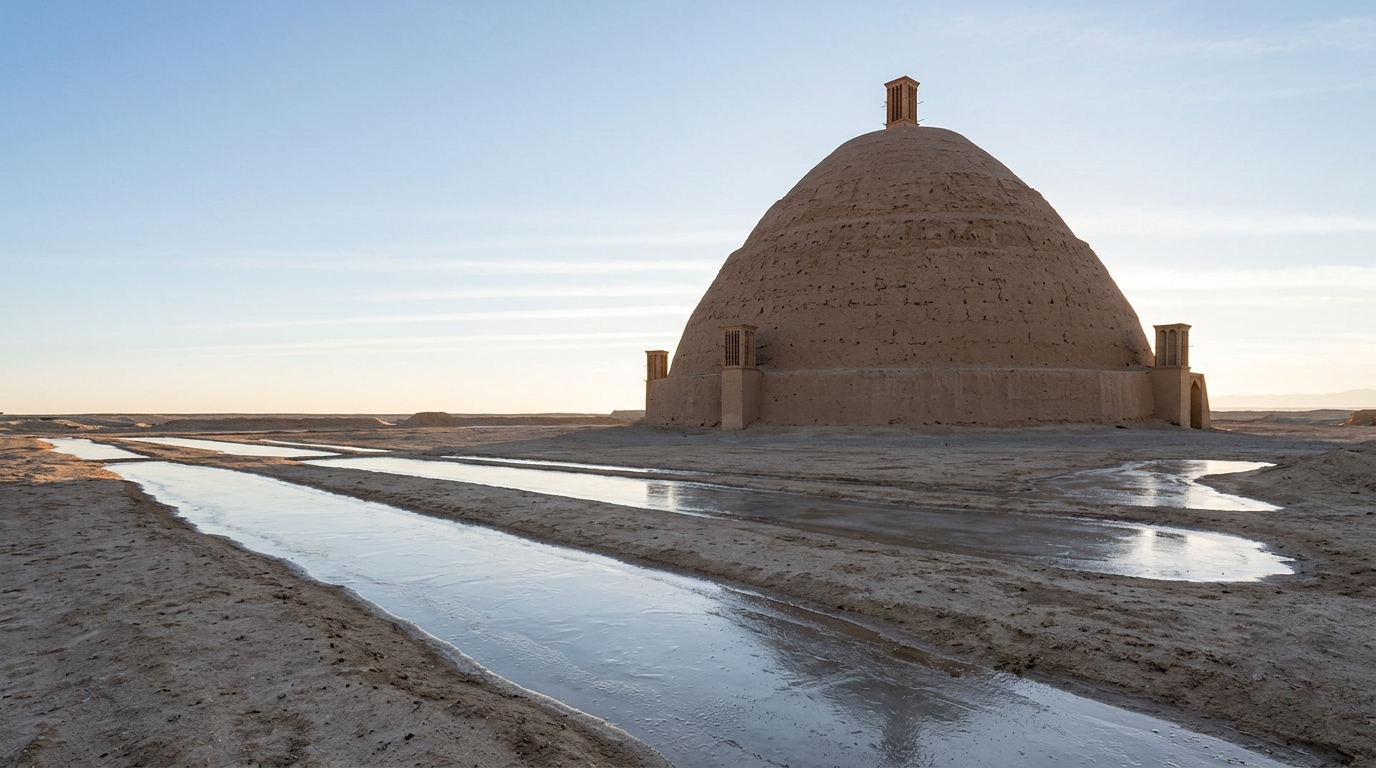
    Around 2,400 years ago, in a desert where summer afternoons climb past 40°C, Persian engineers were making ice. Not importing it. Not hauling it down from a mountain on the backs of exhausted animals. Making it — on site, in the desert — and then keeping it frozen through the whole brutal summer. They had no electricity, no refrigerant, no compressor, and no hotel corridor ice machine rumbling to life at two in the morning. They had physics, mud, and a genuinely excellent understanding of the night sky.

    The building was called a yakhchāl. Persian for “ice pit” — which, in the great tradition of engineers naming things, is both entirely accurate and wildly undersold.

    ~400 BCE roughly when Persian engineers were already doing this — about 2,400 years before the domestic freezer

    18 m the height the largest domes could reach — a six-storey mud cone built to move hot air upward and away

    2 m the thickness of the walls at the base, built from a mortar called saruj

    40°C+ the summer temperature outside, while the chamber below held ice into autumn

    The Trick Starts at Night

    Here is the part that sounds like a lie until you look at the numbers. You do not, in fact, need the air to be below freezing to make ice. You need a clear sky.

    The yakhchāl was fed by shallow pools — often laid out along the shaded north side of a long wall, so the water spent the day out of the sun and the night fully exposed. On a cloudless desert night, the surface of that water radiates its heat straight upward and keeps going, past the thin dry air, out into space. Nothing sends it back. The water sheds heat faster than the air can resupply it, and its surface drops several degrees below the surrounding air — low enough to freeze even when the thermometer at head height still reads a few degrees above zero.

    The sky, on a clear desert night, is not a ceiling. It is a drain.

    By the small hours the pools had skinned over with thin sheets of ice. Before sunrise — and it had to be before sunrise — workers broke the sheets into pieces and carried them underground, layer after layer, into the pit beneath the dome. Then they went home, and the desert spent the next fourteen hours doing its very best to undo the night’s work.


    Sand, Ash, Goat Hair, and Egg Whites

    It failed, because this was not a pile of rocks and optimism.

    The walls could be nearly two metres thick at the base, built from saruj, a mortar mixed from sand, clay, lime, ash, goat hair, and egg white. It was close to waterproof, it resisted heat transfer beautifully, and it has survived in the open desert for centuries, which is more than can be said for most things built last decade.

    It also reads less like a specification and more like a recipe that lost its nerve halfway through and became a building. Somewhere in ancient Persia, a structural engineer and a pastry chef were having the same conversation, and honestly, the results speak for themselves.

    ice02 ice03

    The two halves of the machine: a clear sky with nothing between the water and space, and the result waiting at dawn. Photos: Unsplash

    The Dome Is the Machine

    Above ground, the yakhchāl looks like sculpture. It is not. Every part of that shape is doing a job.

    The dome is tall because hot air rises, and a tall volume gives it somewhere to go — up, away from the ice, and out through vents at the apex. What stays behind, pooled at the bottom where the ice sits, is the coldest, densest, stillest air in the building. Wind catchers — the slotted towers you can see on the roof and flanks — scooped the breeze and pushed it down into the structure. Underground channels called qanats, hand-dug aqueducts that carried mountain water for kilometres beneath the desert floor, ran cool water past the chamber and added evaporative cooling on the way through.

    And the ice itself was below grade, packed in a deep pit where the earth’s own temperature barely moves across the year. My favourite detail is the smallest one: the floor of the pit sloped to a sump, so that whatever did melt drained away instead of sitting in a puddle and eating the rest of the block from underneath. Someone worked that out by watching ice melt, and then built a permanent solution into a structure the size of a church.

    “No compressors. No electricity. No refrigerant. Just thermodynamics, clever materials, underground storage, and a refusal to accept that the desert had the last word.” — The whole system has one moving part, and it is the wind.

    What the Ice Was Actually For

    Not for show, mostly. Ice meant food that kept, water that could be drunk without argument in the middle of the afternoon, and a cold chain in a civilisation that had never heard the phrase supply chain.

    But it also meant dessert. Chilled rose-water sweets. And faloodeh — fine starch noodles suspended in a semi-frozen syrup of rose water and lime — which is one of the oldest frozen desserts anyone can point to, and which you can still order in Shiraz today from someone whose grandfather ordered exactly the same thing. Persia was serving a frozen dessert roughly two thousand years before the ice cream cone showed up and took all the credit.

    ice04

    The operating environment. Everything about the yakhchāl assumes this is what the afternoon looks like. Photo: Unsplash

    See It

    Many yakhchāls are still standing in Iran — Meybod, Abarkuh, Sirjan and Yazd among them — sitting in the sand looking like something that landed rather than something that was built. The qanat networks that fed them are recognised by UNESCO as the Persian Qanat, and Atlas Obscura has catalogued a number of the surviving domes. The photographs are wonderful. They also miss the one thing that mattered most, which is the fifteen-degree drop you feel on the stairs going down.

    Back to the Chair

    I studied electrical engineering before I studied anything else, which means I spent several years learning to solve problems by adding a component. Need it colder? Add a compressor. Need it drier? Add a pump. There is a version of engineering that is really just shopping, and I was fluent in it long before I ever picked up a pair of scissors.

    The yakhchāl is the other version. It has no components. It has an orientation, a shape, a wall thickness, a hole in the roof and a hole in the ground, and it beats a machine at the machine’s own job for eight months of the year. I wrote a while back about the skills that quietly disappear once a device does the work for us, and this is that idea at civilisational scale: we did not get better at cooling things. We got a plug.

    It also rhymes with something I looked at recently — the Metropol Parasol in Seville, a hundred-million-euro timber canopy whose entire purpose is to make shade. Seville built a monument to the absence of sun. Persia built a monument to the absence of heat. Both are, in the end, buildings that understood their own climate well enough to argue with it.

    I have not built a dome over Brasschaat. I went the other way entirely and put solar panels on the roof, so the same sun that makes the salon unbearable in August now generates the electricity that runs the air conditioning cooling it down. The problem pays for its own solution. A Persian engineer would find this either brilliant or hilarious, and I have decided not to ask which — twenty-four centuries of progress, and my answer to the heat is still to point at the sky.

    Which is the part worth keeping. The yakhchāl never beat the desert by out-building it. It won by reading it — the clear night, the rising heat, the cool ground — and then doing the obvious thing with what the climate was already handing over for free. Good engineering doesn’t always require advanced technology. Sometimes it just requires understanding the physics slightly better than the people with the machines, and being willing to let the sky do the work.

    The Salon California Journal is a space for ideas, culture, and conversation from my chair in Brasschaat, Belgium. I write about beauty, technology, society, and the intersections between them.

  • Central Bank

    Central Bank

    Found Guilty. No Punishment. Now She Is Designing the Future of Your Money.

    A French court found Christine Lagarde guilty of negligence over a €403 million arbitration paid from public funds, then imposed no fine, no sentence, and no criminal penalty — citing, among other things, her reputation. Three years later she became President of the European Central Bank. And that history matters when the same person is helping shape the future of money in Europe.

    A client sat down last week and asked me a question I did not expect before ten in the morning. “Is it true,” she said, “that Sweden is telling people to keep cash at home? Sweden. The country where nobody has touched a coin since 2014.”

    “It’s true,” I said.

    “That seems like the sort of thing that should have been on the news more than once.”

    “It does. Although if you want to understand what’s happening to money in Europe, I’d start somewhere else entirely.”

    “Where?”

    “A pair of running shoes,” I said. “1993.”

    [Switches to serious face.] If an ordinary person were responsible for losing hundreds of millions of euros in public money through negligence, most people would expect serious consequences.

    Christine Lagarde was found guilty of negligence in connection with a €403 million arbitration award involving French businessman Bernard Tapie. Yet she received no fine, no prison sentence, and no criminal punishment. Three years later, she was appointed President of the European Central Bank.

    And that history matters when the same person is now helping shape the future of money in Europe.

    €403 million the 2008 arbitration award paid to Bernard Tapie from public funds — including €45 million for moral damages

    0 fines, prison sentences, and criminal penalties imposed after the 2016 guilty verdict for negligence

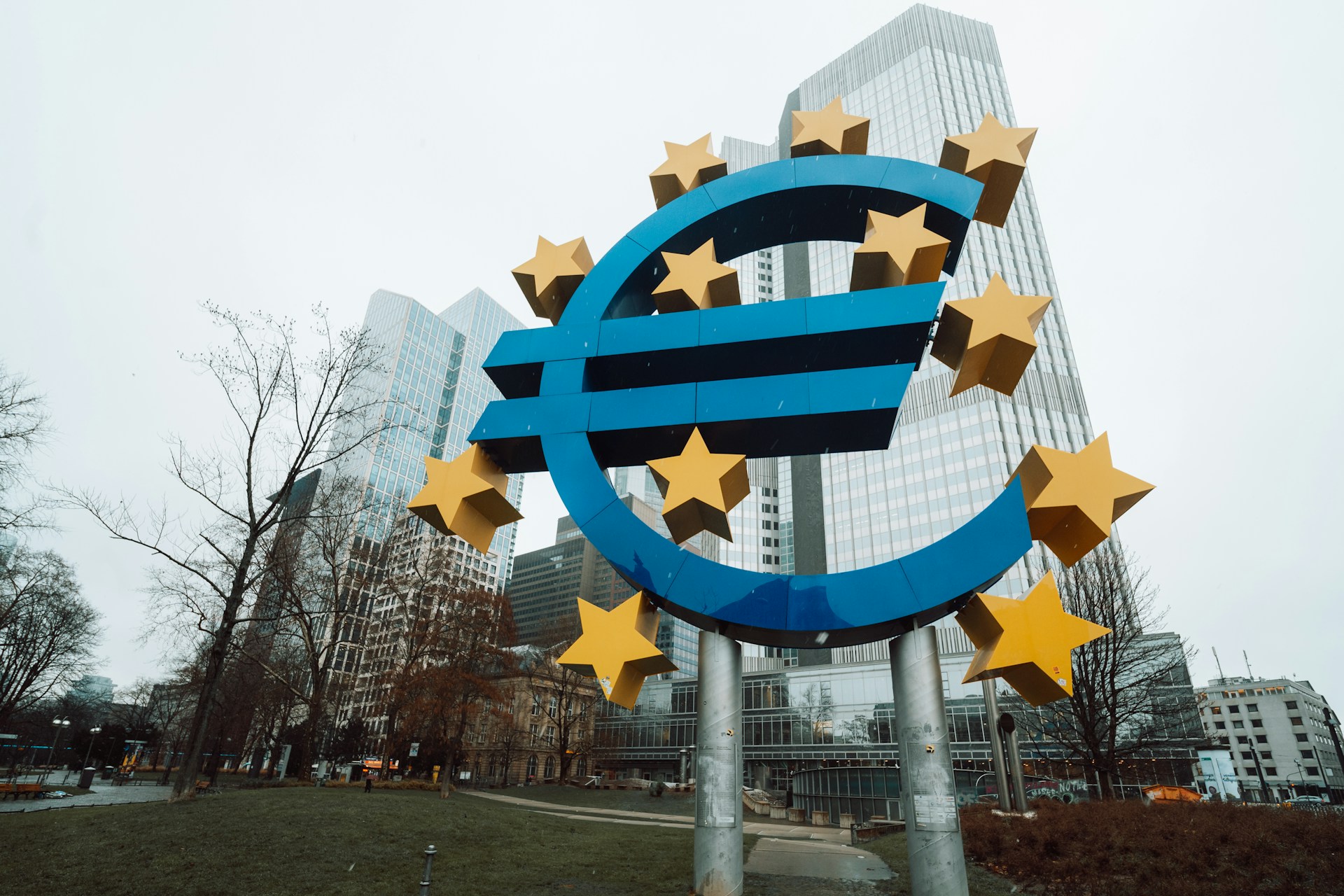
    2029 the earliest possible first issuance of a digital euro, according to the ECB, assuming the legislation is adopted

    1,000 SEK the cash per adult Sweden’s Riksbank recommended households keep at home — in one of the world’s most cashless countries

    1993: The Sale

    The story begins in 1993.

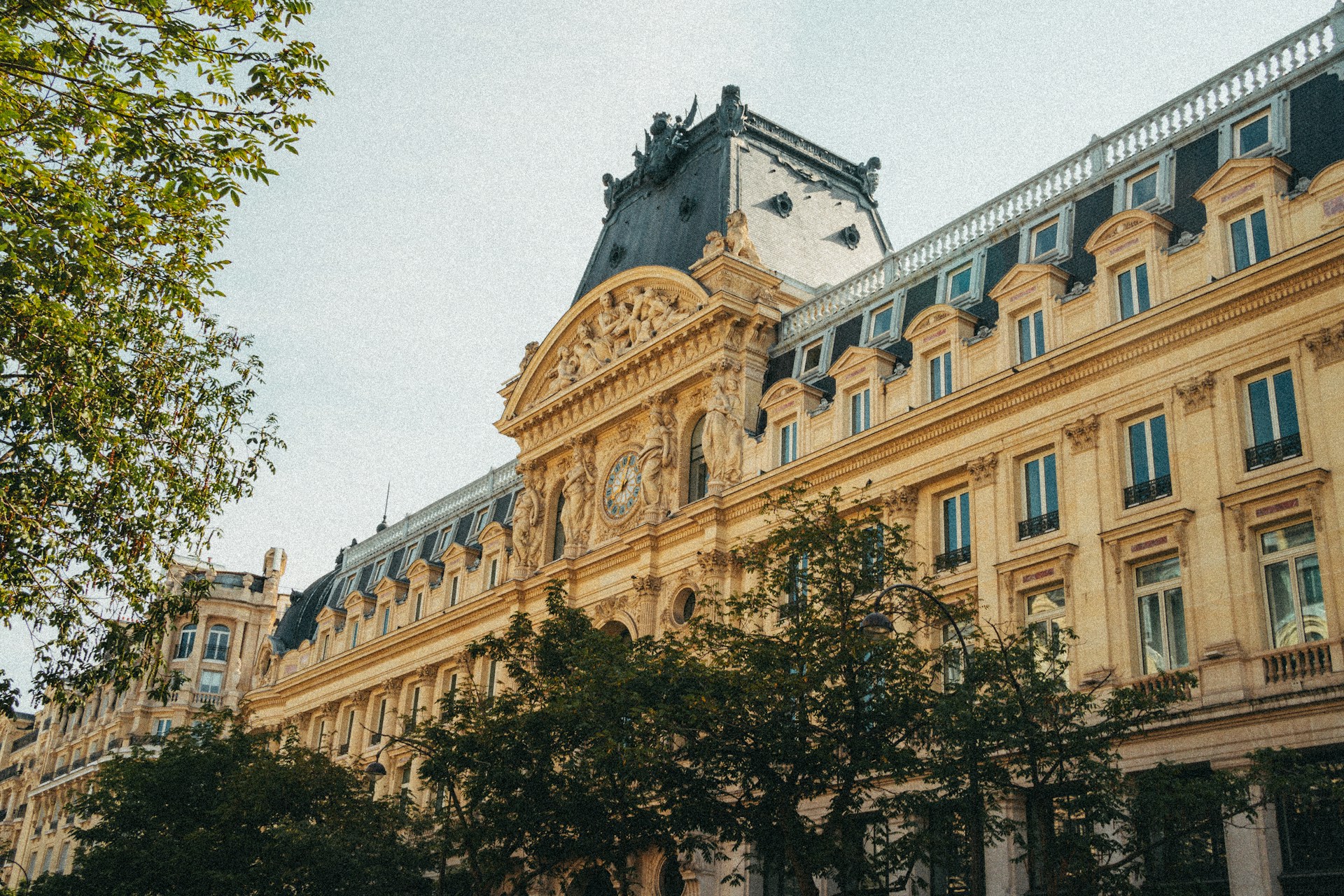
    Bernard Tapie, a French businessman and politician, was required to sell his stake in Adidas after entering the French government. He entrusted the sale to Crédit Lyonnais, then a state-owned French bank.

    The bank arranged the sale and paid Tapie. The matter appeared to be settled.

    Then Tapie discovered something rather inconvenient.

    Some of the companies involved in the transaction had connections to Crédit Lyonnais itself. Less than two years later, Adidas was resold for roughly twice the price of the original transaction.

    Tapie believed he had been cheated.

    For the next 14 years, he pursued legal action against the French state and Crédit Lyonnais.

    bank02

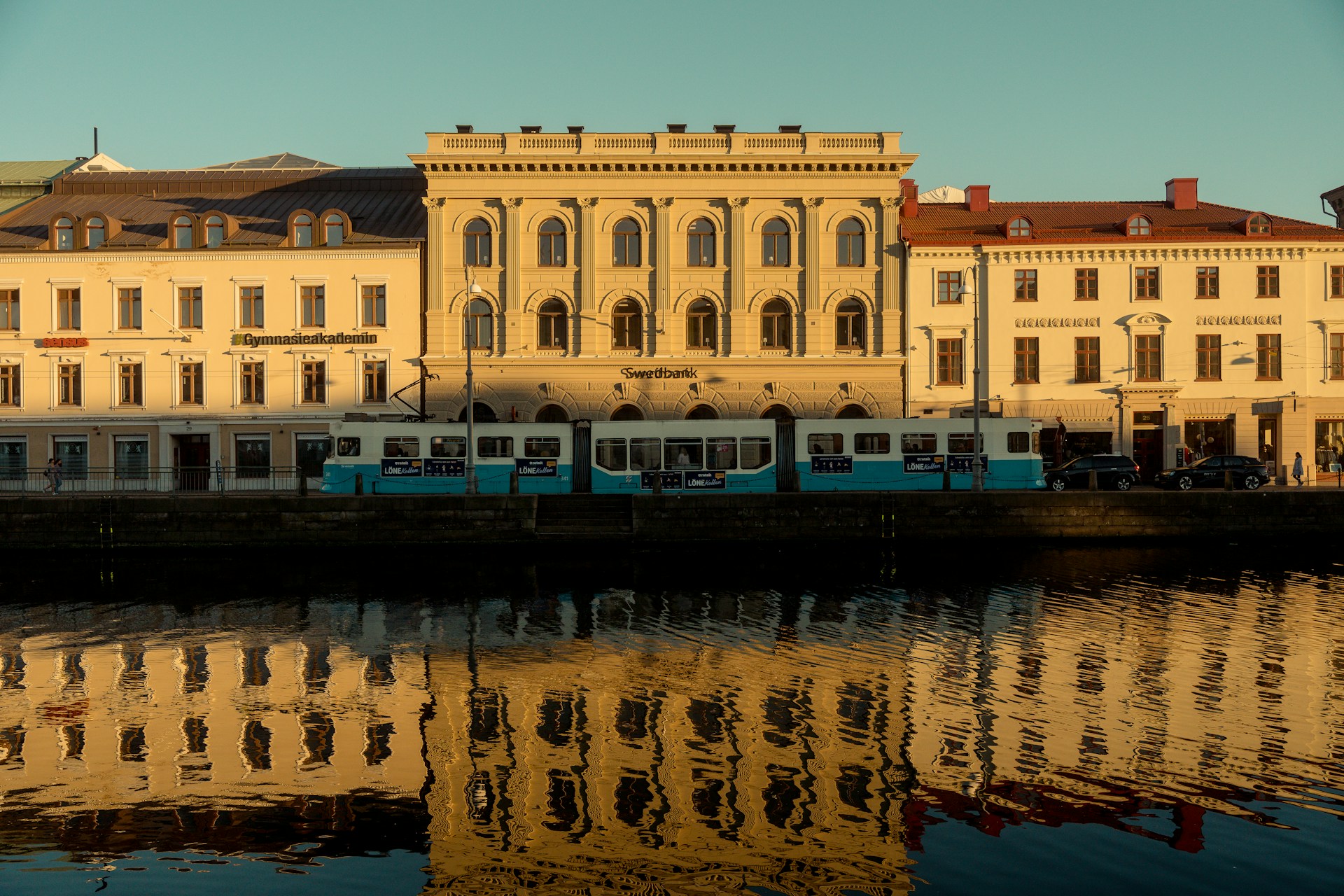
    Crédit Lyonnais. Photo Unsplash

    2007: The Campaign

    Then, in 2007, Tapie publicly supported Nicolas Sarkozy’s successful presidential campaign.

    After Sarkozy became president, his finance minister was Christine Lagarde.

    In 2008, Lagarde allowed the long-running dispute to be taken out of the ordinary court process and sent to a private arbitration panel.

    The three-member panel awarded Tapie approximately €403 million in taxpayer-funded compensation, including €45 million for moral damages.

    The decision immediately attracted controversy.

    It later emerged that one of the arbitrators had undisclosed connections to Tapie’s lawyer. Officials within the French Finance Ministry advised Lagarde to challenge the arbitration award.

    She did not.

    bank03

    €403 million of it, awarded by three arbitrators in a private room and paid from public funds. Photo: Unsplash

    2015: The Unravelling

    In 2015, French courts ruled that the arbitration process had been improper and annulled the award, ordering Tapie to repay the money.

    Tapie subsequently declared bankruptcy, and he died in 2021. The attempt to recover the money became a long and complicated legal process, while the cost of the failed arbitration ultimately fell on French public finances.

    2016: Guilty, and Free to Go

    Then came Lagarde’s own legal case.

    In 2016, France’s Court of Justice of the Republic found Christine Lagarde guilty of negligence for failing to challenge the arbitration award.

    But there was an extraordinary detail.

    The court imposed no punishment.

    No fine.

    No prison sentence.

    No other criminal penalty.

    The court cited the circumstances of the case, including her reputation and international standing, when deciding not to impose a sentence.

    Lagarde did not lose her career.

    In fact, she continued to rise.

    The International Monetary Fund reaffirmed its confidence in her leadership after the verdict. And three years later, European leaders appointed Christine Lagarde President of the European Central Bank.

    So a person found guilty of negligence in connection with a €400 million public arbitration award ultimately became one of the most powerful financial officials in Europe, with responsibility for monetary policy across the euro area.

    bank04 bank05

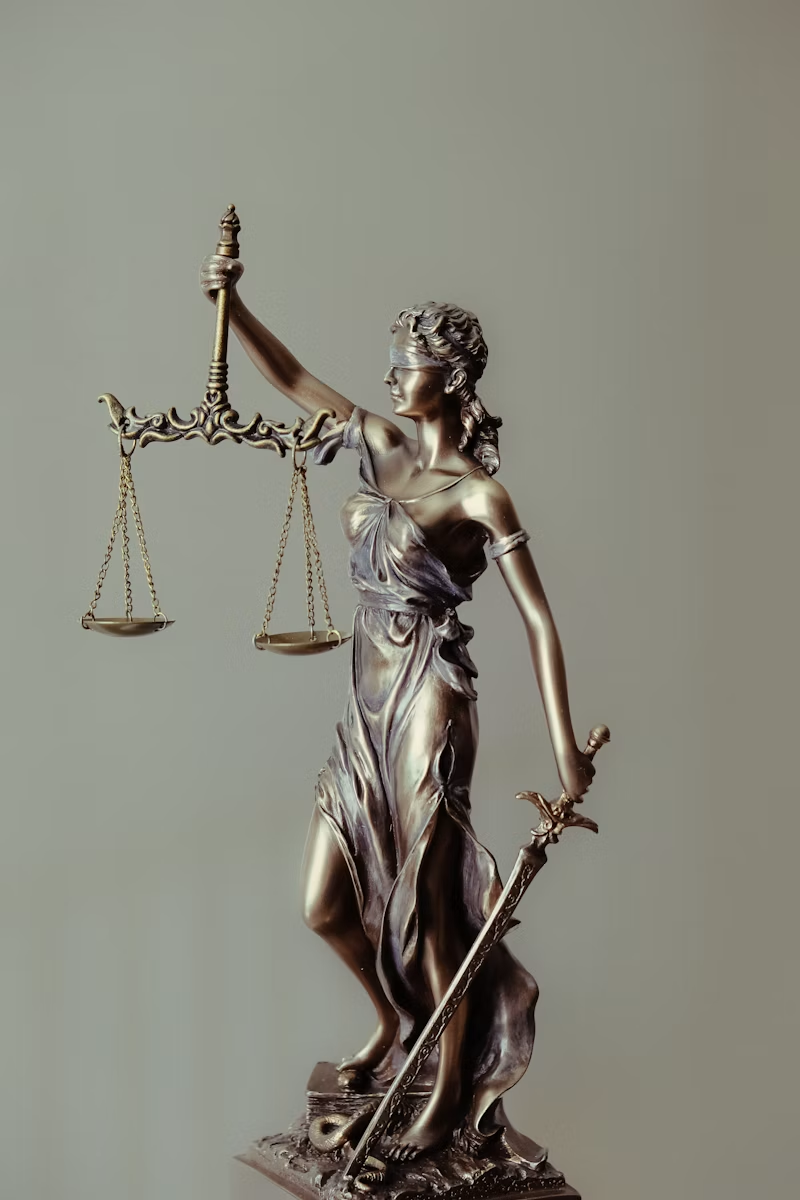
    The statue is blindfolded so she cannot see who is standing in front of her. In 2016, the court took a good long look. Photo: Unsplash

    And That Brings Us to Cash

    Because Lagarde has also been remarkably candid about how central banks think about the future of money.

    In 2023, during a conversation in which she mistakenly believed she was speaking to Ukrainian President Volodymyr Zelensky, Lagarde discussed the digital euro and acknowledged that there would be a degree of control over transactions.

    She was asked about concerns that a digital euro could be used to monitor payments.

    Her response was striking.

    She said there would be control, and that the ECB was considering whether very small transactions, around €300 or €400, could have a mechanism involving zero control. She then argued that completely anonymous transactions could be dangerous, pointing to the financing of terrorist attacks in France through small anonymous prepaid cards.

    That conversation was a prank. It was not an official policy announcement, and it should not be treated as proof that the final digital euro will contain the exact controls she discussed.

    But the underlying issue is real.

    Infrastructure Creates Rules

    Digital payments are not the same thing as cash.

    Cash can be handed from one person to another without a bank, payment processor, internet connection, or digital record of the transaction.

    Digital money requires infrastructure.

    And infrastructure creates rules.

    The important question is not simply whether those rules exist. It is who controls them, what information is available to whom, and under what circumstances those rules can change.

    The ECB now says the digital euro will not be programmable money in the sense of restricting where, when, or with whom you can spend it. It says the system is being designed with strong privacy protections, including an offline version intended to provide cash-like privacy.

    That is an important distinction.

    A digital euro is therefore not automatically some dystopian programmable currency that can be switched off because you bought the wrong sandwich.

    But neither is it simply a banknote transferred onto your phone.

    It would be a new digital monetary infrastructure, governed by legislation, technical architecture, payment providers, anti-money-laundering rules, and institutions capable of changing those rules over time.

    The Machinery Is Being Built

    And the project is no longer theoretical.

    In July 2026, the European Parliament voted 416 to 169, with 22 abstentions, to move forward with negotiations on legislation for the digital euro.

    The ECB has also selected 36 payment-service providers to participate in a 12-month pilot beginning in the second half of 2027. The pilot is designed to test the system in real-world situations, including person-to-person, online, offline, and retail payments.

    The ECB says it could be ready for a potential first issuance in 2029, assuming the necessary legislation is adopted.

    So this is no longer just a white paper sitting on a bureaucrat’s desk gathering the digital equivalent of dust.

    The machinery is being built.

    A Correction About Cash Limits

    And now consider what is happening with cash.

    There is an important correction here. There is not currently a universal €1,000 EU-wide cash-payment limit.

    EU legislation establishes a maximum EU-wide limit of €10,000 for large cash transactions, while individual countries can impose lower national limits. France, for example, already has stricter national rules for certain cash transactions.

    That distinction matters because the argument is not really about one magic number.

    It is about a broader trend toward making large anonymous cash transactions increasingly difficult while digital transactions become increasingly central to everyday life.

    bank06 bank07

    One of these requires a bank, a network, a terminal, and permission. The other requires a hand. Photo: Unsplash

    Sweden’s Interesting Contradiction

    And here is where Sweden provides an interesting contradiction.

    Sweden became one of the world’s most cashless societies.

    Yet in March 2026, Sweden’s central bank, the Riksbank, recommended that households keep approximately 1,000 Swedish kronor in cash per adult at home, enough to help cover essential purchases during disruptions. It specifically cited the need for alternative payment methods during crises, disruptions to digital communications and payment services, and even war.

    Think about what that means.

    A country that went further than most in embracing digital payments is now telling its citizens: keep some physical money.

    Why?

    Because digital systems can fail.

    Cyberattacks can happen. Power grids can fail. Communications networks can go down. Payment processors can become unavailable.

    And in a serious crisis, your bank account may still tell you that you have money while the terminal at the grocery store tells you that none of it is currently accessible.

    The Primitive Advantage

    Cash has one extremely primitive but useful feature: it does not require permission from a server.

    No electricity.

    No internet connection.

    No payment processor.

    No account authentication.

    No software update.

    You hand someone a banknote, and the transaction is finished.

    “Cash has one extremely primitive but useful feature: it does not require permission from a server.” — You hand someone a banknote, and the transaction is finished.

    That does not make cash perfect. Cash can facilitate tax evasion, money laundering, and criminal transactions. Governments have legitimate reasons for imposing limits on large anonymous payments.

    But there is another side to the argument.

    Every time society moves another step from physical cash toward digital money, we also move toward a world in which payments depend on infrastructure and institutions.

    And that creates a question that deserves more attention than either the utopian sales pitch or the conspiracy theory:

    How much financial privacy should an ordinary person have?

    bank08

     Photo: Unsplash

    Safeguards Are Not Permanence

    The ECB says the digital euro will protect privacy.

    It says offline payments can provide cash-like privacy.

    It says the Eurosystem itself will not be able to directly identify users from their online payments, while banks and payment providers will still have to comply with existing laws governing money laundering and terrorist financing.

    Those safeguards may be genuine.

    But safeguards are not the same thing as permanence.

    Technology can change.

    Legislation can change.

    Governments can change.

    And institutions can acquire new powers during emergencies that were once considered unacceptable during normal times.

    Where the Numbers Come From

    Every figure above is on the public record. The European Central Bank publishes the digital euro’s design principles, the privacy commitments, the pilot participants, and the potential 2029 timeline. The European Parliament records its July 2026 vote and the legislative process that follows. Sweden’s Riksbank publishes its preparedness advice, cash recommendation included. And the 2016 verdict, the 2015 annulment, and the €403 million award are all matters of French public record, reported at the time across Europe. The facts are not in dispute. Only their meaning is.

    Why the History Is Relevant

    That is why the history of Christine Lagarde is relevant.

    The issue is not whether Lagarde is personally a villain. She was found guilty of negligence, not corruption, in the Tapie case. The court did not find that she deliberately stole €400 million from taxpayers.

    The issue is something more uncomfortable.

    A person who was found guilty of negligence in handling a €400 million public arbitration award received no punishment and went on to become President of the institution responsible for Europe’s monetary system.

    That does not automatically make every policy she supports illegitimate.

    But it does make questions about accountability, institutional power, and financial privacy rather difficult to dismiss.

    “Safeguards are not the same thing as permanence.” — Technology can change. Legislation can change. Governments can change.

    Because when money becomes increasingly digital, the people who design the system do not merely influence how we pay.

    They influence the infrastructure through which payment itself becomes possible.

    And perhaps that is the real debate.

    Not whether digital money is good or bad.

    Not whether cash is old-fashioned or convenient.

    But whether ordinary citizens should retain at least one form of money that works without asking a bank, a payment network, a government, or a central database for permission.

    Sweden’s central bank appears to understand that risk.

    The question is whether the rest of Europe will remember it before the backup plan becomes the thing everyone wishes they had kept.

    Back to the Chair

    My client listened to all of it, which is more patience than most people extend to a hairdresser with opinions about arbitration panels. At the end she asked the only question that really mattered to her.

    “So should I keep cash at home?”

    “A Swedish central bank thinks so,” I said. “They are not famous for hysteria.”

    I touched a related thread in a previous piece on Germany’s quiet resistance to giving up cash — a country where most transactions still happen in notes and coins, for reasons its history explains better than any economist could. Germans have a long memory for what happens when institutions acquire powers during emergencies. Sweden, arriving from the opposite direction, has now reached a similar conclusion by way of cyberattacks and power cuts. Two countries, two arguments, one recommendation.

    I run a one-person salon. My till has to balance to the cent, and if I am careless with someone’s money the consequence sits in my chair, looks at me in the mirror, and decides whether to come back. That is a small accountability, and it fits in a small room. I am not asking that the President of the European Central Bank be held to my standard. I am only noticing, out loud, that nobody seems to have been held to any.

    And I keep some cash in a drawer at home. Not because I expect the lights to go out. Because it costs me nothing to be wrong about that, and quite a lot to be right.

    The Salon California Journal is a space for ideas, culture, and conversation from my chair in Brasschaat, Belgium. I write about beauty, technology, society, and the intersections between them.

  • Empires

    Empires

    Empires Once Sailed for Spices. The New Ones Are Mining You.

    Extraction of resources that were never theirs. Armies of invisible labor. Knowledge concentrated behind corporate walls. And a grand story about civilization and salvation to justify all of it. The AI empires of today operate strikingly like the empires of the past — and even the Pope has noticed.

    A client put down her phone last week and asked, with genuine puzzlement, “Why is the Pope talking about artificial intelligence? Isn’t that a little… outside his department?”

    “I don’t think so,” I said. “I think he recognises the business model.”

    “The business model?”

    “He runs one of the oldest institutions on earth. He has seen empires come and go — and he has seen what they say about themselves while they’re doing it.”

    [Switches to serious face.] The AI empires of today operate in strikingly similar ways to the empires of the past. The parallels are not decorative. They run straight through the business model — the extraction, the labor, the knowledge, and above all, the story.

    Billions of people whose data — words, images, clicks, conversations — became the raw material for training AI systems

    €0 the going rate paid to most of the artists, writers, and musicians whose work the models learned from

    1891 the year Pope Leo XIII published Rerum Novarum, the Church’s answer to the industrial revolution and its treatment of workers

    2025 the year the new pope chose the name Leo XIV — citing, among his reasons, artificial intelligence as a new industrial revolution

    The Extraction

    Like their predecessors, the new empires claim resources that do not truly belong to them. Instead of land or minerals, they extract something even more valuable in the digital age: data from billions of people, along with the intellectual property of artists, writers, musicians, and creators whose work becomes the raw material for training AI systems.

    Empires04

    Photos: Unsplash

    The Labor

    Their business model also depends on an enormous amount of labor. Countless workers contribute to building, labeling, testing, and refining these technologies, yet only a small fraction of the value they create flows back to them. At the same time, the very systems they help build are increasingly used to automate knowledge work, displacing employees while allowing AI companies to capture revenue that would otherwise have gone to human workers in the form of wages.

    empires05

    Photo: Unsplash

    The Concentration of Knowledge

    Another striking parallel is the concentration of knowledge. The largest AI firms employ a significant share of the world’s leading AI researchers, giving them extraordinary influence over what research is funded, what findings are published, and what remains hidden behind corporate walls.

    Imagine if most climate scientists were funded by fossil fuel companies. We would rightly question whether we were getting the full picture of the climate crisis. Likewise, when AI research is concentrated within a handful of corporations, it becomes much harder for the public to understand how these systems truly work, where they fail, and who bears the consequences of those failures.

    The Grand Narrative

    Like historical empires, today’s technology giants justify this extraction with a grand narrative. Colonial powers once claimed they were bringing civilization, progress, and enlightenment. AI companies tell a remarkably similar story. They argue that their mission is to advance humanity, promising a future where diseases like cancer are cured, climate change is solved, poverty disappears, and human flourishing reaches unprecedented heights. The vision they paint is nothing short of a technological utopia.

    At the same time, they frame the alternative in stark terms. If they are not allowed to build these systems, they argue, less responsible actors will. The result, they warn, would be catastrophe. Humanity must therefore trust them with unprecedented power because they alone can prevent disaster.

    “Colonial powers once claimed they were bringing civilization, progress, and enlightenment. AI companies tell a remarkably similar story.” — Heaven if you trust them, catastrophe if you don’t. Empires have always sold exactly this menu.

    The Pope Has Seen This Religion Before

    This rhetoric echoes the moral and religious justifications that accompanied the expansion of earlier empires. Faith was often used to legitimize conquest and extraction by portraying imperial expansion as a higher calling.

    That is why it is so fascinating that Pope Leo XIV, representing one of the world’s oldest religious traditions, has begun addressing the ethical challenges posed by artificial intelligence. In many ways, his message can be seen as an attempt to confront the emerging belief system surrounding AI — one that increasingly presents technological progress not simply as innovation, but as a promise of salvation itself.

    Empires02

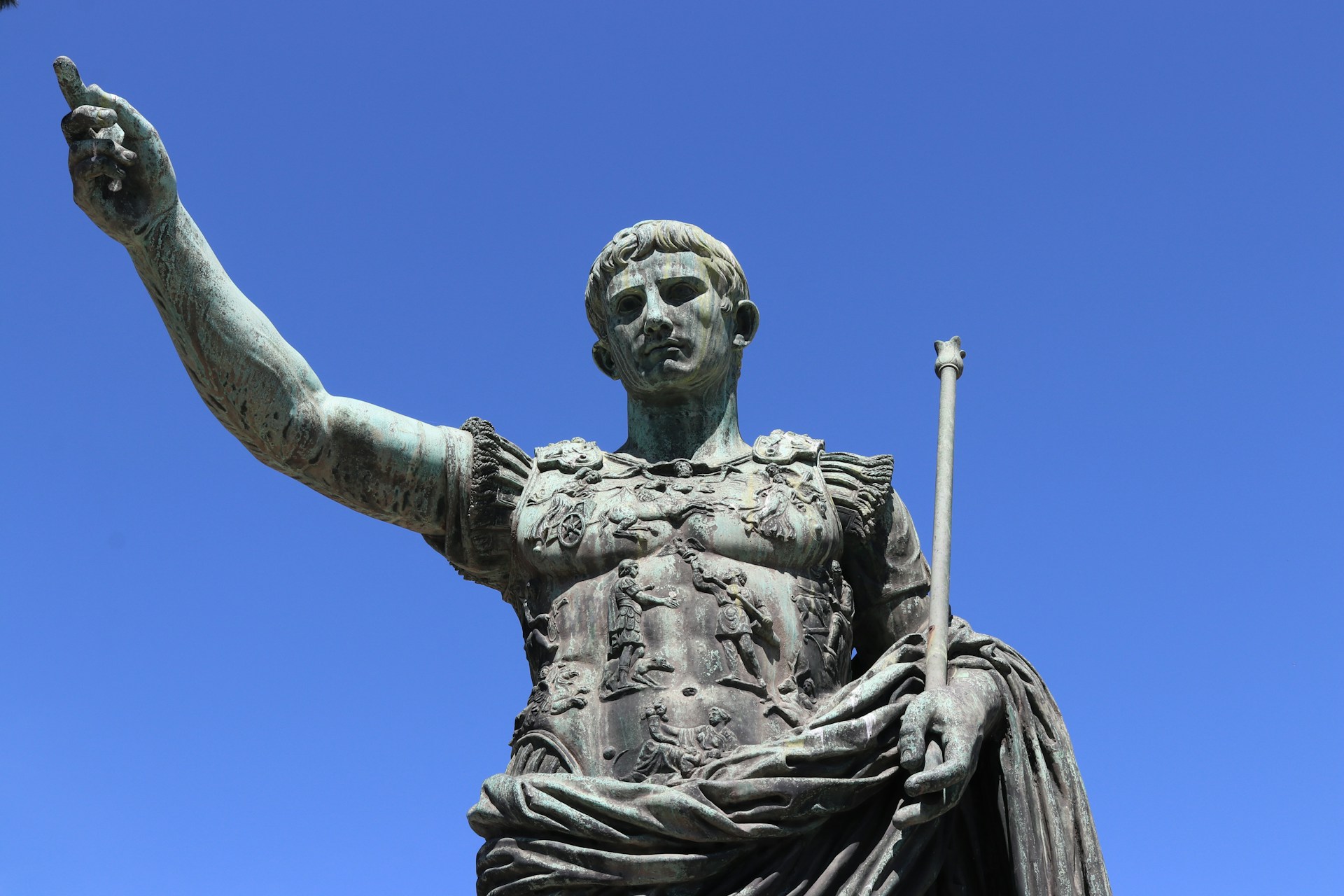
    One institution has spent two thousand years thinking about promises of salvation. It recognises a new one when it sees it. Photo: Unsplash

    The Ledger, Again

    The choice of papal name was itself a message: Leo XIII wrote Rerum Novarum in 1891 to confront the industrial revolution’s treatment of workers, and the Vatican has framed Leo XIV’s attention to AI as the same tradition meeting a new machine age. Outside the Church, independent research groups such as the AI Now Institute document the field’s concentration of power — who funds the research, who owns the infrastructure, who bears the failures. Different vocabularies, same audit.

    Back to the Chair

    My client thought about it while the color set. Eventually she said, “So when a company says ‘trust us with everything, and we’ll save the world’…”

    “Then the interesting question is never the promise,” I said. “It’s the ledger underneath it. Who supplies the raw material. Who does the labor. Where the profit lands. The promise is the oldest part of the machine.”

    I touched a related thread in a previous piece on what Britain’s emancipation ledger revealed about its empire — the discovery that empires keep two sets of books: the speeches and the accounts. The speeches said civilization. The accounts said extraction. Nothing about the new empires is settled yet — the technology is real, some of the promises may even be kept, and I say that as someone genuinely astonished by what these systems can do. But when the speeches soar this high, history suggests exactly one response: applaud if you like, and then ask to see the accounts.

    Empires, it turns out, update their fleets and keep their paperwork habits. The spices are data now. The plantations are server farms. The civilizing mission has a product launch. And somewhere in Rome, a man whose institution has outlived every empire that ever made these promises has quietly cleared his throat.

    The Salon California Journal is a space for ideas, culture, and conversation from my chair in Brasschaat, Belgium. I write about beauty, technology, society, and the intersections between them.
  • 3 Truths

    3 Truths

    If They Wanted To, They Would. And Two Other Truths That Simplify Everything.

    Most of the stress people carry around isn’t caused by what happened. It’s caused by wishing people were different than they are. Three truths about people that are uncomfortable to accept — and the peace waiting on the other side of them.

    A client handed me her phone last week, mid-appointment, with a text conversation open. “Read this,” she said. “What does he mean?” I read it. It said, in its entirety, “ok.” She had been analysing it for two days. I have held a lot of things in my hands in thirty years behind the chair, but rarely anything as heavy as that one syllable.

    [Switches to serious face.] What I told her is what follows. Life gets surprisingly peaceful when you stop arguing with reality.

    Most of the stress people carry around isn’t caused by what happened. It’s caused by wishing people were different than they are. We invent excuses, write imaginary backstories, and convince ourselves that one more conversation, one more chance, or one more perfectly worded text will magically change everything.

    It rarely does.

    There are three truths about people that are uncomfortable to accept, but once you do, life becomes infinitely less complicated.

    Smartphone_message_accepting_rea…_202607301859

    1. If They Wanted To, They Would

    This one hurts because it leaves very little room for fantasy.

    People spend hours dissecting text messages like they’re decoding an ancient civilization.

    “They used a period instead of an emoji.”

    “They watched my story but didn’t reply.”

    “It took them seven hours and forty-three minutes to text back. What does that mean?”

    Probably that they took seven hours and forty-three minutes to text back.

    Humans have an extraordinary talent for turning silence into a full-length movie, complete with plot twists, dramatic music, and an ending that usually doesn’t exist.

    Here’s the simpler explanation: people make time for what matters to them.

    Not always immediately. Not perfectly. Life gets busy. People have jobs, families, bad days, and phones with dying batteries.

    But effort leaves fingerprints.

    Someone who wants you in their life finds ways to stay in it. Someone who doesn’t slowly turns every interaction into an excuse.

    Stop becoming a detective in a mystery that never needed solving. Save your energy for people who don’t make you question whether they care.

    “Effort leaves fingerprints.” — Someone who wants you in their life finds ways to stay in it.

    2. You Cannot Change People

    This lesson has probably funded half the self-help industry.

    We all think we’re the exception.

    “Once they realize how much I love them…”

    “Once they get this new job…”

    “Once they mature…”

    “Once they understand how this affects me…”

    Maybe.

    But probably not.

    You can support someone. Encourage them. Challenge them. Inspire them. Hold up a mirror. Stand beside them through difficult seasons.

    What you cannot do is climb inside another person’s mind and rearrange the furniture.

    People change for one reason: they decide to.

    There’s an old saying: you can lead a horse to water, but you can’t make it drink.

    Modern version? You can send someone twenty podcasts, six books, three motivational quotes, and a heartfelt voice note. If they don’t want to change, congratulations. You’ve simply created a very well-informed version of the same person.

    Stop confusing potential with reality.

    Love people for who they are today, not for who you hope they’ll become five years from now.

    Person_and_horse_by_lake_202607301857

    You can lead it to water. That is where your authority ends.

    3. You Are Responsible for Your Own Happiness

    This is the hardest one because it’s also the least negotiable.

    We spend so much of life waiting.

    Waiting for the perfect relationship. The perfect job. The perfect body. The perfect amount of money. The perfect apology. The perfect moment to finally feel okay.

    Life, meanwhile, continues without asking whether you’re ready.

    No partner can permanently make you happy. No parent can rewrite your childhood. No therapist can do your healing for you. No best friend can carry your emotional weight forever.

    People can help. They can love you. Support you. Walk beside you.

    But they cannot walk for you.

    Nobody is coming with a magic toolbox to repair every painful chapter of your life.

    That’s both the bad news and the good news.

    The bad news is that nobody is coming to save you.

    The good news is that you don’t have to wait for someone else to start saving yourself.

    Your life changes the moment you stop asking, “Who’s going to fix this?” and start asking, “What can I do today?”

    Because freedom begins the moment responsibility does.

    Traveler_driving_camper_van_dese…_202607301857

    The mystery that never needed solving — and your own life, already in motion. Choose which one gets your attention.

    The Bottom Line

    Accept these three truths. If they wanted to, they would. You can’t change people. Your happiness is your responsibility.

    You’ll stop chasing people who are already running away.

    You’ll stop trying to renovate people who never asked for construction.

    And you’ll stop postponing your own life while waiting for someone else to hand you permission to be happy.

    Reality isn’t always kind.

    But it’s almost always simpler than the stories we invent to avoid it.

    Woman_overthinking_with_smartphone_202607301857

    Back to the Chair

    My client took her phone back and looked at the message for a long moment. “So ‘ok’ means…”

    “Ok,” I said. “It means ok. It took him three seconds to write, and it took you two days to read. That difference is the answer to a question you haven’t asked yet.”

    I touched a related thread in a previous piece on the birthday party where only five friends came — the father who found out who cared by telling everyone his son was in trouble. Same principle, opposite direction: the people who want to be in your life leave evidence. Everyone else leaves explanations. You don’t need to decode either one.

    She booked her next appointment on the way out. Some decisions, it turns out, get easier the moment you stop outsourcing them.

    The Salon California Journal is a space for ideas, culture, and conversation from my chair in Brasschaat, Belgium. I write about beauty, technology, society, and the intersections between them.
  • Setas de Sevilla

    Setas de Sevilla

    The World’s Largest Wooden Structure Is a Parasol. Seville Calls It the Mushrooms.

    A vast timber canopy that shades a square from the Andalusian sun, shifts with the light all day, hides Roman ruins beneath it and a panoramic walkway above. The Metropol Parasol is proof that great architecture isn’t only about what we see — it’s about how a place makes us feel.

    Brasschaat spent part of this July pretending to be Andalusia. For a week, every client arrived flushed, sat down in front of my heroic air-condition, and said some version of “I can’t function in this.” And every time, my mind drifted to a city that gets this heat for four months a year — and answered it, fifteen years ago, not with air conditioning but with architecture. The locals call it Las Setas. The mushrooms.

    [Switches to serious face.] Would you believe that the world’s largest wooden structure is, essentially, a parasol? Known as the Metropol Parasol, this extraordinary landmark was designed by German architect Jürgen Mayer and opened in 2011, after an investment of around €100 million.

    150 m the length of the canopy — seventy metres wide, stretched over what was once an overlooked, underused square

    ~30 m the height of the timber structure — a six-storey parasol over the heart of Seville

    2011 the year it opened, after an investment of around €100 million

    2,000 years of history under one roof — Roman and Moorish ruins below, a panoramic walkway above, and a living square in between

    seville01

    The Mushrooms of Seville

    Stretching 150 metres long, 70 metres wide, and almost 30 metres high, it completely transformed what was once an overlooked and underused square into one of Seville’s most vibrant public spaces. Today, it’s far more than an architectural icon. It’s a place where locals gather, tourists explore, children play, and people simply pause to enjoy the city.

    What makes the Metropol Parasol so remarkable isn’t just its size or its striking honeycomb-like form. It’s the experience it creates. The vast timber canopy provides much-needed shade from Seville’s intense summer heat while allowing soft, dappled sunlight to filter through the structure. As the light shifts throughout the day, the space beneath constantly changes, creating an atmosphere that feels calm, welcoming, and alive.

    Past, Present, and Future in One Place

    The design also reconnects the city with its history. Beneath the structure lies an archaeological museum preserving Roman and Moorish ruins discovered during construction, while above, a winding panoramic walkway offers spectacular views across Seville’s skyline. In a single destination, visitors can experience the city’s past, present, and future.

    seville02

    The Seville parasol keeps its own museum beneath the timber canopy. Photos: Unsplash

    Designing With the Senses

    Research in environmental psychology shows that thoughtfully designed public spaces can reduce stress, improve well-being, encourage social interaction, and strengthen our emotional connection to a place. When architecture engages our senses through light, texture, scale, temperature, sound, and movement, it becomes more than a building. It becomes an experience that people remember.

    The Metropol Parasol is a perfect example of designing with the senses. It doesn’t simply provide shelter or create an impressive skyline. It invites people to slow down, explore, interact, and feel connected, proving that great architecture isn’t only about what we see. It’s about how a place makes us feel.

    “Great architecture isn’t only about what we see. It’s about how a place makes us feel.” — Which is why the most important material in the Metropol Parasol isn’t timber. It’s shade.

    seville03

    Seville’s skyline. The Parasol’s winding rooftop walkway serves this view in every direction. Photos: Unsplash

    The structure’s architect, Jürgen Mayer H., documents the project — officially Metropol Parasol, eternally Las Setas to Sevillanos — through his Berlin studio, and ArchDaily has covered the building extensively since its opening. The photographs are striking. And, as with every building designed for the senses, they miss the point slightly — the shade, the temperature, the murmur of the square — which is the best possible argument for standing under it yourself.

    seville04

    Photo: Unsplash

    The Bottom Line

    The heatwave broke on a Thursday. And my clients have returned to complaining about rain, which in Belgium is less a complaint than a national anthem.

    I touched a related thread in a previous piece on Álvaro Siza’s Pavilion of Portugal in Lisbon — another vast canopy over another public space, built for another world fair. The two make a fascinating pair. Siza’s canopy is silent and empty: it frames a river and asks you to look. Mayer’s is crowded and alive: it casts shade and asks you to stay. One is a picture frame, the other is a living room, and both understood the same secret — that the most generous thing architecture can build is not a wall or a roof, but a reason to be somewhere.

    During my two years of architecture studies, a professor once assigned each of us a sense to design for. I got sight, and I thought that was the whole assignment. The Metropol Parasol is what the full exam looks like: light for the eyes, shade for the skin, ruins for the memory, a square for the company of strangers. Seville built a place that answers to every sense at once. In my one-room corner of Brasschaat, I settle for a good haircut, a comfortable chair, and air-condition in July. The scale is different. The exam, I’ve come to believe, is the same.

    The Salon California Journal is a space for ideas, culture, and conversation from my chair in Brasschaat, Belgium. I write about beauty, technology, society, and the intersections between them.
  • Britain Paid Compensation for Slavery.

    Britain Paid Compensation for Slavery.

    Every Penny Went to the Owners.

    The 1807 act that abolished the slave trade did not free a single enslaved person. Emancipation took another thirty-one years — and when it finally came, the government borrowed £20 million to compensate the owners for the loss of their “property.” The formerly enslaved received nothing. British taxpayers serviced the debt until 2015.

    A client arrived mid-podcast, one earbud still in, the way people do when they cannot quite let go of what they were listening to. She sat down, pulled the earbud out, and said, “Can I ask you something strange? Is it true that British taxpayers were still paying off the slavery debt in 2015? Twenty-fifteen. That can’t be right.”

    “It’s right,” I said.

    “That’s only eleven years ago. I had a smartphone. I had this smartphone.”

    “And here is the part the podcast may have skipped,” I said. “The debt wasn’t borrowed to compensate the enslaved. It was borrowed to compensate the owners.”

    She looked at me the way people look when a fact refuses to fit the shelf they reached for. [Switches to serious face.] This is a story about the gap between ending an injustice and repairing one — and about a ledger that tells you, more honestly than any speech ever could, whose losses a society decided to take seriously.

    1807 the year Britain abolished the transatlantic slave trade — a landmark act that did not free a single enslaved person

    £20 million the compensation fund created at emancipation — an enormous share of government spending at the time, worth billions today. All of it went to slave owners

    0 the compensation paid to the formerly enslaved — no money, no land, no reparations, no formal apology from the state

    2015 the year the government debt that included the borrowing behind that compensation was finally redeemed

    The Act That Freed No One

    On March 25, 1807, Britain passed the Slave Trade Act, abolishing the transatlantic slave trade throughout the British Empire. It is remembered, rightly, as a landmark moment. It is remembered, less often, for what it did not do: it did not free a single enslaved person.

    The act ended the traffic, not the condition. Hundreds of thousands of Africans in British colonies remained enslaved — on the sugar plantations, in the boiling houses, in the fields — for another thirty-one years. The ships stopped. The system sailed on.

    Thirty-One More Years

    Slavery itself was not abolished until the Slavery Abolition Act of 1833, which came into force the following year. Even then, freedom arrived with an asterisk. Most of the formerly enslaved were forced into an “apprenticeship” system — a word doing extraordinary work — requiring them to continue labouring for their former enslavers, unpaid for most of their working hours, with little or no real freedom. Full emancipation did not take effect until 1838, when the apprenticeship system collapsed under its own indefensibility.

    So the timeline runs: the trade abolished in 1807, the institution in 1833, the people in 1838. It took thirty-one years to travel from the first proclamation to an actual morning on which a person woke up free.

    slavery002

    The claims were filed, assessed, and paid with meticulous bureaucratic care. The paperwork survives. That is how we know exactly who got what. Photo: Unsplash

    The Check

    And when emancipation finally came, Britain’s priorities became unmistakably clear — because that is when the money moved.

    The government created a £20 million compensation fund. To feel the size of that number: it was an enormous share of the state’s annual spending, financed by one of the largest borrowings the Treasury had ever undertaken, worth billions in today’s money. Every penny of it was paid to slave owners, as compensation for the loss of what the law considered their “property.”

    The formerly enslaved received nothing. No financial compensation. No land. No reparations. No formal apology from the state. The people who had spent their lives as the collateral in other men’s ledgers watched those ledgers get settled — in the other direction.

    “The law’s final act was to compensate the owners for losing what it had been wrong to let them own.” — Emancipation, as recorded not in the speeches but in the accounts.

    slavery003

    The Parliament that wrote the check. Photo: Unsplash

    Paying Until 2015

    The loan raised to finance the compensation was so large that it was folded into Britain’s long-term government debt — and there it sat, decade after decade, quietly collecting interest. The bonds that included it were not fully redeemed until 2015.

    Think about what that means. Generations of British taxpayers — through Victoria’s reign, two world wars, the welfare state, the Beatles, Thatcher, the internet — helped service money borrowed to compensate slave owners. And among those taxpayers, in the later decades, were British citizens of Caribbean descent: people whose ancestors had been the “property” in question, now helping to repay the loan that had paid their ancestors’ enslavers. The descendants of the owners inherited the compensation. The descendants of the enslaved inherited part of the bill.

    slavery001

    The islands that never saw the check. Photo: Unsplash

    Credit Where It Is Due — and Where It Is Not

    Let me be fair, because fair is the point.

    Britain’s abolition of slavery was undeniably a historic achievement. The abolitionist movement was real and remarkable: decades of petitions, boycotts, pamphlets, and testimony — including the voices of formerly enslaved people like Olaudah Equiano, whose memoir put a human being where the ledgers had put a line item. Britain then used its navy to suppress the Atlantic trade it had once dominated. None of that should be waved away, and this post does not wave it away.

    But the same honesty has to run in the other direction. Abolition was also shaped by political and economic interests, and its terms were dictated by them. When the moment came to put a number on the injustice, the number was calculated on the owners’ losses, not the victims’. The end of slavery did not bring justice to those who had suffered under it. The people who had profited most from the system were compensated; the people who had borne its cruelty were left to rebuild their lives from nothing — on the same islands, often in the same fields, frequently for the same families.

    Both of these things are true at once. History rarely asks us to choose between them. It asks us to hold them together, which is harder.

    The Ledger Survives

    We know precisely where the £20 million went, because the compensation commission kept meticulous records — tens of thousands of claims, each naming the owner, the colony, the number of enslaved people, and the sum awarded. University College London’s Legacies of British Slavery project has turned those records into a searchable public database — and tracing the money forward leads into banks, insurance firms, railways, country houses, and family fortunes that still have names today. The original documents sit in The National Archives. This is not a hidden history. It is a filed one.

    The Question Under the Question

    Here is what stays with me. The compensation fund was not an oversight or a rounding error. It was the system describing itself with perfect accuracy, one last time. For three centuries, the law had treated human beings as property. At the very moment of repudiating that idea, the state honoured it in full — paying out on the property claim even as it abolished the property. The principle was cancelled; the invoice was settled.

    Emancipation ended a crime. It did not repair one. Those are different acts, and the £20 million measures the distance between them — a distance that, as of the last payment in 2015, at least one party can say it has finished walking.

    Back to the Chair

    My client sat with it for a while. Then she said, “So when the podcast said ‘Britain paid off its slavery debt in 2015,’ I heard something completely different from what actually happened.”

    “You heard the sentence,” I said. “The ledger says who was paid. That’s the part the sentence leaves out.”

    I touched a related thread in a previous piece on the Indonesian statesman who answered a lecture on respectability with an inventory — Agus Salim, holding up a clove cigarette in The Hague and asking, politely, where its ingredients came from. Empires keep two sets of books: the speeches and the accounts. The speeches say civilization, progress, emancipation. The accounts say who was compensated, who was billed, and for how long. When the two disagree, believe the accounts.

    In my shop, the cash drawer has to balance to the cent, and everyone  gets paid — a rule so basic it feels absurd to write down. It took one of history’s largest empires until 1838 to accept the second half of that rule, and it never did apply it retroactively. The first half, to its credit, it managed by 2015.

    The Salon California Journal is a space for ideas, culture, and conversation from my chair in Brasschaat, Belgium. I write about beauty, technology, society, and the intersections between them.

  • Friends

    Friends

    He Invited Everyone. Five Came. That Was the Real Gift.

    An old story about a father, a birthday, and a guest list with a secret. Anyone can celebrate with you during your best moments. The question the story asks — and the question life eventually asks everyone — is who shows up for the other kind of day.

    A client told me recently, in the flat tone people use for things that still sting, that she had learned exactly who her friends were this year. There had been a rough stretch — the details are hers, not mine to publish — and the discovery wasn’t who let her down. It was who didn’t. “Two people I’d have called close barely texted,” she said. “And one woman I only ever saw at book club drove me to appointments for a month.”

    “May I tell you a story?” I said. “It’s old. I didn’t write it. It’s about a birthday.”

    She waved her hand at the mirror: the chair is yours.

    The Birthday That Wasn’t

    A young boy said to his father, “Dad, today is my birthday.”

    His father smiled. “Yes, son. Today is your birthday.”

    “Do me a favor,” the boy said. “Please call all of my friends and invite them over to celebrate with me.”

    The father agreed. The boy went to school excited, counting the hours. But when he came home, only five people were there.

    Confused, he asked, “Dad, did you really call all of my friends?”

    “Yes, son. Every one of them.”

    “Then why didn’t they come?”

    His father replied gently, “Because I didn’t tell them it was your birthday. I told them you were in trouble and needed help. The five people you see here came because they cared about you.”

    Then he said: “Listen carefully, son. Celebrate the people who stand beside you when life gets hard. Celebrate the ones who stay when you’re sick, when you fall, and when you need someone to help you back on your feet. Those are your real friends.”

    [Switches to serious face.] Anyone can celebrate with you during your best moments. Your true friends are the ones who show up during your hardest ones. The father in the story did something few of us would dare to do: he ran the audit on purpose. Most of us find out the way my client did — unscheduled, unprepared, and mid-crisis. Because humans have an impressive talent for confusing likes, followers, and party guests with loyalty. And life has a habit of conducting surprise audits.

    5 the friends who came when the invitation said “trouble” instead of “birthday”

    ~5 the size of the innermost circle in Robin Dunbar’s research on human relationships — the handful of people we can truly lean on. The parable and the science agree

    ~150 Dunbar’s famous ceiling on stable relationships of any kind — roughly the number of people you can keep as more than names

    3 a.m. the hour at which friendship stops being a word and becomes a person with car keys

    friends002

    Photos: Unsplash

    Five Is Not a Small Number

    Here is the part of the story I find most quietly reassuring: the number.

    The boy saw five people and read it as failure. The anthropologist Robin Dunbar would read it as a full house. His decades of research on social networks — in primates first, then in humans — suggest our relationships arrange themselves in layers: roughly a hundred and fifty people we can maintain as stable acquaintances, some fifty friends, about fifteen close ones. And at the very center, an innermost circle of around five. Five people you can call in genuine trouble. Five people whose problems are automatically your problems. The number is not a coincidence of the parable. It appears to be a property of the species.

    Which reframes the boy’s birthday entirely. The empty room was not evidence that he had few friends. It was evidence that he had the full complement — and had simply, like most of us, been counting the wrong list.

    friends003

    Photos: Unsplash

    The Friendship Recession

    The parable is old. The problem is newer than it has ever been.

    We live in the first era in which a person can have four hundred “friends” and no one to drive them to an appointment. The Survey Center on American Life has documented what researchers now call a friendship recession: the share of people reporting no close friends at all has multiplied over the past few decades, even as our follower counts have gone up like a fever chart. The metrics we check daily measure the outer layers — the audience, the crowd, the confetti. No platform on earth has a counter for the inner five. Nothing pings when someone would visit you in a hospital.

    Meanwhile, the longest-running study of human happiness ever conducted — the Harvard Study of Adult Development, tracking lives since 1938 — keeps returning the same unfashionable conclusion: the quality of our close relationships is the single best predictor of how healthy and happy we end up. Not the size of the network. The quality of the handful. The study needed eight decades and hundreds of lives to prove what the father in the parable taught before dinner.

    “Humans have an impressive talent for confusing likes, followers, and party guests with loyalty. Life has a habit of conducting surprise audits.” — And unlike the tax office, life does not announce the audit, accept appeals, or reschedule.

    The Other Side of the Ledger

    There is a version of this post that ends here, with you mentally sorting your contacts into the five and the confetti. I want to resist that version, because the audit has a second page that is much less comfortable.

    You are also on other people’s lists. Somewhere, someone counting their five is either counting you or not. And the qualifying exam is not warmth, wit, or how much you like them — it is whether you have shown up. The woman from my client’s book club never declared herself a close friend. She just drove, weekly, without being asked twice. She passed an audit she didn’t know was running, which is the only way anyone ever passes one.

    So the practical question the parable leaves behind is not “who are my real friends?” It is the harder one: whose real friend am I? The first question you can only wonder about. The second one you can do something about — today, with a phone you are already holding.

    frienda005

    Not a crowd. A circle. The research says this is roughly what wealth looks like. Photo: Unsplash

    Back to the Chair

    When I finished the story, my client was quiet for a moment. Then she said, “Five came. I got one book-club woman and a brother-in-law.”

    “Then you’re two-fifths funded,” I said. “That’s better than most portfolios.”

    She laughed, which was the point. But on her way out she stopped at the door and said, “I’m going to call the book-club woman. Not about appointments. Just to ask how she is.” Which is, I think, the only correct response to the parable ever recorded.

    I touched a related thread in a previous piece on what happened to fathers, on television and elsewhere — the quiet kind who teach by arranging the lesson rather than announcing it. The father in this story belongs to that tradition. He could have lectured the boy about loyalty and been forgotten by bedtime. Instead he let five chairs and an uncomfortable silence do the teaching, and the lesson has outlived everyone at the party.

    As for me — I have spent years listening to people take inventory of their lives from this chair, and I notice nobody ever gets to the end of their trouble and says, “Thank God for my followers.” They name people. Usually fewer than five. Always by first name. I keep no such list myself, of course. But I know who would come if my wife told them I was in trouble, and I know the number would be small, and I have stopped thinking of that as a small number.

    The Salon California Journal is a space for ideas, culture, and conversation from my chair in Brasschaat, Belgium. I write about beauty, technology, society, and the intersections between them.

  • A Trillion Dollars

    A Trillion Dollars

    A Trillion Dollars: Let’s Spend It

    A trillion dollars is almost unimaginable. So let’s make it very, very concrete. Eight of humanity’s worst crises. Eight known price tags. One number that covers them all — with a great deal left over.

    A client put his phone face-down on his knee last week, the way people do when they have read something they cannot quite put back. “Another merger,” he said. “Pharmaceutical. Two hundred and something billion.”

    “Business as usual,” I said.

    “Where does that kind of money even go?” he asked. Not really asking me. Just asking the room.

    “Well,” I said. “I’ve been thinking about a different number. A bigger one. Want to help me spend it?”

    He looked up from the mirror. “How much bigger?”

    “A trillion.”

    [Switches to serious face.] A trillion dollars is an almost unimaginable amount of money. So let’s imagine it very carefully.

    2,740 years it would take to spend $1 trillion at $1 million per day

    318M people facing crisis-level hunger right now — today, not in a history book

    8 major solvable crises that together cost less than one trillion dollars

    $0 the amount the global malaria funding target has ever been fully met — in any year

    The Scale of the Number

    Imagine having $1 trillion. Even if you spent $1 million every single day, it would still take nearly 2,740 years to spend it all. Julius Caesar would have been your financial adviser. The Roman Empire would not yet have fallen. You would still have money in your pocket today.

    So let’s spend it a little faster.

    Right now, 318 million people are facing crisis-level hunger. The UN World Food Programme has estimated that ending extreme hunger would cost about $93 billion a year. Let’s fund it for one year. Running total: $93 billion spent. $907 billion remaining.

    Providing clean water and basic sanitation for everyone on Earth is estimated to cost about $50 billion a year. Let’s fund that for three years. That’s $150 billion. Running total: $243 billion spent. $757 billion remaining.

    Rebuilding Gaza has been estimated to cost around $70 billion. Let’s do that too. Running total: $313 billion spent. $687 billion remaining.

    Every year, people in developing countries pay more than $500 billion out of pocket for healthcare, pushing around 100 million people into poverty. Let’s eliminate that burden for a year. Running total: $813 billion spent. $187 billion remaining.

    trillion002

    These are the faces at the front of the queue. The money that could reach them exists. Photo: Unsplash

    More than 250 million children are currently out of school. Closing the global education financing gap would cost roughly $97 billion a year. Let’s fund it. UNICEF tracks this gap in real time. Running total: $910 billion spent. $90 billion remaining.

    Malaria kills over 600,000 people every year, most of them children under five. The World Health Organization’s global malaria targets require about $9.3 billion annually. That target has never been fully met. Not once, in any year. It is now. Running total: $919 billion spent. $81 billion remaining.

    trillion003

    The Great Pacific Garbage Patch — a floating mass of plastic waste roughly twice the size of Texas — could be cleaned up for an estimated $7.5 billion. Consider it done. Running total: $927 billion spent. $73 billion remaining.

    Tuberculosis remains the world’s deadliest infectious disease, killing more than 1.2 million people every year. Effective treatments have existed for decades. Controlling it globally is estimated to cost about $22 billion a year. The World Health Organization has been asking for it. Here it is. Running total: $949 billion spent.

    “Eight problems. Eight problems that are, in principle, solvable. Eight problems that remain underfunded. And after all of that, there would still be tens of billions of dollars left.” — The sentence that ended the conversation in the chair for approximately thirty seconds.

    trillion004

    What we are putting into the water. What billions still cannot reliably take out of it. $157.5 billion covers both. Photos: Unsplash

    What Is Left

    After all of that — feeding the hungry for a year, clean water for the entire planet for three years, rebuilding Gaza, eliminating healthcare debt across the developing world, getting 250 million children back into school, finally meeting the malaria target, cleaning the Pacific, controlling tuberculosis — after all of that, there would still be roughly fifty billion dollars remaining.

    Fifty billion dollars. A number that, in any other conversation, would sound outrageous. Here, it is the change at the bottom of the pocket after the bill is paid.

    At a spending rate of $1 million a day, you’d still need over a century to burn through what’s left. Or, if you prefer a more concrete image: at roughly half a million dollars per vehicle, you could buy approximately 100,000 Rolls-Royces. Humanity has always been creative when it comes to luxury.

    Eight Items. One Receipt.

    Hunger ($93B) + Clean water, 3 years ($150B) + Gaza rebuild ($70B) + Healthcare burden, 1 year ($500B) + Education gap ($97B) + Malaria ($9.3B) + Great Pacific Garbage Patch ($7.5B) + Tuberculosis ($22B) = approximately $949 billion. These are estimates drawn from UN agency projections, NGO assessments, and established development financing targets. Some will be higher in practice; some lower. The point is not the precision of any single figure. The point is the order of magnitude. One trillion covers all of them. The money exists. The allocation does not.

    The Real Question

    The money to change the world exists. This is not a statement of optimism. It is an arithmetical observation. The global economy produces more than enough wealth to address every crisis listed above, simultaneously, in a single year. It has been doing so for decades. The crises persist not because the resources are absent but because the decisions that allocate them go elsewhere.

    The real question is not whether we can afford to fix these things. We can. The real question is: who decides where the money goes?

    That question has an answer, of course. It just tends to be answered quietly, in rooms with good catering, by people who have already solved their own food and water problems and are now focusing on the next merger.

    Back to the Chair

    My client left saying he was going to look up the World Food Programme when he got home. Whether he did, I cannot say. People mean it when they say things like that. Life then offers them several competing priorities before they reach the front door.

    But something in the conversation settled differently from the usual news exchange. When the number is abstract — a trillion dollars, a billion people, 600,000 deaths — it is very easy to feel that the scale itself is the problem. That things are simply too big to fix. The useful thing about doing the maths out loud is that it removes that comfort. The scale is not the obstacle. The scale, in this case, is on our side.
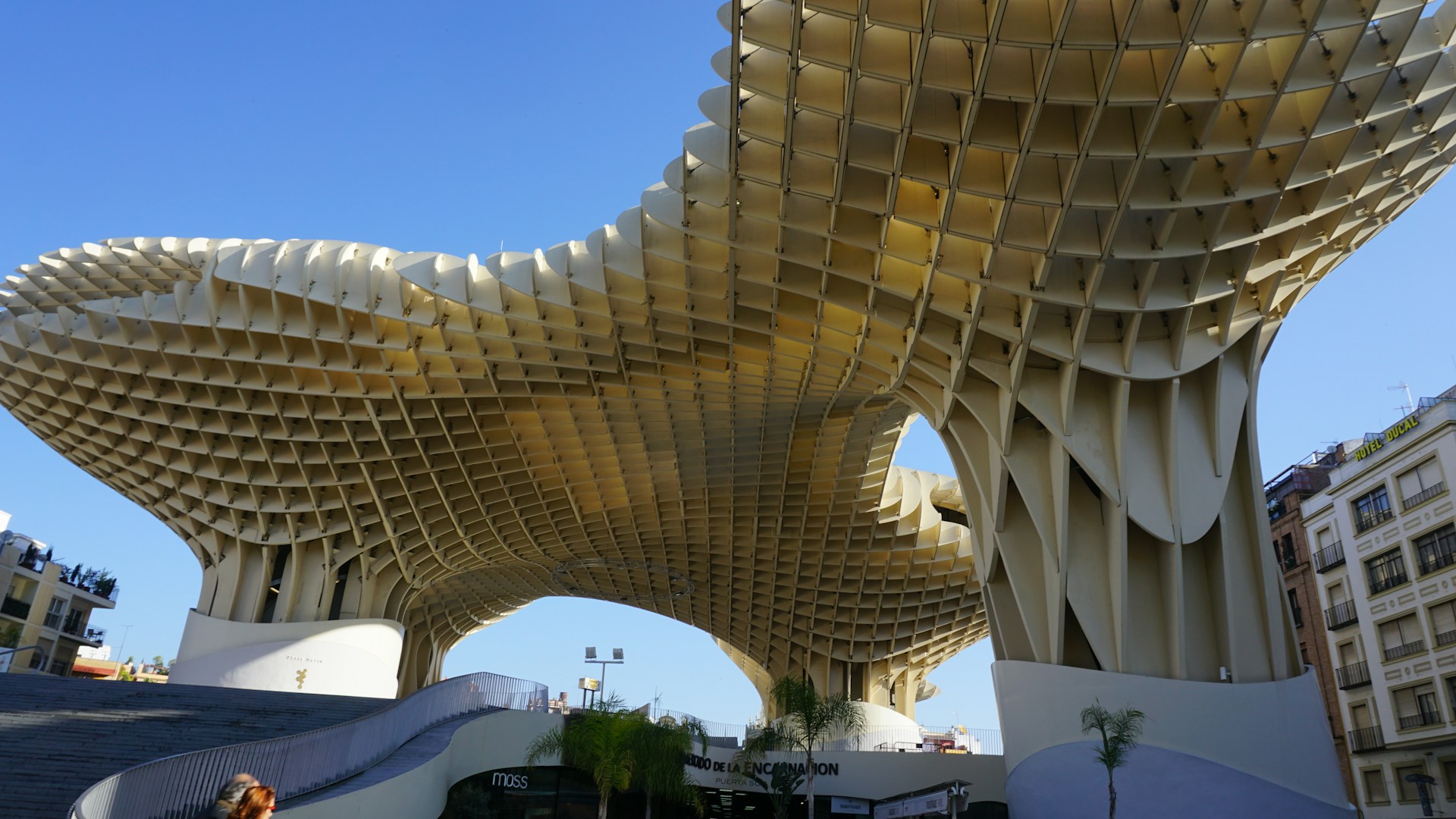
    I touched a related thread in a previous piece on who the tax system is actually built for — and what happens when you run the numbers instead of the rhetoric. The numbers, in both cases, are rude. They keep suggesting that the choices being made are choices, not inevitabilities. Math, that rude little tyrant, keeps showing up with the same conclusion: we are not poor. We are badly organised.

    The bill has been on the table for a long time. It is not unpayable. We simply keep changing the subject before anyone has to pick it up.

    The Salon California Journal is a space for ideas, culture, and conversation from my chair in Brasschaat, Belgium. I write about beauty, technology, society, and the intersections between them.