
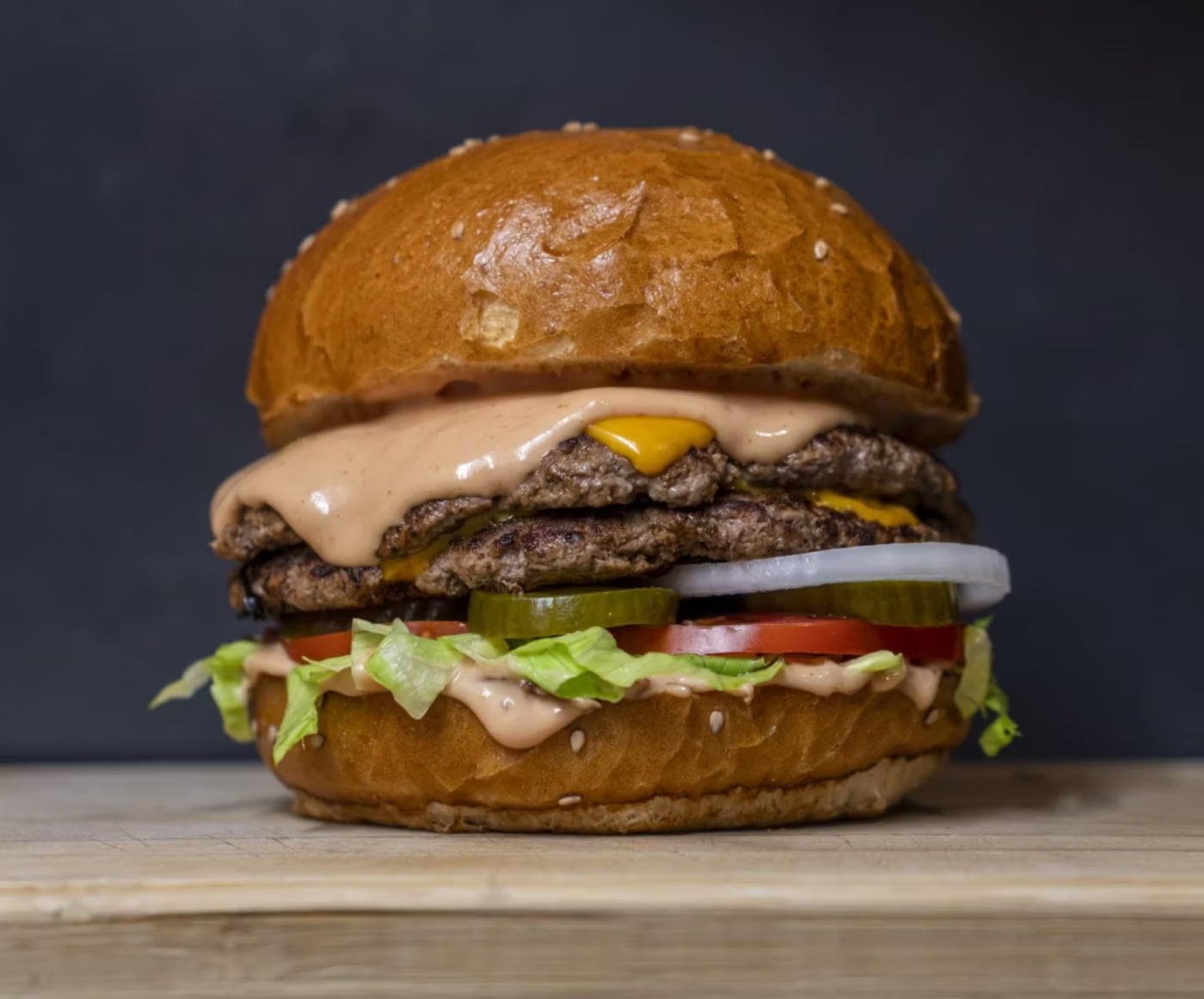
Fast food education
What a Chef Taught Me About Why School Feels Like a Drive-Thru
A mother read her son’s school report aloud in my chair: “Lacks focus. Easily distracted.” Her son had just rebuilt a toaster for fun. We talked about the menu instead of the boy.
A mother was in the chair last week, scrolling through an email from her son’s school with the particular weariness of someone who has read this exact email before, just with different dates. “Lacks focus,” she read aloud, in the flat voice people reserve for things they have stopped being surprised by. “Easily distracted. Needs to apply himself more.”
“What does he like doing?” I asked.
She thought about it properly, which told me something on its own. “Building things,” she said. “He took apart the toaster last month. To see how it worked.”
“Did he get it back together?”
“Better than before, actually. It pops up gentler now.”
I kept cutting for a moment. “And how’s he doing in the class where he sits still and listens to someone talk for fifty minutes about a textbook?”
She didn’t need to answer. The email was still open on her phone.
“I have a friend who’s a chef,” I said. “He told me something a while back that I haven’t been able to shake. He said politics has become fast food. Standardized menu, same everywhere, nobody expects greatness, the goal is just consistency. Last week it occurred to me he’d accidentally described our entire school system.”
[Switches to serious face.] She looked at me the way people look at you when a sentence rearranges something they already half-knew. “Go on,” she said. So I did, and by the time I was done, the toaster had come up twice more.
1 sizecurriculum most students are served, regardless of how they learn
19th. century the dominant school model was designed in — for factories, not minds
~30% of students across OECD countries report regularly feeling bored in class
∞ number of toasters a curious child can take apart if nobody stops them
The Standardized Menu
My chef friend’s comparison was sharper than he probably realised. Politics, he said, has become fast food. Everywhere you go, the menu looks the same. The ingredients are standardised, the portions are measured, and the outcome is predictable. Nobody expects greatness. The goal is consistency.
Real life, he pointed out, is closer to a restaurant. The menu changes with the season, the neighbourhood, and the people sitting at the table. The chef adapts. The customers adapt. Nobody files a complaint because the tomatoes developed a personality.
Unfortunately, we built education on the fast food model. Everything must be standardised, measured, tested, ranked, compared, and audited. Children arrive with different talents, interests, and temperaments, yet we insist on serving them the same intellectual meal and then act surprised when some leave it untouched.
Imagine a doctor prescribing the same medicine to every patient. Or a tailor producing only one size of suit. We would call them incompetent. In education, we call it policy.
“Imagine a doctor prescribing the same medicine to every patient. Or a tailor producing only one size of suit. We would call them incompetent. In education, we call it policy.” — The sentence that made the email on her phone look a little different.
What Passion Actually Looks Like
The problem is not intelligence. People often assume success comes down to ability, as if human beings were smartphones shipped with different processors — some destined for great things, others quietly capped from the factory. But ability is only part of the equation. Passion matters far more than most systems are willing to admit.
People do extraordinary things when they care. My wife recently started a job she loves. When she encounters a challenge, she disappears into it for hours. The rest of the day wonders where she went. She thinks twenty minutes have passed. The clock quietly informs her that civilisation has advanced considerably since breakfast.
We all know the feeling. Spend an hour doing something you love and it feels like five minutes. Spend five minutes doing something that deadens your soul and you start checking the clock as if you’re serving a life sentence.
Psychologists have a name for the first state: flow — the condition in which a person is so absorbed in a task that self-consciousness, hunger, and the passage of time itself seem to switch off. It is not a rare gift reserved for artists and athletes. It is a normal human response to doing something that fits. The boy with the toaster was, by every meaningful measure, in flow. The school report did not have a box for that.
“The mother carries the emotional weight of the household. The father becomes another item on her list.” — The plot of roughly four hundred consecutive sitcom episodes, summarised.
What If the Menu Is Terrible?
Yet schools often behave as though boredom is evidence of character. If students are disengaged, the assumption is that they need more discipline, more testing, more structure, or perhaps another inspirational poster in the hallway.
Rarely does anyone ask the obvious question: what if the menu is terrible?
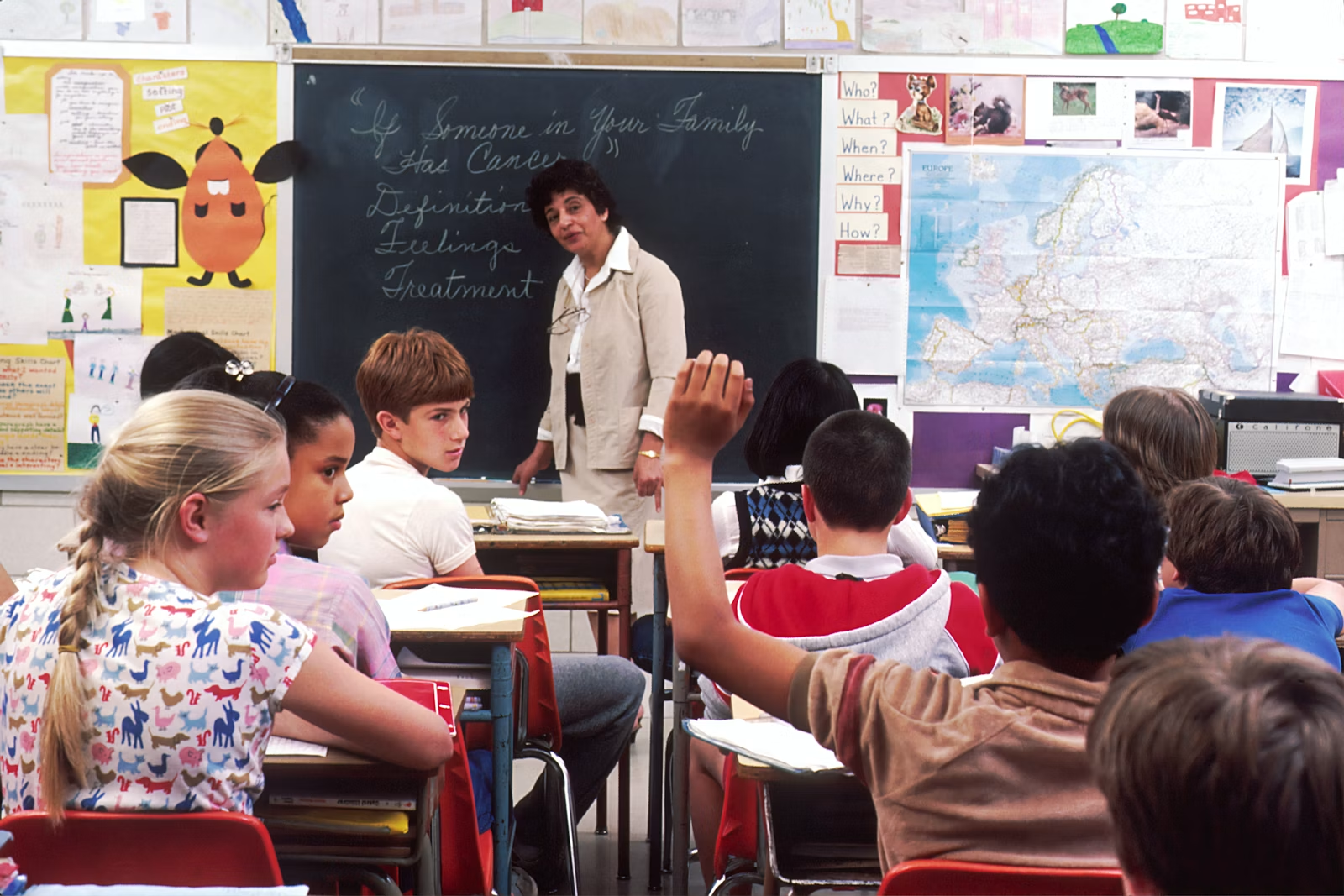
Photos: Unsplash
An Education Built for a Factory
The industrial model of education was designed for a different age. It borrowed its logic from factories — efficiency, uniformity, standardisation, sorting, batching. Children enter at one end and, with luck, emerge at the other stamped “ready for society.”
The trouble is that children are not manufactured goods. They are not identical components waiting to be assembled according to specification. Human development is messy, unpredictable, and inconveniently human.
The educator and author Sir Ken Robinson made a version of this argument famous, describing how modern schooling was built in the image of the assembly line at precisely the moment factories were the most impressive thing society had ever produced — and how the model has been quietly running on those same assumptions ever since, long after the factories themselves modernised and moved on without it.
What the Farmer Knows
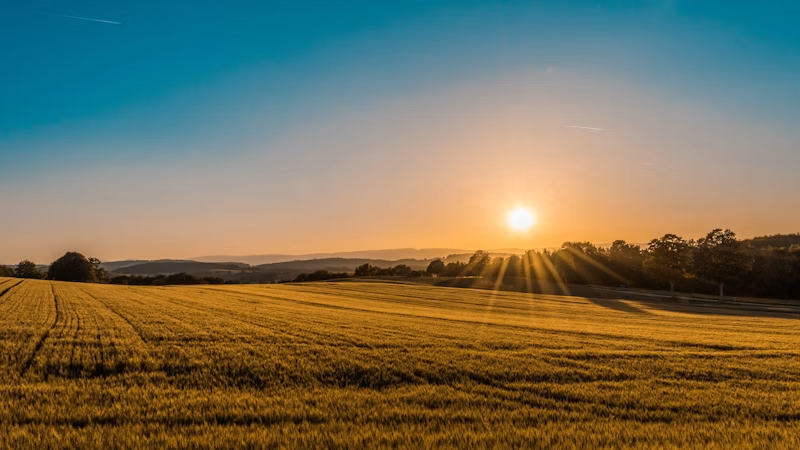
A farmer understands this better than most policymakers.
A farmer cannot stand over a field shouting at crops to grow faster.
He cannot increase yields by giving tomatoes standardised tests.
He cannot improve a carrot’s self-esteem with a motivational seminar.
He can only create the conditions in which growth becomes possible.
Good soil. Water. Light. Time.
The growth happens on its own.
Education should work the same way. The role of a school is not to manufacture human beings. It is to create the conditions in which they can flourish.
Instead, we built an educational version of a fast food franchise. We standardised the recipe, timed every process, measured every output, and then spent decades wondering why so many students leave intellectually undernourished.
It is not theoretical. Finland’s education system — consistently among the highest-performing in OECD’s PISA assessments — uses less standardised testing, shorter school days, and far more autonomy for teachers and students than most industrial-model systems.
Meanwhile, organisations like Edutopia document schools worldwide that have replaced fixed curricula with project-based learning — and found that engagement, not just test scores, changes when the menu changes.
The conditions are not a mystery. They are simply a different set of choices than the ones the factory model made by default.
Back to the Chair
By the time the mother left, the school email was still unanswered, but it had stopped looking like a verdict on her son and started looking like a description of the menu he’d been served.
I told her about the toaster line one more time, on the way out, just to watch her smile again. “Maybe,” I said, “the report should’ve said: shows excellent troubleshooting skills, improved a household appliance without supervision, occasionally finds the curriculum less interesting than a toaster. Which, frankly, is a high bar for a toaster to clear.”
I come from a place where school was simply what you survived, not something anyone expected to enjoy — which may be why the idea that a child’s boredom might be the system’s failure rather than the child’s still strikes me as faintly radical, in the way obvious things often do once you say them out loud. I touched a related thread in our piece on what AI in the classroom actually changes — the tools shift, but the menu underneath them rarely does, and a faster way to serve the same fast food is still fast food.
The mystery is not why some children fail.
The mystery is that any of them manage to stay curious after spending years being treated like inventory.
The Salon California Journal is a space for ideas, culture, and conversation from my chair in Brasschaat, Belgium. I write about beauty, technology, society, and the intersections between them.



Intelligence – Salon California
September 15, 2026 @ 12:54 pm
[…] have written before about what happens when education is optimised for throughput, and about what the classroom might look like once the machines arrive properly. This is the […]