

Democracy
Democracy: Code Has a Deeply Authoritarian Streak. Shocking, I Know.
A client’s new car wouldn’t let her go five over the limit, even at 2am on an empty road. It just beeped. There was no arguing with it. Neither, it turns out, is there much arguing with most of the software running our lives.
A client was in the chair last week, irritated about her new car. “It won’t let me go five over the limit, even on an empty freeway at two in the morning,” she said. “It just… refuses. Beeps at me like I’m a child.”
“What happens if you ignore the beeping?” I asked.
“Nothing, really. The limiter just kicks back in. There’s no arguing with it.”
I thought about my engineering days for a moment. “That’s not a bug,” I said. “That’s the whole point. Someone designed it to behave exactly that way.”
She frowned. “Designed it to be annoying?”
“Designed it to be authoritarian,” I said. “There’s a difference. Well — sometimes.”
[Switches to serious face.] One problem here is that code has a deeply authoritarian streak. Shocking, I know.
If your car says, “This is the speed limit,” and that rule is hard coded, that is the end of the discussion. No leeway. No context. No emergency. No negotiation. No “fine, I’ll pay the ticket.” The machine has spoken. Apparently silicon now does what kings used to do, only with cleaner branding.
2 reasons code and democracy seem to be moving in opposite directions
0 votes most citizens cast on the rules a piece of software enforces on them
130+ countries with no comprehensive law governing algorithmic decision-making
1 word that should make you suspicious every time a tech company uses it: “inevitable”
Not Accidental
I do not think it is accidental that democracy is struggling at the same time digital technology is rising. There are two reasons.
First, code tends to be authoritarian. Software loves rigid rules. It hates ambiguity, nuance, and human mess, unless someone goes out of their way to build those things in. So the real question is not simply what the code does, but who writes it.
“The machine has spoken. Apparently silicon now does what kings used to do, only with cleaner branding.” — The observation that made my client stop being annoyed and start being unsettled.
Who Is Making These Rules?
And who is making these rules? Usually not your elected representatives. More often, it is a handful of well-paid engineers in Silicon Valley deciding what billions of people can do, see, or access. Democracy used to mean voting for the people who made the rules. Now the rules arrive as software updates.
AlgorithmWatch, a research organisation that tracks exactly this shift, has spent years documenting how automated decision-making systems — in credit scoring, hiring, policing, content moderation — quietly assume governmental functions without ever passing through anything resembling a legislature. Nobody campaigned for the job. Nobody can be voted out of it.
The Second Reason: Surveillance
Second, AI threatens democracy through surveillance.
The AI systems we are building need vast amounts of data, endless streams of it, and much of that data is personal. Personal data becomes dangerous when citizens have little power over it, while corporations and governments hold plenty. That imbalance matters. Give institutions detailed knowledge about everyone, while keeping citizens in the dark, and you do not get freedom. You get control, wrapped in convenience.
The Imbalance, Documented
Access Now, a digital rights organisation operating across more than 25 countries, has tracked a consistent pattern: surveillance infrastructure built for one stated purpose — fraud prevention, public health, counterterrorism — routinely expands into general-purpose population monitoring once it exists. The capability rarely gets removed once installed. Researchers at Harvard’s Berkman Klein Center describe this as a one-way ratchet: surveillance powers granted during a crisis are almost never returned once the crisis passes.
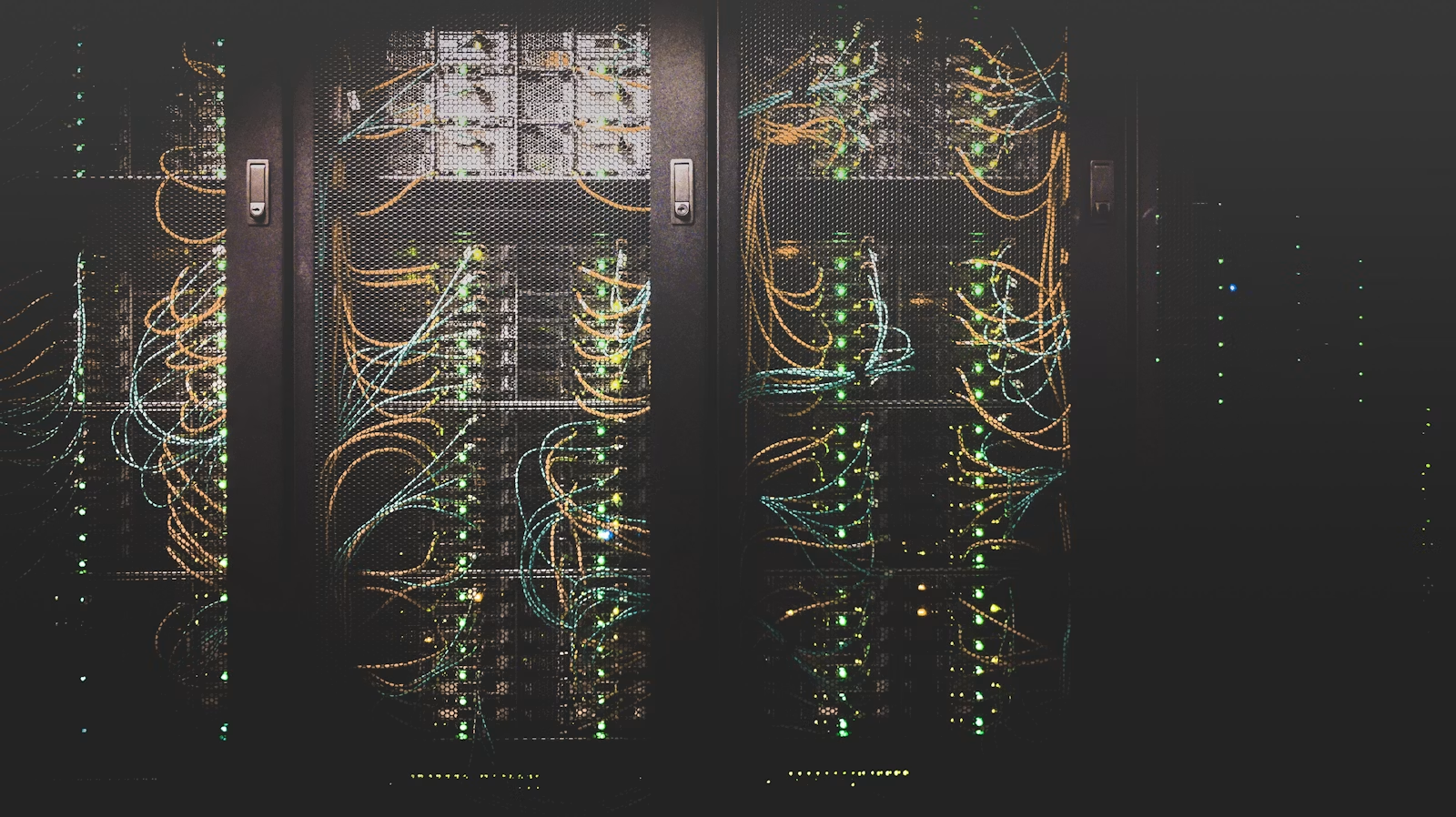
Control, wrapped in convenience, stored on racks like these. Photo: Unsplash
Technology Is Not Destiny
Most importantly, technology is not destiny. It is design.
We are building these systems. That means we choose what they become. So when someone in tech says, “Relax, this is inevitable,” I would challenge that. “Inevitable” often means, “We already built it and would prefer fewer ethical questions.”
“’Inevitable’ often means, ‘We already built it and would prefer fewer ethical questions.’” — A useful translation for the next time someone uses the word in a pitch meeting.
The Truly Strange Part
Yes, we should ask if AI could become conscious one day. That is a serious question.
But the more urgent question is simpler. Should we design these systems this way at all? Should we keep building machines that deliberately blur the line between simulation and consciousness — systems that speak, emote, and perform sentience so well that people forget it may all be mimicry?
And then comes the truly strange part. We are no longer talking only about imitation. Some people want to go further — from mimicking consciousness to creating the real thing.
Because apparently humanity looked at all its existing relationship problems and decided, “You know what would help? Conscious machines.”
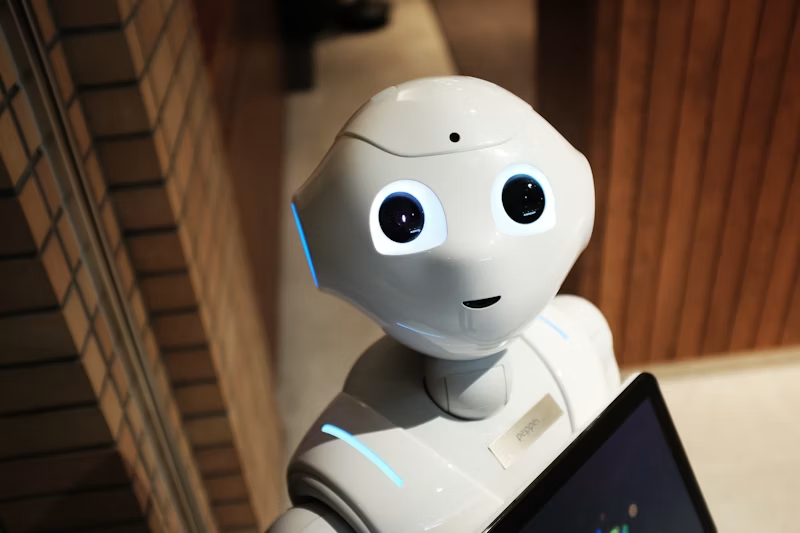
One of these is performing an expression. Increasingly, that’s the part we’re being asked to stop noticing. Photo: Unsplash
Back to the Chair
My client left with a haircut and, she said, a newfound urge to read the manual for her car — not because she expected to find anything reassuring in it, but because she wanted to know exactly which decisions had already been made on her behalf before she ever sat in the driver’s seat.
I could see both sides of this divide — the engineering side that writes the rules, and the chair where people sit and live inside them — to notice how rarely anyone in the first group is required to explain themselves to anyone in the second. That used to be called accountability. It used to require a vote.
I followed a related thread in our piece on what AI clears space for and what it quietly forecloses, and another in the house nobody is fixing — institutions left running on autopilot long after the people meant to maintain them stopped paying attention. Code is just the fastest-moving version of that pattern. Nobody voted for the speed limiter. Nobody voted for the algorithm either. Both arrived the same way: quietly, as an update, with the explanation that this was simply how things had to be now.
It wasn’t. It never is. Someone just decided it would be easier if we stopped asking.
The Salon California Journal is a space for ideas, culture, and conversation from my chair in Brasschaat, Belgium. I write about beauty, technology, society, and the intersections between them.