20th. Century
The House Nobody Is Fixing: Three Theories About History and the Roof That Started Leaking
The twentieth century offered three grand scripts for where history was going. One of them looked like the winner. In 2026, the lights still work, the water still runs, and nobody seems particularly interested in fixing the roof.
A regular client came in last week cursing gently about the noise from his apartment building — a roof repair that, from the sound of it, had become somewhat more urgent than the building committee had anticipated when they declined to approve the budget for it three years ago.
“When did it start leaking?” I asked.
“Nobody’s sure,” he said. “Could have been last winter. Could have been the one before. You only notice when water is actually coming through the ceiling.”
I adjusted my angle. “When do you think they should have fixed it?”
“Before it started leaking,” he said, in the tone of someone who had achieved clarity the hard way.
I thought about that for the rest of the cut. About roofs. About maintenance. About all the things that continue functioning long after the moment someone should have noticed they needed attention.
[Switches to serious face.] In the twentieth century, humanity entertained three grand theories about where history was headed.
None of them were particularly optimistic about the roof.
18+ consecutive years of global democratic decline documented by Freedom House
1945 was the year the liberal international order was formally established
80 yrs of relative institutional stability the post-war framework produced
2026 the year nobody is quite sure who the caretaker is
The Three Grand Theories
The fascist story argued that history was a brutal contest between nations and races.
The strongest would crush the weak, plant its flag on the ruins, and call it destiny. Not a cheerful vision, but at least an honest one about its intentions.
The communist story agreed about the conflict but disagreed on the contestants. The real struggle, it said, was between classes. Workers and owners were locked in an unavoidable collision that would end with the triumph of the proletariat and the arrival of a worker’s paradise, administered, naturally, by a dictatorship.
The paradise part was always coming. The dictatorship arrived on schedule.
Then liberalism arrived like the sensible neighbour who suggested that perhaps not every disagreement required artillery.
Liberalism argued that history did not have to revolve around conflict at all. Human beings, regardless of race, nation, or class, shared enough interests that cooperation often made more sense than fighting. Trade could be more profitable than conquest. Agreements could be cheaper than wars. People could build things together instead of spending centuries finding new ways to destroy them.
For a while, this looked like the winning script.
The Winning Script
The post-war order that liberalism built was, by almost any historical measure, extraordinary. International institutions to manage disputes before they became armed conflicts. Trade agreements that made economic interdependence more attractive than territorial expansion. Human rights frameworks that gave individuals standing against the states that governed them. Democratic systems that provided a mechanism for changing leadership without requiring the previous leader to be carried out in a box.
It was imperfect. Spectacularly imperfect, in many places, for many people, for long stretches of time. The gap between liberalism’s principles and its practice was wide enough to drive a considerable amount of justified resentment through. But the underlying architecture held for eight decades, which is longer than either of its twentieth-century competitors managed before collapsing under the weight of their own internal contradictions.
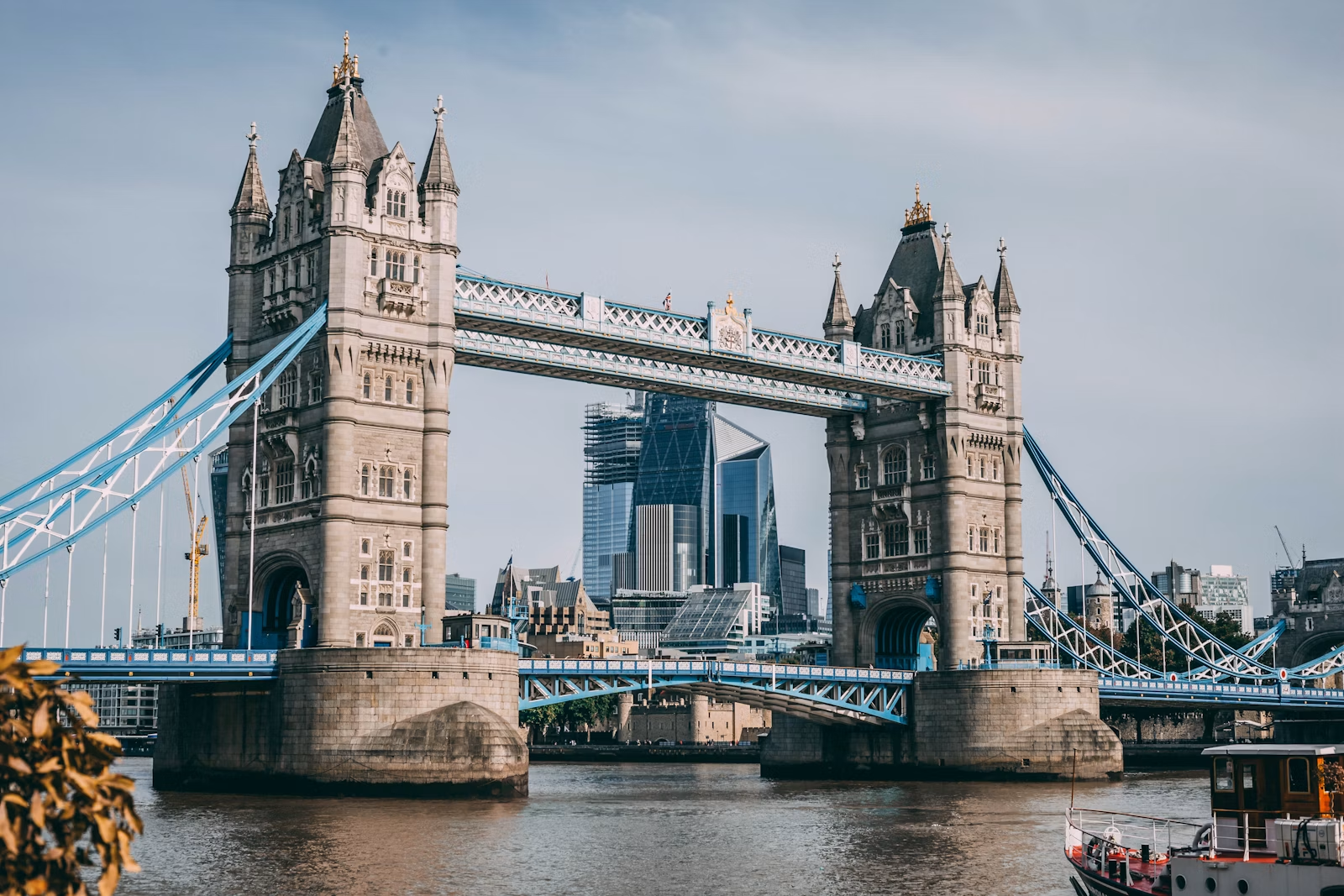
Still standing. Still functioning. Built to last, by people who believed it needed to. Photos: Unsplash
The House That Runs Itself
Now, in 2026, the liberal story has not completely failed, but it no longer inspires the confidence it once did. By many measures, we are still living in the most prosperous, peaceful, and technologically capable period humanity has ever seen. The strange part is that it increasingly feels like nobody is in charge of maintaining it.
Our civilisation resembles a large old house. The lights still work. Water still comes out of the taps. The sewage system still carries away yesterday’s mistakes. Everything appears functional.
The problem is that nobody seems interested in fixing the roof.
The house was built with such skill and redundancy that it continues operating long after the caretakers stopped caring. We walk through the hallways assuming the structure is permanent because it survived another year. Institutions that took generations to build are treated as given — obvious features of the landscape rather than things someone constructed deliberately, maintained deliberately, and could allow to deteriorate through simple inattention.
“Houses do not collapse the day maintenance stops. They collapse years later, after enough leaks, cracks, and neglected repairs accumulate.” — The sentence the client recognised immediately. His building committee had proved the same point.
But houses do not collapse the day maintenance stops. They collapse years later, after enough leaks, cracks, and neglected repairs accumulate. And when the ceiling finally caves in, people rarely say, “The problem started today.” They usually say, “I thought someone else was taking care of that.”
Freedom House has published its Freedom in the World report annually since 1973. In their most recent assessments, the organisation has documented more than eighteen consecutive years in which the number of countries registering democratic decline exceeded those registering democratic gains — the longest continuous downturn since the index began. The V-Dem Institute at the University of Gothenburg, which tracks democracy through a different methodology, reaches similar conclusions: the share of the world’s population living under democratic governance has returned to levels last seen in the 1980s. The house has been losing heat for some time. The thermometer simply wasn’t on display in the hallway.
What Maintenance Actually Looks Like
The question worth asking is not who broke the liberal order, because the answer to that is complicated, contested, and probably involves a longer list than anyone finds comfortable. The more useful question is what maintaining it actually requires.
Institutions are not self-sustaining. They require people who believe in them enough to staff them, defend them when they become inconvenient, and resist the temptation to hollow them out for short-term advantage.
Democratic norms are not enforced by the laws that describe them but by the willingness of participants to treat those norms as binding even when breaking them would be advantageous. International agreements held not because of abstract principle but because enough actors calculate that the system is more valuable intact than the gain available from defection.
None of this is dramatic. Nobody gets a monument for choosing not to exploit a loophole. Nobody’s approval rating rises because they maintained an institution rather than dismantling it for parts. The incentive structure of democratic politics often rewards exactly the kind of performance that the underlying structure can least afford — visible, short-term action over invisible, long-term maintenance.
Back to the Chair
The building committee, my client told me, had finally approved the repair budget — after the ceiling of a ground-floor flat had begun showing water damage, which was apparently the level of evidence required to convert a theoretical problem into an actual one.
“Will they fix it properly?” I asked.
He thought about it. “They’ll fix the part that’s leaking now,” he said. “Whether they check the rest of the roof while they’re up there—” He shrugged.
That seems about right.
I come from a place with a complicated relationship with the institutions that were supposed to protect people — where the gap between what structures promised and what they delivered was not theoretical but daily. Which may be why I find it easier than some to imagine those structures not being there, and harder than some to take for granted that they will simply continue to exist because they have so far.
I explored a related thread in our piece on growth, limits, and the things we treat as permanent until they aren’t — the same pattern, different domain. Systems built on assumptions that were once reasonable and have since quietly stopped being true. The difficulty of acting on a problem before the ceiling makes the argument for you.
The three grand theories of the twentieth century each had a vision of where history was going. The liberal one was the most liveable. It was also, perhaps, the most demanding — because it required not a revolutionary vanguard or a master race, but something considerably harder to sustain: a large number of ordinary people, generation after generation, choosing to maintain something they had not built and would not live to see completed.
The roof does not fix itself.
It never did. Someone just used to go up there.
The Salon California Journal is a space for ideas, culture, and conversation from my chair in Brasschaat, Belgium. I write about beauty, technology, society, and the intersections between them.