
No Tax under 30
No Tax Under 30: Math, That Rude Little Tyrant, and the $46 Trillion Question
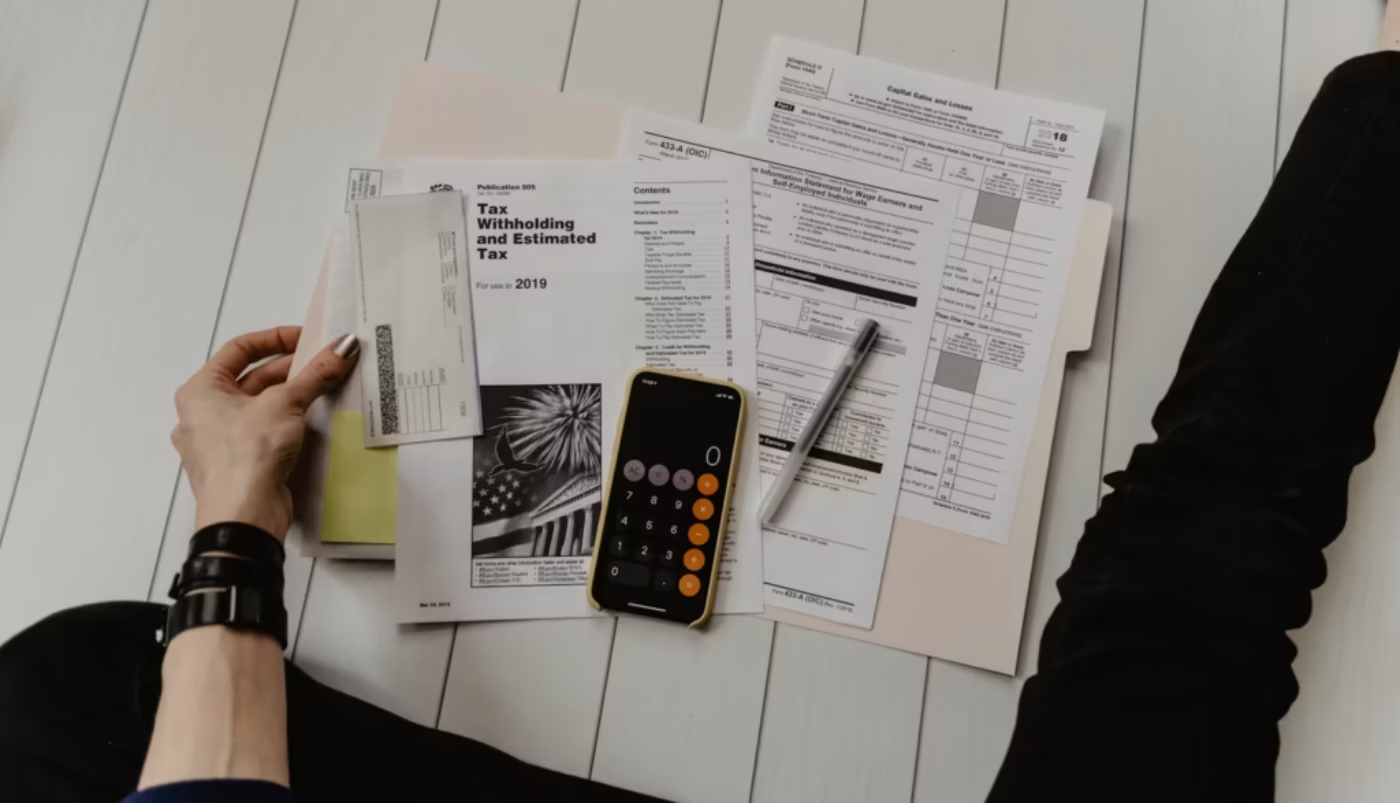
A client watched a third of his first paycheck disappear and went pale, like he’d just read a death certificate. So here is a radical thought. What if we stopped taxing people in their twenties?
A client in his early twenties checked his banking app in the chair last week, went pale, and read the number out loud like it was a death certificate.
“They took a third,” he said. “A third.”
“Congratulations,” I said. “You’ve just discovered taxation.”
“That’s not helpful.”
“If I ran things,” I said, “you’d keep every cent of that until you turned thirty.”
He looked at me like I’d just told him the moon was made of cheese, in a good way. “Go on,” he said.
[Switches to serious face.] So here is a radical thought. What if we stopped taxing people in their twenties? Simpler still: under 30, no tax.
Immediately someone clutches their pearls and says, “But wouldn’t that incentivise young people not to go to university and instead get jobs?”
Yes. That is called an incentive. Glad we are keeping up.
$514T approximate global wealth in 2025 (UBS Global Wealth Report)
$46.26 Trillion what a flat 9% tax on that wealth would raise per year
30 – 60 the proposed taxable window — peak earning years
0% the proposed rate under 30, and again after 60
The Sacred Cow
And before people faint, let’s address the sacred cow: university.
We treat university as if it is a universal human right, somewhere between clean water and oxygen. Everyone must go. Everyone must get a degree. Apparently the dream is for half the population to graduate and then compete for jobs that did not require degrees twenty years ago.
Brilliant system.
Here is the uncomfortable truth. University is, in many cases, a luxury item. And luxury items stop being luxurious when everyone has one. If 50 percent of people go to university, that does not scream equality to me. It screams credential inflation. Congratulations — you spent three years and a small fortune to qualify for an entry-level job answering emails.
“Congratulations, you spent three years and a small fortune to qualify for an entry level job answering emails.” — The line my client read twice before laughing, a little uncomfortably.
University is the third stage of education. It should be selective, purposeful, and ideally useful. Researchers at Georgetown’s Center on Education and the Workforce have tracked exactly this drift for years — degree requirements creeping into roles that never structurally needed one, while the wage premium attached to many of those same degrees quietly erodes. The credential keeps costing more. It does not keep delivering more.

A credential that costs more every year and signals less every year it does. Photo: Unsplash
Free, But Only If It Keeps Civilisation Running
And yes, I would make it free — but only for subjects that actually keep civilisation from collapsing.
Study something that grows corn, builds bridges, keeps the lights on, or cures disease. Agriculture, engineering, medicine, physics, technology — call it STEM. Free.
That seems like a fair deal. Society pays for what society needs.
If you are in the younger generation and academics is your path, excellent. Go study. Become useful. We need smart people.
But if university is not for you, also fine. Go work. Build something. Learn a trade. Start a business. Earn money and keep it.
Keep all of it.

Grows corn, builds bridges, keeps the lights on, cures disease. Free. Photo: Unsplash
No Tax Under 30
No tax under 30. Imagine that. Young people accumulating capital instead of debt. Revolutionary.
Then perhaps taxation happens mainly between 30 and 60, when people tend to be at peak earning power.
And maybe after 60, no tax again.
Fantasy Politics
Why?
Because at some point we need to stop doing fantasy politics.
Every election sounds like a children’s birthday party. Yes, yes, yes, we will pay everyone’s pension forever. Free this, subsidised that, endless benefits for all.
Wonderful.
Tiny issue: we do not have enough young people paying into the system to fund pensions forever.
Math, that rude little tyrant, keeps ruining political speeches.
The Tyrant, Quantified
The IMF has repeatedly flagged ageing populations and shrinking worker-to-retiree ratios as one of the most structurally underpriced risks in advanced economies — not a future hypothetical, but a current trajectory. Every pay-as-you-go pension system was built on the assumption of a population pyramid, more young workers than retirees, indefinitely. That pyramid is inverting almost everywhere it was once assumed permanent. No campaign promise changes the denominator.
The Real Tragedy
Just as food for thought: global wealth in 2025 was approximately $514 trillion. Flat tax that at only 9 percent and you get $46.26 trillion.
Forty six trillion dollars.
Just imagine what that could solve. Poverty. Hunger. Healthcare. Infrastructure. Education.
Many of humanity’s grand crises could be dramatically reduced.
The tragedy is not lack of wealth.
It is that we live in a civilisation astonishingly good at producing wealth and almost artistically talented at concentrating it into fewer hands, then acting baffled when the rest get angry.
Back to the Chair
My client left with a haircut and the same third of his paycheck gone, because I run a salon in Brasschaat, not a finance ministry. He asked, on his way out, whether any of this had a real chance of happening.
“Probably not,” I said. “Doesn’t mean the maths is wrong.”
I followed a related thread in our piece on growth, limits, and the invoice nobody wants to read — the same arithmetic, really, wearing a different line item. Pensions, tuition, payslips. Different receipts, same civilisation, remarkably consistent at the one talent nobody campaigns on: turning collective wealth into a small number of very comfortable private bank accounts, then expressing genuine surprise at the resulting mood in the room.
Math, that rude little tyrant, is still waiting for someone to argue with it directly instead of around it.
The Salon California Journal is a space for ideas, culture, and conversation from my chair in Brasschaat, Belgium. I write about beauty, technology, society, and the intersections between them.