Human Mind
By 2030, AI Files Patents: A Salon Conversation About the One Thing Machines Can’t Originate
A design student asked if AI was going to replace him. I told him about the calculator. He was not immediately reassured. Fair enough — neither was I, the first time.
A young man was in the chair last week, a design student about to graduate, asking the kind of question that already contains the answer the person is afraid of.
“Do you think AI is going to replace us?” he said. “Like, actually replace us?”
I thought about my engineering degree for a moment — a detail I don’t bring up often, mostly because nobody believes a man holding scissors studied electrical engineering at university, and explaining it usually takes longer than the haircut.
“I sat through lectures convinced the calculator had already ended my career before it started,” I said. “Spoiler: it hadn’t.”
He looked unconvinced, in the specific way the anxious look when offered reassurance instead of evidence. “Different scale, though,” he said.
“Maybe,” I admitted. “Let’s actually think it through.”
[Switches to serious face.] By 2030, AI files patents. By 2035, it directs films. By 2040, it runs companies.
Sit with that for a moment.
Most people, hearing this, reach for the exit. The ones who don’t — who get curious instead of careful — are the ones this era is being built for.
2030 projected year AI systems begin filing patents independently
40% of employers expect AI to change required skills within five years
3rd major automation wave in 200 years — mechanisation, computing, now AI
0 machines, so far, that have chosen a target worth optimising toward
The Calculator Didn’t Retire the Mathematician
History keeps offering the same lesson, and we keep forgetting it.
The calculator didn’t retire the mathematician; it handed him a rocket. The camera didn’t bury the painter; it handed her a century of cinema. Every time a machine absorbed a task, the human behind it didn’t shrink. They expanded.
I watched a smaller version of this panic in real time, in a lecture hall, decades ago. An entire room of engineering students convinced that computational tools would make the slower, more laborious parts of our training obsolete — and they were right, those parts did become obsolete. What nobody predicted accurately was what would fill the space left behind. Not less engineering. More of it, aimed at problems the previous generation didn’t have the bandwidth to attempt by hand.
The part of the process no model has figured out how to schedule. Photos: Unsplash
What AI Clears Space For
So what does AI clear space for now? The thing it cannot replicate: a mind at full stretch.
The idea that arrives at 2 a.m. uninvited. The instinct in a meeting that the data cannot locate. The leap nobody else saw coming. These aren’t soft skills. They’re the only skills a machine genuinely cannot mass-produce.
AI can write. It cannot wonder. It can calculate. It cannot dream. It can optimise endlessly toward a target — but it cannot choose the target that matters. That has always been a human job.
“AI can write. It cannot wonder. It can calculate. It cannot dream. It can optimize endlessly toward a target — but it cannot choose the target that matters.” — The part of the conversation where the student finally put his phone down.
Thinking Alongside It
The decision, then, isn’t whether to compete with AI. It’s whether to think alongside it or be replaced by the people who will.
This distinction matters more than it sounds. Competing with a system built to process more data faster than any human brain is a contest with a predetermined loser. Thinking alongside it — using it to clear the repetitive, mechanical, first-draft work out of the way so that attention can go toward the part only a human can do — is a different proposition entirely, and one with considerably better odds.
The World Economic Forum’s Future of Jobs Report consistently finds that the skills employers expect to matter most over the coming decade are not technical fluency with AI tools themselves, but the distinctly human layer around them — creative thinking, analytical judgment, and the ability to originate a direction worth pursuing in the first place. Researchers at Stanford’s Human-Centered AI Institute have made a related point repeatedly: the systems improving fastest are the ones that augment human judgment rather than attempt to replace the act of judging.
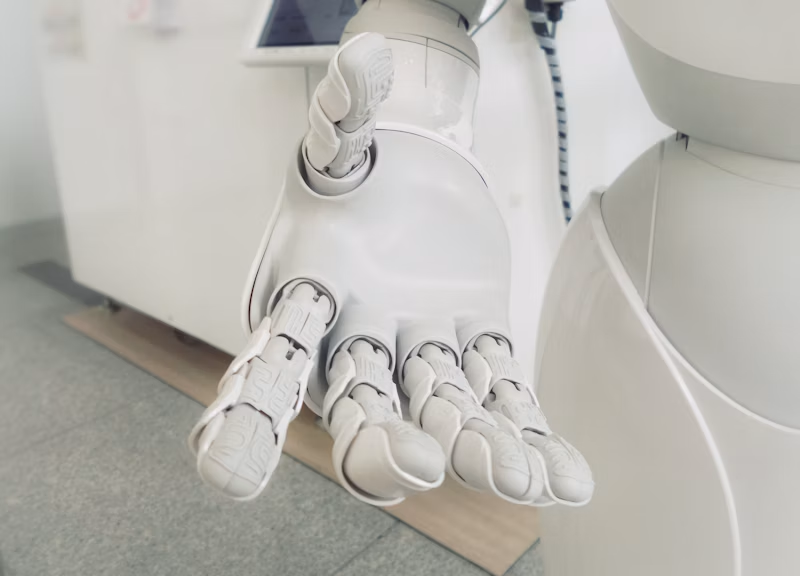
Photos: Unsplash
Use it. Build with it. But don’t hand it the one thing that’s actually yours — the willingness to originate. Every previous wave of automation removed the labour and left the authorship intact. There is no evidence yet that this one works differently, and considerable evidence — the calculator, the camera, the spreadsheet, the search engine — that authorship has always been the part worth protecting.
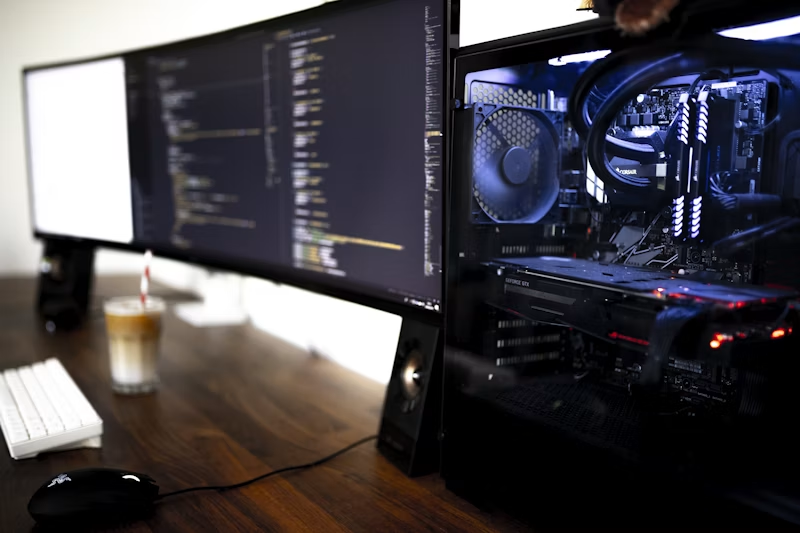
Use It. Build With It. Just Don’t Hand It This.
Back to the Chair
The student left with a haircut and, I think, slightly fewer reasons to lose sleep — though he was still not entirely convinced, which I respect more than instant agreement. “I’ll believe it when I see it,” he said at the door.
“That’s exactly the right amount of scepticism,” I said. “Just don’t let it stop you from making something this year that nothing currently existing could have made for you.”
I think about my own pivot more than I let on in the chair — engineering studies, decades behind scissors, a salon named after a place I no longer live in. None of that followed a script a calculator, or anything since, could have written for me. The tools changed considerably across that stretch of time. The willingness to point them somewhere new did not come from the tools.
I touched a related thread in our piece on what schools are actually built to produce — the idea that the most valuable output of any system, educational or technological, was never meant to be uniformity. It was meant to be someone walking out the other end with a question nobody had thought to ask yet.
The future runs on that. It always has.
The Salon California Journal is a space for ideas, culture, and conversation from my chair in Brasschaat, Belgium. I write about beauty, technology, society, and the intersections between them.