
Social Media
Not One of My Friends Has Children: A Client’s Vent About Social Media, Dating Apps, and the Bill We’re Now Paying
“How hard do you have to stress a mammal before it stops reproducing?” He didn’t wait for the cape before he started venting. By the end, neither of us had a comfortable answer.
A client was in the chair last week, around thirty, and barely waited for the cape before he started venting.
“Not one of my friends has children,” he said. “Not one.”
I kept cutting. “How many friends?”
“Fifteen, maybe twenty if you count the ones I only see at weddings. Which have also mostly stopped happening, by the way.”
He went on for a while after that. By the time he left, I had heard more about dating apps, algorithms, and mammalian reproduction than I expected to hear before lunch — most of it, frankly, hard to argue with.
“Pause on that for a second,” he said at one point. “Do you realise how badly you have to stress a mammal before it stops reproducing? Give most mammals food, safety, and a halfway decent environment, and nature takes care of the rest. Humans, apparently, built Wi-Fi and talked ourselves out of it.”
“And it’s not local,” he added. “It’s everywhere. West, East, rich countries, poor countries. The pattern repeats.”
[Switches to serious face.] He is not wrong about the pattern, and he is not wrong about the timing of his own generation, either. He is old enough to remember the promise technology made about connection, and young enough to be living with the bill.
↓ fertility rates declining across nearly every region tracked by the UN, rich and poor alike
5B+ people now active on social media platforms worldwide
1 metric most dating apps are actually built to optimise: retention, not matches
∞ scroll — the design pattern with no natural stopping point
They Don’t Really Go Out Anymore
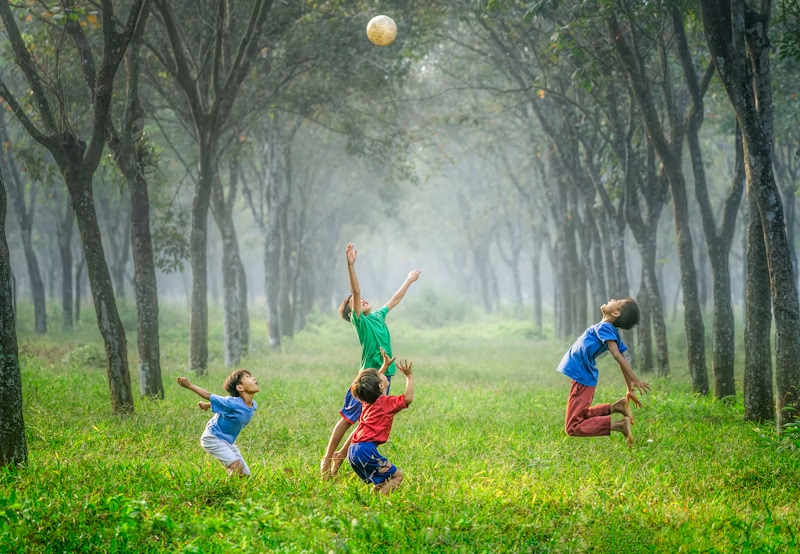
Something has broken, especially among younger people, he said. Kids don’t dance anymore. They go out, but they don’t really go out. They perform presence. They curate existence. Every moment feels like an audition for an invisible panel of judges.
Imagine being eighteen and wanting to approach someone you like. You walk over, say the wrong thing, stumble over a sentence, act awkward for ten seconds — and suddenly you’re content. Recorded. Uploaded. Shared. Mocked by strangers before breakfast.
Of course people hesitate.
Photos: Unsplash
That Would Be Terrible for Business
So when you ask why this is happening, his answer was simple. Technology. Social media. Artificial intelligence. Algorithms.
And no — dating algorithms are not trying to help you find the love of your life. That would be terrible for business.
Dating apps optimise for one thing: retention. They want you swiping tomorrow, next week, next month. The perfect match is not the product. Your attention is.
“Dating apps optimize for one thing, retention. The perfect match is not the product. Your attention is.” — The client, somewhere around the point I stopped trimming and started listening properly.
We quietly outsourced dating, intimacy, and large parts of human courtship to a small number of publicly traded companies, all without much public debate. We handed over our social norms to profit-driven systems and then acted surprised when the results felt transactional. Investigations by outlets like The Markup, which specialises in examining how algorithms actually behave rather than how companies describe them, have repeatedly found that engagement-optimised platforms are designed around exactly this incentive — the metric that gets reported to investors is time spent, not relationships formed.

What presence used to look like, before it needed an audience. Photo: Unsplash
Tools Shape Behaviour
As a society, we treated technology like a neutral tool. It isn’t.
Tools shape behaviour. Platforms shape culture. Algorithms shape desire.
For decades we were promised that if we simply let technology scale unchecked, it would deliver democracy, freedom, happiness, and economic growth.
Well — where is it?
The Numbers Behind the Vent
Fertility rates have fallen below replacement level across most high-income countries and a growing number of middle-income ones, according to data tracked by the UN’s World Population Prospects. The decline is not confined to wealthy nations or any single culture — it spans East and West, religious and secular societies, places with generous parental leave and places with none. Researchers debate the exact weight of any single cause, but the timeline lines up uncomfortably well with the rise of smartphone-mediated dating and socialising. Correlation is not proof. It is, at minimum, a question worth sitting with.

The thing the product was never actually built to deliver. Photo: Unsplash
Back to the Chair
He left lighter than he arrived, which is usually how it goes when someone gets to say the whole thing out loud to a person who isn’t about to post a reaction to it.
I’ve cut hair across four decades now — Boston, California, Belgium — long enough to have watched several versions of “technology will finally deliver the good life” arrive, get believed, and quietly fail to show up. Each version had its true believers. Each one left a slightly different kind of bill on the table for the generation that came next. His generation’s bill happens to be denominated in swipes, screen time, and an unusually empty wedding calendar.
I touched a related thread in our piece on what actually predicts whether a relationship works — the finding, consistently, that compatibility, communication, and shared values matter more than almost anything else. None of those three things are what a retention-optimised algorithm is built to surface. They take time, proximity, and a willingness to be mocked for ten awkward seconds without an audience. The apps were never going to deliver that. It was never the business they were in.
He’s right to be unsettled. The question isn’t really about phones, or apps, or even fertility rates, in the end.
It’s about how badly you have to stress a mammal before it stops wanting to reproduce — and what it says about the environment we built, that so many of us seem to be finding out.
The Salon California Journal is a space for ideas, culture, and conversation from my chair in Brasschaat, Belgium. I write about beauty, technology, society, and the intersections between them.