
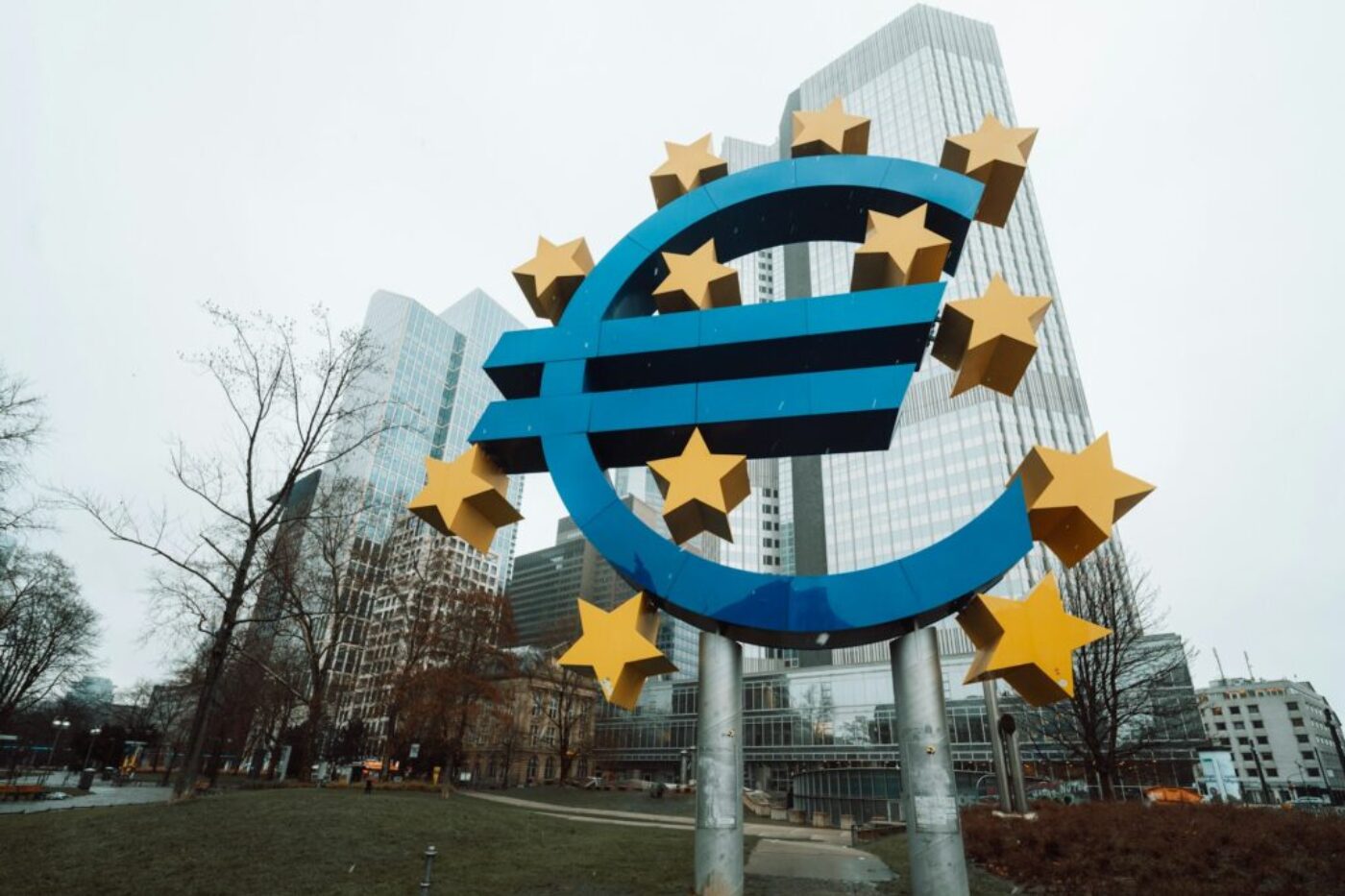
Central Bank
Found Guilty. No Punishment. Now She Is Designing the Future of Your Money.
A French court found Christine Lagarde guilty of negligence over a €403 million arbitration paid from public funds, then imposed no fine, no sentence, and no criminal penalty — citing, among other things, her reputation. Three years later she became President of the European Central Bank. And that history matters when the same person is helping shape the future of money in Europe.
A client sat down last week and asked me a question I did not expect before ten in the morning. “Is it true,” she said, “that Sweden is telling people to keep cash at home? Sweden. The country where nobody has touched a coin since 2014.”
“It’s true,” I said.
“That seems like the sort of thing that should have been on the news more than once.”
“It does. Although if you want to understand what’s happening to money in Europe, I’d start somewhere else entirely.”
“Where?”
“A pair of running shoes,” I said. “1993.”
[Switches to serious face.] If an ordinary person were responsible for losing hundreds of millions of euros in public money through negligence, most people would expect serious consequences.
Christine Lagarde was found guilty of negligence in connection with a €403 million arbitration award involving French businessman Bernard Tapie. Yet she received no fine, no prison sentence, and no criminal punishment. Three years later, she was appointed President of the European Central Bank.
And that history matters when the same person is now helping shape the future of money in Europe.
€403 million the 2008 arbitration award paid to Bernard Tapie from public funds — including €45 million for moral damages
0 fines, prison sentences, and criminal penalties imposed after the 2016 guilty verdict for negligence
2029 the earliest possible first issuance of a digital euro, according to the ECB, assuming the legislation is adopted
1,000 SEK the cash per adult Sweden’s Riksbank recommended households keep at home — in one of the world’s most cashless countries
1993: The Sale
The story begins in 1993.
Bernard Tapie, a French businessman and politician, was required to sell his stake in Adidas after entering the French government. He entrusted the sale to Crédit Lyonnais, then a state-owned French bank.
The bank arranged the sale and paid Tapie. The matter appeared to be settled.
Then Tapie discovered something rather inconvenient.
Some of the companies involved in the transaction had connections to Crédit Lyonnais itself. Less than two years later, Adidas was resold for roughly twice the price of the original transaction.
Tapie believed he had been cheated.
For the next 14 years, he pursued legal action against the French state and Crédit Lyonnais.

Crédit Lyonnais. Photo Unsplash
2007: The Campaign
Then, in 2007, Tapie publicly supported Nicolas Sarkozy’s successful presidential campaign.
After Sarkozy became president, his finance minister was Christine Lagarde.
In 2008, Lagarde allowed the long-running dispute to be taken out of the ordinary court process and sent to a private arbitration panel.
The three-member panel awarded Tapie approximately €403 million in taxpayer-funded compensation, including €45 million for moral damages.
The decision immediately attracted controversy.
It later emerged that one of the arbitrators had undisclosed connections to Tapie’s lawyer. Officials within the French Finance Ministry advised Lagarde to challenge the arbitration award.
She did not.

€403 million of it, awarded by three arbitrators in a private room and paid from public funds. Photo: Unsplash
2015: The Unravelling
In 2015, French courts ruled that the arbitration process had been improper and annulled the award, ordering Tapie to repay the money.
Tapie subsequently declared bankruptcy, and he died in 2021. The attempt to recover the money became a long and complicated legal process, while the cost of the failed arbitration ultimately fell on French public finances.
2016: Guilty, and Free to Go
Then came Lagarde’s own legal case.
In 2016, France’s Court of Justice of the Republic found Christine Lagarde guilty of negligence for failing to challenge the arbitration award.
But there was an extraordinary detail.
The court imposed no punishment.
No fine.
No prison sentence.
No other criminal penalty.
The court cited the circumstances of the case, including her reputation and international standing, when deciding not to impose a sentence.
Lagarde did not lose her career.
In fact, she continued to rise.
The International Monetary Fund reaffirmed its confidence in her leadership after the verdict. And three years later, European leaders appointed Christine Lagarde President of the European Central Bank.
So a person found guilty of negligence in connection with a €400 million public arbitration award ultimately became one of the most powerful financial officials in Europe, with responsibility for monetary policy across the euro area.


The statue is blindfolded so she cannot see who is standing in front of her. In 2016, the court took a good long look. Photo: Unsplash
And That Brings Us to Cash
Because Lagarde has also been remarkably candid about how central banks think about the future of money.
In 2023, during a conversation in which she mistakenly believed she was speaking to Ukrainian President Volodymyr Zelensky, Lagarde discussed the digital euro and acknowledged that there would be a degree of control over transactions.
She was asked about concerns that a digital euro could be used to monitor payments.
Her response was striking.
She said there would be control, and that the ECB was considering whether very small transactions, around €300 or €400, could have a mechanism involving zero control. She then argued that completely anonymous transactions could be dangerous, pointing to the financing of terrorist attacks in France through small anonymous prepaid cards.
That conversation was a prank. It was not an official policy announcement, and it should not be treated as proof that the final digital euro will contain the exact controls she discussed.
But the underlying issue is real.
Infrastructure Creates Rules
Digital payments are not the same thing as cash.
Cash can be handed from one person to another without a bank, payment processor, internet connection, or digital record of the transaction.
Digital money requires infrastructure.
And infrastructure creates rules.
The important question is not simply whether those rules exist. It is who controls them, what information is available to whom, and under what circumstances those rules can change.
The ECB now says the digital euro will not be programmable money in the sense of restricting where, when, or with whom you can spend it. It says the system is being designed with strong privacy protections, including an offline version intended to provide cash-like privacy.
That is an important distinction.
A digital euro is therefore not automatically some dystopian programmable currency that can be switched off because you bought the wrong sandwich.
But neither is it simply a banknote transferred onto your phone.
It would be a new digital monetary infrastructure, governed by legislation, technical architecture, payment providers, anti-money-laundering rules, and institutions capable of changing those rules over time.
The Machinery Is Being Built
And the project is no longer theoretical.
In July 2026, the European Parliament voted 416 to 169, with 22 abstentions, to move forward with negotiations on legislation for the digital euro.
The ECB has also selected 36 payment-service providers to participate in a 12-month pilot beginning in the second half of 2027. The pilot is designed to test the system in real-world situations, including person-to-person, online, offline, and retail payments.
The ECB says it could be ready for a potential first issuance in 2029, assuming the necessary legislation is adopted.
So this is no longer just a white paper sitting on a bureaucrat’s desk gathering the digital equivalent of dust.
The machinery is being built.
A Correction About Cash Limits
And now consider what is happening with cash.
There is an important correction here. There is not currently a universal €1,000 EU-wide cash-payment limit.
EU legislation establishes a maximum EU-wide limit of €10,000 for large cash transactions, while individual countries can impose lower national limits. France, for example, already has stricter national rules for certain cash transactions.
That distinction matters because the argument is not really about one magic number.
It is about a broader trend toward making large anonymous cash transactions increasingly difficult while digital transactions become increasingly central to everyday life.


One of these requires a bank, a network, a terminal, and permission. The other requires a hand. Photo: Unsplash
Sweden’s Interesting Contradiction
And here is where Sweden provides an interesting contradiction.
Sweden became one of the world’s most cashless societies.
Yet in March 2026, Sweden’s central bank, the Riksbank, recommended that households keep approximately 1,000 Swedish kronor in cash per adult at home, enough to help cover essential purchases during disruptions. It specifically cited the need for alternative payment methods during crises, disruptions to digital communications and payment services, and even war.
Think about what that means.
A country that went further than most in embracing digital payments is now telling its citizens: keep some physical money.
Why?
Because digital systems can fail.
Cyberattacks can happen. Power grids can fail. Communications networks can go down. Payment processors can become unavailable.
And in a serious crisis, your bank account may still tell you that you have money while the terminal at the grocery store tells you that none of it is currently accessible.
The Primitive Advantage
Cash has one extremely primitive but useful feature: it does not require permission from a server.
No electricity.
No internet connection.
No payment processor.
No account authentication.
No software update.
You hand someone a banknote, and the transaction is finished.
“Cash has one extremely primitive but useful feature: it does not require permission from a server.” — You hand someone a banknote, and the transaction is finished.
That does not make cash perfect. Cash can facilitate tax evasion, money laundering, and criminal transactions. Governments have legitimate reasons for imposing limits on large anonymous payments.
But there is another side to the argument.
Every time society moves another step from physical cash toward digital money, we also move toward a world in which payments depend on infrastructure and institutions.
And that creates a question that deserves more attention than either the utopian sales pitch or the conspiracy theory:
How much financial privacy should an ordinary person have?
Photo: Unsplash
Safeguards Are Not Permanence
The ECB says the digital euro will protect privacy.
It says offline payments can provide cash-like privacy.
It says the Eurosystem itself will not be able to directly identify users from their online payments, while banks and payment providers will still have to comply with existing laws governing money laundering and terrorist financing.
Those safeguards may be genuine.
But safeguards are not the same thing as permanence.
Technology can change.
Legislation can change.
Governments can change.
And institutions can acquire new powers during emergencies that were once considered unacceptable during normal times.
Where the Numbers Come From
Every figure above is on the public record. The European Central Bank publishes the digital euro’s design principles, the privacy commitments, the pilot participants, and the potential 2029 timeline. The European Parliament records its July 2026 vote and the legislative process that follows. Sweden’s Riksbank publishes its preparedness advice, cash recommendation included. And the 2016 verdict, the 2015 annulment, and the €403 million award are all matters of French public record, reported at the time across Europe. The facts are not in dispute. Only their meaning is.
Why the History Is Relevant
That is why the history of Christine Lagarde is relevant.
The issue is not whether Lagarde is personally a villain. She was found guilty of negligence, not corruption, in the Tapie case. The court did not find that she deliberately stole €400 million from taxpayers.
The issue is something more uncomfortable.
A person who was found guilty of negligence in handling a €400 million public arbitration award received no punishment and went on to become President of the institution responsible for Europe’s monetary system.
That does not automatically make every policy she supports illegitimate.
But it does make questions about accountability, institutional power, and financial privacy rather difficult to dismiss.
“Safeguards are not the same thing as permanence.” — Technology can change. Legislation can change. Governments can change.
Because when money becomes increasingly digital, the people who design the system do not merely influence how we pay.
They influence the infrastructure through which payment itself becomes possible.
And perhaps that is the real debate.
Not whether digital money is good or bad.
Not whether cash is old-fashioned or convenient.
But whether ordinary citizens should retain at least one form of money that works without asking a bank, a payment network, a government, or a central database for permission.
Sweden’s central bank appears to understand that risk.
The question is whether the rest of Europe will remember it before the backup plan becomes the thing everyone wishes they had kept.
Back to the Chair
My client listened to all of it, which is more patience than most people extend to a hairdresser with opinions about arbitration panels. At the end she asked the only question that really mattered to her.
“So should I keep cash at home?”
“A Swedish central bank thinks so,” I said. “They are not famous for hysteria.”
I touched a related thread in a previous piece on Germany’s quiet resistance to giving up cash — a country where most transactions still happen in notes and coins, for reasons its history explains better than any economist could. Germans have a long memory for what happens when institutions acquire powers during emergencies. Sweden, arriving from the opposite direction, has now reached a similar conclusion by way of cyberattacks and power cuts. Two countries, two arguments, one recommendation.
I run a one-person salon. My till has to balance to the cent, and if I am careless with someone’s money the consequence sits in my chair, looks at me in the mirror, and decides whether to come back. That is a small accountability, and it fits in a small room. I am not asking that the President of the European Central Bank be held to my standard. I am only noticing, out loud, that nobody seems to have been held to any.
And I keep some cash in a drawer at home. Not because I expect the lights to go out. Because it costs me nothing to be wrong about that, and quite a lot to be right.
The Salon California Journal is a space for ideas, culture, and conversation from my chair in Brasschaat, Belgium. I write about beauty, technology, society, and the intersections between them.