

Britain Paid Compensation for Slavery.
Every Penny Went to the Owners.
The 1807 act that abolished the slave trade did not free a single enslaved person. Emancipation took another thirty-one years — and when it finally came, the government borrowed £20 million to compensate the owners for the loss of their “property.” The formerly enslaved received nothing. British taxpayers serviced the debt until 2015.
A client arrived mid-podcast, one earbud still in, the way people do when they cannot quite let go of what they were listening to. She sat down, pulled the earbud out, and said, “Can I ask you something strange? Is it true that British taxpayers were still paying off the slavery debt in 2015? Twenty-fifteen. That can’t be right.”
“It’s right,” I said.
“That’s only eleven years ago. I had a smartphone. I had this smartphone.”
“And here is the part the podcast may have skipped,” I said. “The debt wasn’t borrowed to compensate the enslaved. It was borrowed to compensate the owners.”
She looked at me the way people look when a fact refuses to fit the shelf they reached for. [Switches to serious face.] This is a story about the gap between ending an injustice and repairing one — and about a ledger that tells you, more honestly than any speech ever could, whose losses a society decided to take seriously.
1807 the year Britain abolished the transatlantic slave trade — a landmark act that did not free a single enslaved person
£20 million the compensation fund created at emancipation — an enormous share of government spending at the time, worth billions today. All of it went to slave owners
0 the compensation paid to the formerly enslaved — no money, no land, no reparations, no formal apology from the state
2015 the year the government debt that included the borrowing behind that compensation was finally redeemed
The Act That Freed No One
On March 25, 1807, Britain passed the Slave Trade Act, abolishing the transatlantic slave trade throughout the British Empire. It is remembered, rightly, as a landmark moment. It is remembered, less often, for what it did not do: it did not free a single enslaved person.
The act ended the traffic, not the condition. Hundreds of thousands of Africans in British colonies remained enslaved — on the sugar plantations, in the boiling houses, in the fields — for another thirty-one years. The ships stopped. The system sailed on.
Thirty-One More Years
Slavery itself was not abolished until the Slavery Abolition Act of 1833, which came into force the following year. Even then, freedom arrived with an asterisk. Most of the formerly enslaved were forced into an “apprenticeship” system — a word doing extraordinary work — requiring them to continue labouring for their former enslavers, unpaid for most of their working hours, with little or no real freedom. Full emancipation did not take effect until 1838, when the apprenticeship system collapsed under its own indefensibility.
So the timeline runs: the trade abolished in 1807, the institution in 1833, the people in 1838. It took thirty-one years to travel from the first proclamation to an actual morning on which a person woke up free.
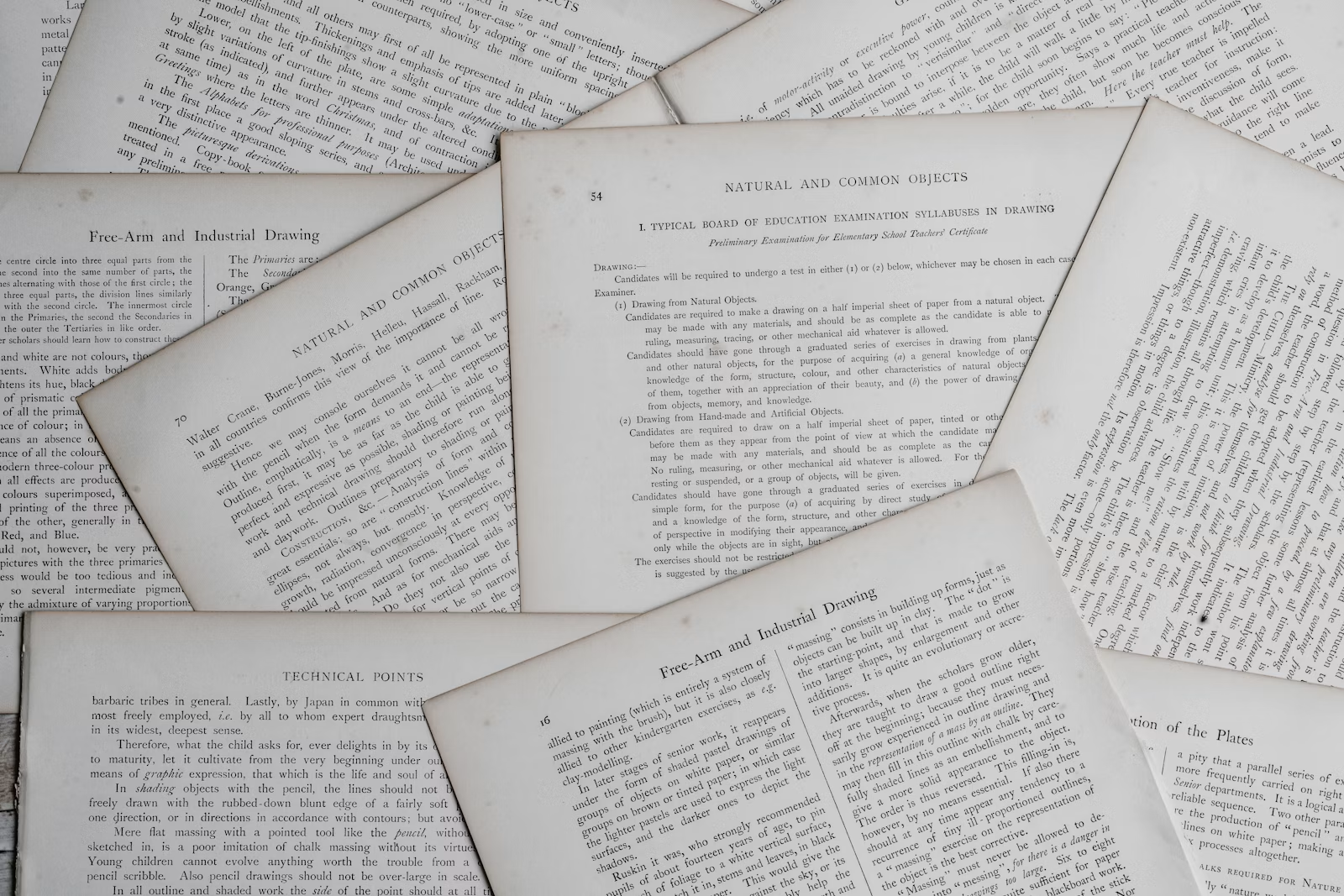
The claims were filed, assessed, and paid with meticulous bureaucratic care. The paperwork survives. That is how we know exactly who got what. Photo: Unsplash
The Check
And when emancipation finally came, Britain’s priorities became unmistakably clear — because that is when the money moved.
The government created a £20 million compensation fund. To feel the size of that number: it was an enormous share of the state’s annual spending, financed by one of the largest borrowings the Treasury had ever undertaken, worth billions in today’s money. Every penny of it was paid to slave owners, as compensation for the loss of what the law considered their “property.”
The formerly enslaved received nothing. No financial compensation. No land. No reparations. No formal apology from the state. The people who had spent their lives as the collateral in other men’s ledgers watched those ledgers get settled — in the other direction.
“The law’s final act was to compensate the owners for losing what it had been wrong to let them own.” — Emancipation, as recorded not in the speeches but in the accounts.
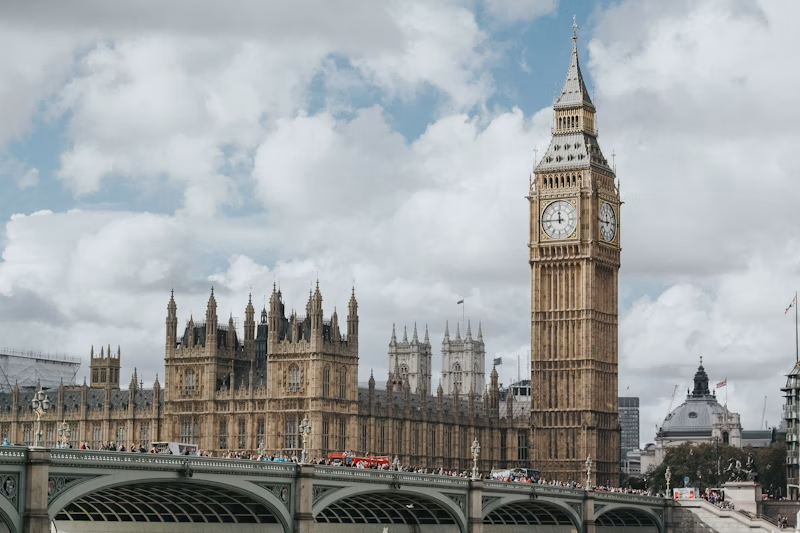
The Parliament that wrote the check. Photo: Unsplash
Paying Until 2015
The loan raised to finance the compensation was so large that it was folded into Britain’s long-term government debt — and there it sat, decade after decade, quietly collecting interest. The bonds that included it were not fully redeemed until 2015.
Think about what that means. Generations of British taxpayers — through Victoria’s reign, two world wars, the welfare state, the Beatles, Thatcher, the internet — helped service money borrowed to compensate slave owners. And among those taxpayers, in the later decades, were British citizens of Caribbean descent: people whose ancestors had been the “property” in question, now helping to repay the loan that had paid their ancestors’ enslavers. The descendants of the owners inherited the compensation. The descendants of the enslaved inherited part of the bill.

The islands that never saw the check. Photo: Unsplash
Credit Where It Is Due — and Where It Is Not
Let me be fair, because fair is the point.
Britain’s abolition of slavery was undeniably a historic achievement. The abolitionist movement was real and remarkable: decades of petitions, boycotts, pamphlets, and testimony — including the voices of formerly enslaved people like Olaudah Equiano, whose memoir put a human being where the ledgers had put a line item. Britain then used its navy to suppress the Atlantic trade it had once dominated. None of that should be waved away, and this post does not wave it away.
But the same honesty has to run in the other direction. Abolition was also shaped by political and economic interests, and its terms were dictated by them. When the moment came to put a number on the injustice, the number was calculated on the owners’ losses, not the victims’. The end of slavery did not bring justice to those who had suffered under it. The people who had profited most from the system were compensated; the people who had borne its cruelty were left to rebuild their lives from nothing — on the same islands, often in the same fields, frequently for the same families.
Both of these things are true at once. History rarely asks us to choose between them. It asks us to hold them together, which is harder.
The Ledger Survives
We know precisely where the £20 million went, because the compensation commission kept meticulous records — tens of thousands of claims, each naming the owner, the colony, the number of enslaved people, and the sum awarded. University College London’s Legacies of British Slavery project has turned those records into a searchable public database — and tracing the money forward leads into banks, insurance firms, railways, country houses, and family fortunes that still have names today. The original documents sit in The National Archives. This is not a hidden history. It is a filed one.
The Question Under the Question
Here is what stays with me. The compensation fund was not an oversight or a rounding error. It was the system describing itself with perfect accuracy, one last time. For three centuries, the law had treated human beings as property. At the very moment of repudiating that idea, the state honoured it in full — paying out on the property claim even as it abolished the property. The principle was cancelled; the invoice was settled.
Emancipation ended a crime. It did not repair one. Those are different acts, and the £20 million measures the distance between them — a distance that, as of the last payment in 2015, at least one party can say it has finished walking.
Back to the Chair
My client sat with it for a while. Then she said, “So when the podcast said ‘Britain paid off its slavery debt in 2015,’ I heard something completely different from what actually happened.”
“You heard the sentence,” I said. “The ledger says who was paid. That’s the part the sentence leaves out.”
I touched a related thread in a previous piece on the Indonesian statesman who answered a lecture on respectability with an inventory — Agus Salim, holding up a clove cigarette in The Hague and asking, politely, where its ingredients came from. Empires keep two sets of books: the speeches and the accounts. The speeches say civilization, progress, emancipation. The accounts say who was compensated, who was billed, and for how long. When the two disagree, believe the accounts.
In my shop, the cash drawer has to balance to the cent, and everyone gets paid — a rule so basic it feels absurd to write down. It took one of history’s largest empires until 1838 to accept the second half of that rule, and it never did apply it retroactively. The first half, to its credit, it managed by 2015.
The Salon California Journal is a space for ideas, culture, and conversation from my chair in Brasschaat, Belgium. I write about beauty, technology, society, and the intersections between them.