A Trillion Dollars
A Trillion Dollars: Let’s Spend It
A trillion dollars is almost unimaginable. So let’s make it very, very concrete. Eight of humanity’s worst crises. Eight known price tags. One number that covers them all — with a great deal left over.
A client put his phone face-down on his knee last week, the way people do when they have read something they cannot quite put back. “Another merger,” he said. “Pharmaceutical. Two hundred and something billion.”
“Business as usual,” I said.
“Where does that kind of money even go?” he asked. Not really asking me. Just asking the room.
“Well,” I said. “I’ve been thinking about a different number. A bigger one. Want to help me spend it?”
He looked up from the mirror. “How much bigger?”
“A trillion.”
[Switches to serious face.] A trillion dollars is an almost unimaginable amount of money. So let’s imagine it very carefully.
2,740 years it would take to spend $1 trillion at $1 million per day
318M people facing crisis-level hunger right now — today, not in a history book
8 major solvable crises that together cost less than one trillion dollars
$0 the amount the global malaria funding target has ever been fully met — in any year
The Scale of the Number
Imagine having $1 trillion. Even if you spent $1 million every single day, it would still take nearly 2,740 years to spend it all. Julius Caesar would have been your financial adviser. The Roman Empire would not yet have fallen. You would still have money in your pocket today.
So let’s spend it a little faster.
Right now, 318 million people are facing crisis-level hunger. The UN World Food Programme has estimated that ending extreme hunger would cost about $93 billion a year. Let’s fund it for one year. Running total: $93 billion spent. $907 billion remaining.
Providing clean water and basic sanitation for everyone on Earth is estimated to cost about $50 billion a year. Let’s fund that for three years. That’s $150 billion. Running total: $243 billion spent. $757 billion remaining.
Rebuilding Gaza has been estimated to cost around $70 billion. Let’s do that too. Running total: $313 billion spent. $687 billion remaining.
Every year, people in developing countries pay more than $500 billion out of pocket for healthcare, pushing around 100 million people into poverty. Let’s eliminate that burden for a year. Running total: $813 billion spent. $187 billion remaining.
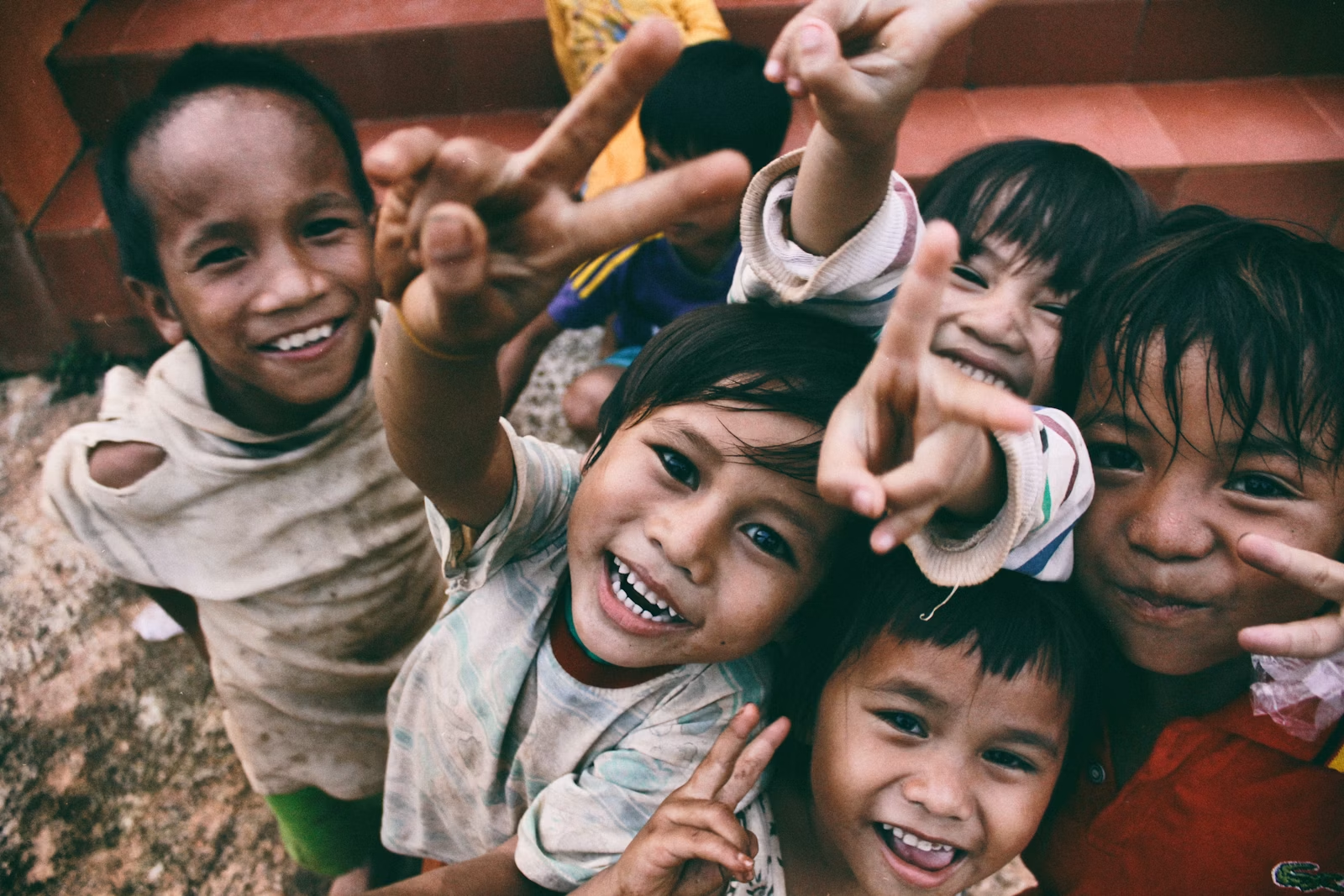
These are the faces at the front of the queue. The money that could reach them exists. Photo: Unsplash
More than 250 million children are currently out of school. Closing the global education financing gap would cost roughly $97 billion a year. Let’s fund it. UNICEF tracks this gap in real time. Running total: $910 billion spent. $90 billion remaining.
Malaria kills over 600,000 people every year, most of them children under five. The World Health Organization’s global malaria targets require about $9.3 billion annually. That target has never been fully met. Not once, in any year. It is now. Running total: $919 billion spent. $81 billion remaining.
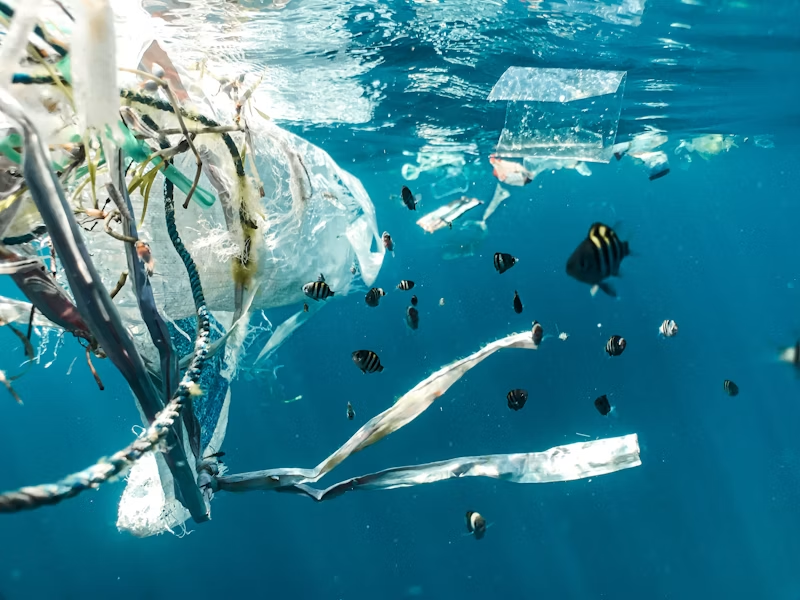
The Great Pacific Garbage Patch — a floating mass of plastic waste roughly twice the size of Texas — could be cleaned up for an estimated $7.5 billion. Consider it done. Running total: $927 billion spent. $73 billion remaining.
Tuberculosis remains the world’s deadliest infectious disease, killing more than 1.2 million people every year. Effective treatments have existed for decades. Controlling it globally is estimated to cost about $22 billion a year. The World Health Organization has been asking for it. Here it is. Running total: $949 billion spent.
“Eight problems. Eight problems that are, in principle, solvable. Eight problems that remain underfunded. And after all of that, there would still be tens of billions of dollars left.” — The sentence that ended the conversation in the chair for approximately thirty seconds.

What we are putting into the water. What billions still cannot reliably take out of it. $157.5 billion covers both. Photos: Unsplash
What Is Left
After all of that — feeding the hungry for a year, clean water for the entire planet for three years, rebuilding Gaza, eliminating healthcare debt across the developing world, getting 250 million children back into school, finally meeting the malaria target, cleaning the Pacific, controlling tuberculosis — after all of that, there would still be roughly fifty billion dollars remaining.
Fifty billion dollars. A number that, in any other conversation, would sound outrageous. Here, it is the change at the bottom of the pocket after the bill is paid.
At a spending rate of $1 million a day, you’d still need over a century to burn through what’s left. Or, if you prefer a more concrete image: at roughly half a million dollars per vehicle, you could buy approximately 100,000 Rolls-Royces. Humanity has always been creative when it comes to luxury.
Hunger ($93B) + Clean water, 3 years ($150B) + Gaza rebuild ($70B) + Healthcare burden, 1 year ($500B) + Education gap ($97B) + Malaria ($9.3B) + Great Pacific Garbage Patch ($7.5B) + Tuberculosis ($22B) = approximately $949 billion. These are estimates drawn from UN agency projections, NGO assessments, and established development financing targets. Some will be higher in practice; some lower. The point is not the precision of any single figure. The point is the order of magnitude. One trillion covers all of them. The money exists. The allocation does not.
The Real Question
The money to change the world exists. This is not a statement of optimism. It is an arithmetical observation. The global economy produces more than enough wealth to address every crisis listed above, simultaneously, in a single year. It has been doing so for decades. The crises persist not because the resources are absent but because the decisions that allocate them go elsewhere.
The real question is not whether we can afford to fix these things. We can. The real question is: who decides where the money goes?
That question has an answer, of course. It just tends to be answered quietly, in rooms with good catering, by people who have already solved their own food and water problems and are now focusing on the next merger.
Back to the Chair
My client left saying he was going to look up the World Food Programme when he got home. Whether he did, I cannot say. People mean it when they say things like that. Life then offers them several competing priorities before they reach the front door.
But something in the conversation settled differently from the usual news exchange. When the number is abstract — a trillion dollars, a billion people, 600,000 deaths — it is very easy to feel that the scale itself is the problem. That things are simply too big to fix. The useful thing about doing the maths out loud is that it removes that comfort. The scale is not the obstacle. The scale, in this case, is on our side.
I touched a related thread in a previous piece on who the tax system is actually built for — and what happens when you run the numbers instead of the rhetoric. The numbers, in both cases, are rude. They keep suggesting that the choices being made are choices, not inevitabilities. Math, that rude little tyrant, keeps showing up with the same conclusion: we are not poor. We are badly organised.
The bill has been on the table for a long time. It is not unpayable. We simply keep changing the subject before anyone has to pick it up.
The Salon California Journal is a space for ideas, culture, and conversation from my chair in Brasschaat, Belgium. I write about beauty, technology, society, and the intersections between them.