
Making Money
Nobody Taught Me Either
School teaches you how to work for money and almost never how money works. The complaint is fair. What is interesting is what has happened to it in the last four years.
“He’s finishing in June,” a client told me, about her son. “Thirteen years of school, and I don’t think anybody has once explained to him what a pension is.”
I said that sounded about right.
“Do you know what a pension is?”
I told her that I run a business, employ an accountant and have been paying into things for three decades, and that I had to learn all of it afterwards, in my thirties, from a mixture of expensive mistakes and patient professionals.
Nobody taught me either. That is really the whole point of this piece, so I may as well put it near the top.
17 → 30 US states requiring a standalone personal finance course to graduate, in just four years
76 randomised experiments in the study that settled whether teaching this actually works
3–5× how much larger the effects turned out to be than the previous consensus believed
1 afternoon, which is roughly how long the genuinely important part takes to teach
The Complaint
When children go to school, they learn a great many things.
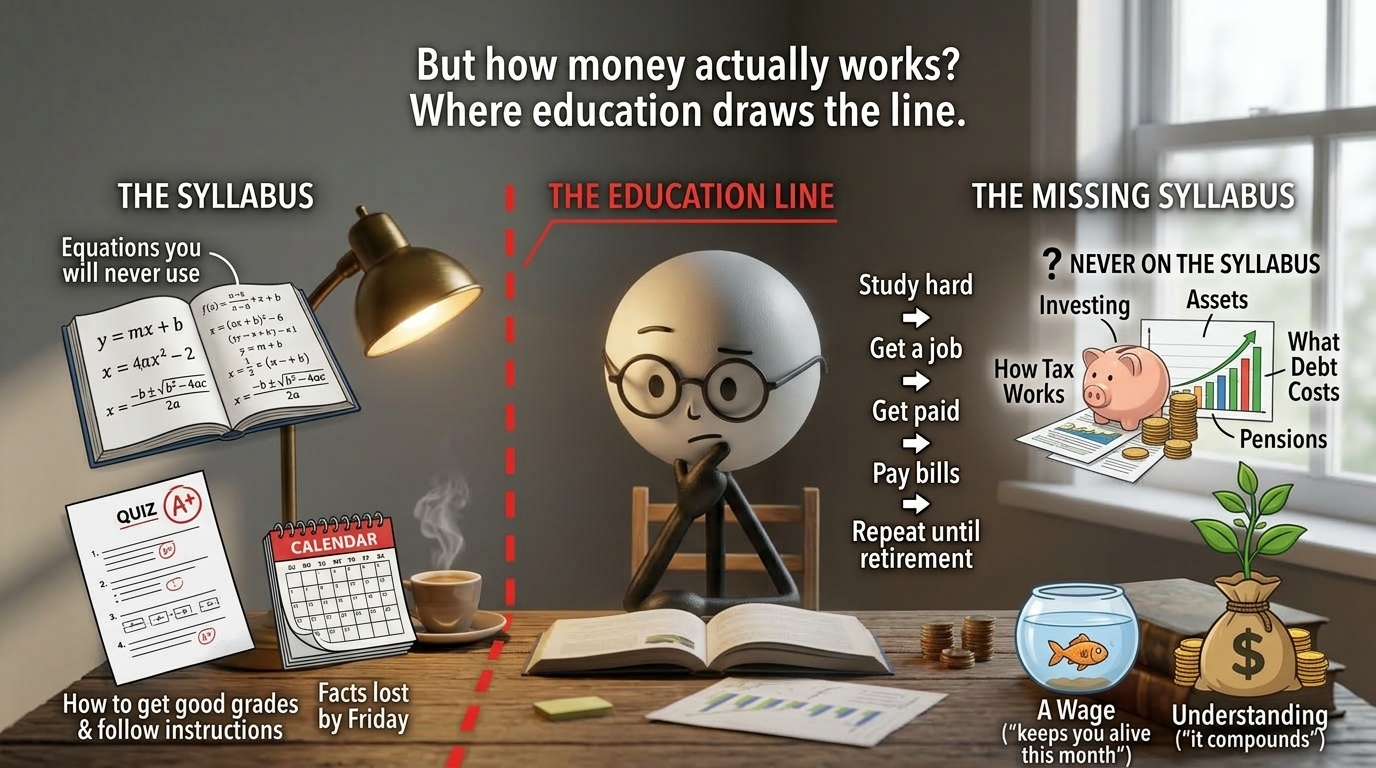
How to solve equations they will never use.
How to memorise facts they will have lost by Friday.
How to get good grades, follow instructions, and eventually qualify for a job.
But how money actually works? That is, apparently, where education draws the line.
We live in a capitalist world, and the implied strategy runs: study hard, get a job, get paid, pay bills, repeat until retirement. Investing, assets, how tax works, what debt costs, what a pension is actually doing with your money — somehow those never quite make it onto the syllabus.
There is an old saying. Give a man a fish and you feed him for a day. Teach a man to fish and you feed him for a lifetime.
It has lasted because the distinction is real.
Giving someone a paycheque helps them survive this month. Teaching them how money works — how to invest it, what an asset is, how to create value and generate income — hands them something they can use for years.
A wage is the fish. And unlike the fish, the second kind of knowledge compounds.
What Actually Changed
So here is the first thing I did not expect to find when I went looking.
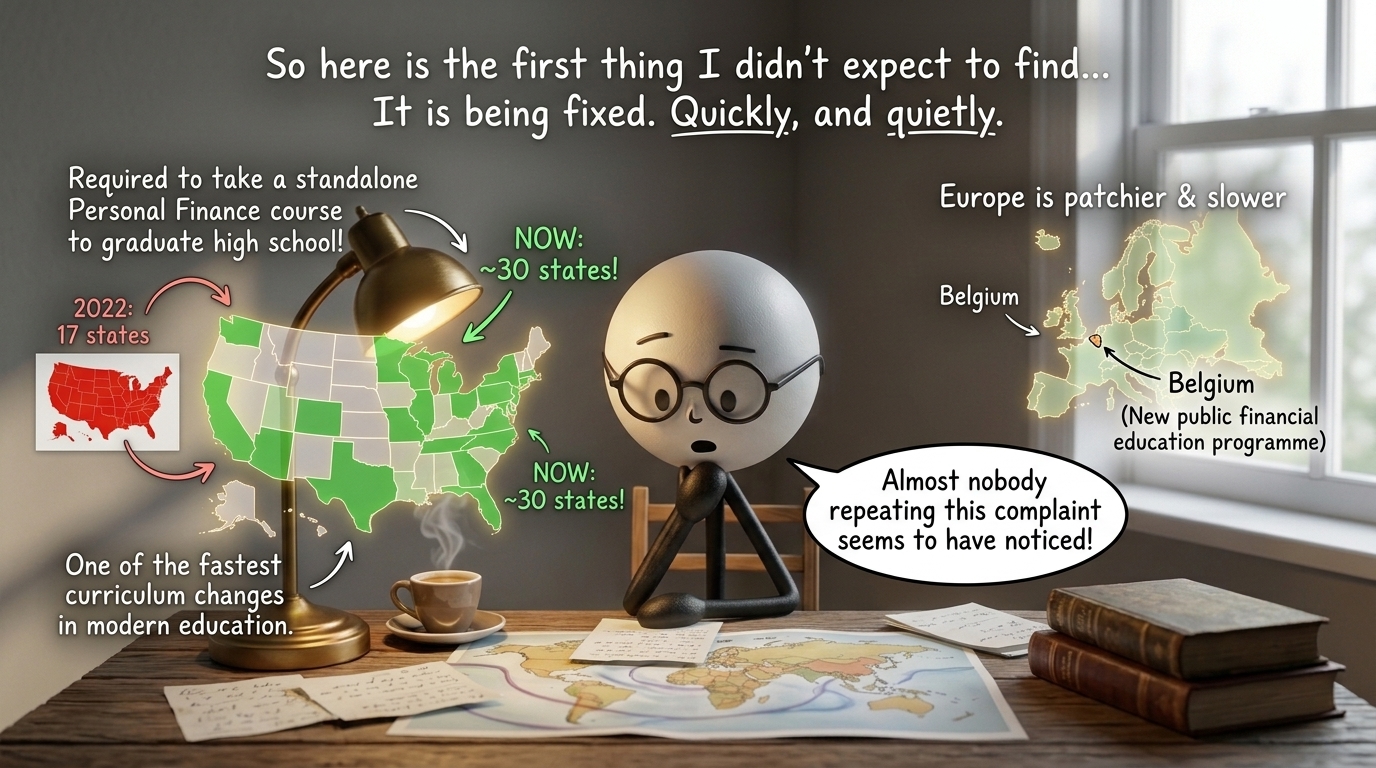
It is being fixed. Quickly, and quietly, and almost nobody repeating this complaint online seems to have noticed.
In the United States, the number of states requiring a standalone personal finance course to graduate from high school has gone from seventeen in 2022 to around thirty now, with more requiring it in some embedded form. That is one of the fastest curriculum changes in modern education, and it happened in the time it takes a child to get through middle school.
Europe is patchier and slower, and Belgium is no shining example, though the financial regulator here does now run a public education programme that did not exist when I arrived. The direction is the same.
Which does not make the complaint wrong. It makes it late, which is a nicer problem.
And the Research Reversed
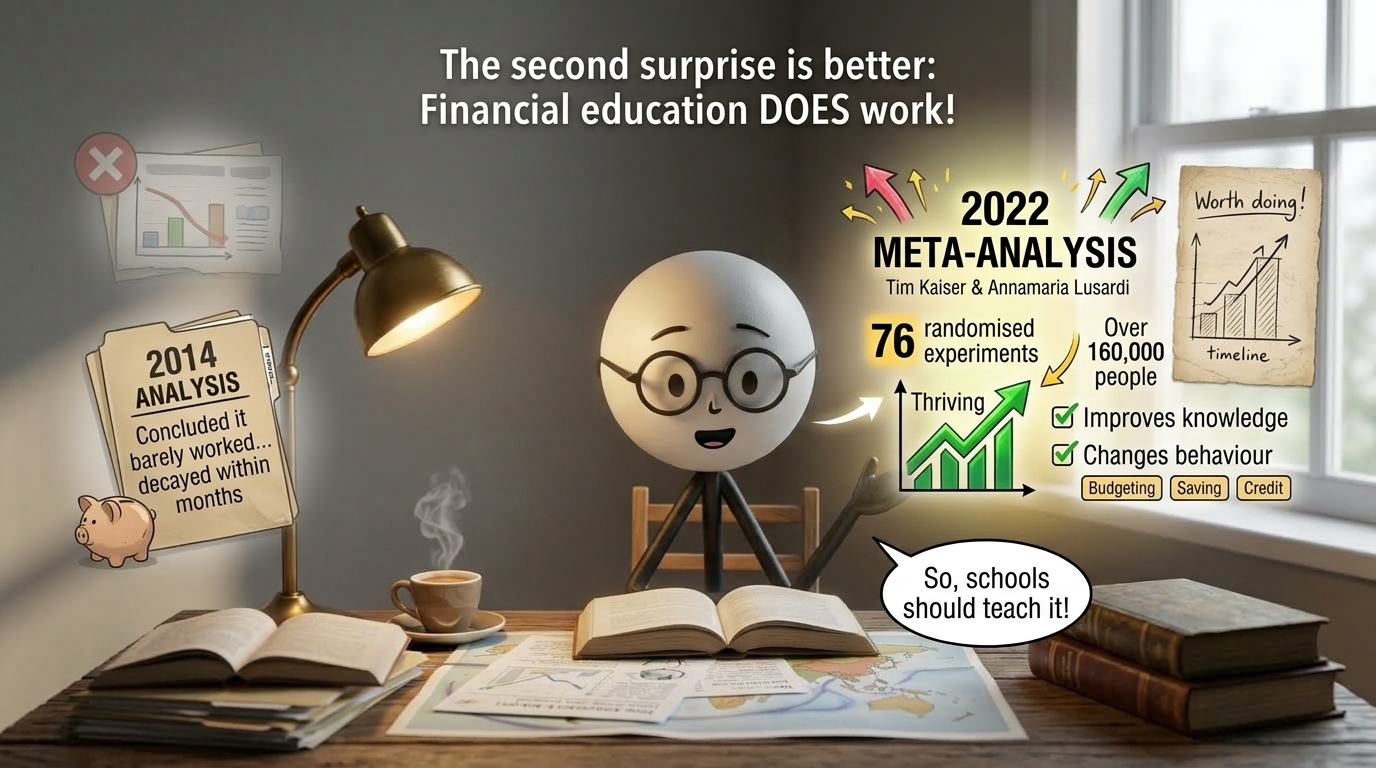
The second surprise is better, because for about a decade the evidence appeared to be on the other side.
An influential 2014 analysis concluded that financial education barely worked — that it explained a vanishingly small share of what people actually did with money, and that whatever it taught decayed within months. For years that finding was used, quite reasonably, to argue against adding it to crowded timetables.
Then in 2022 a team led by Tim Kaiser and Annamaria Lusardi did it properly: seventy-six randomised experiments, more than 160,000 people, restricted to studies that could actually establish cause. Financial education does work. It improves knowledge, and — the part that matters — it changes behaviour, particularly around budgeting, saving and credit. The effects came out three to five times larger than the earlier pessimistic consensus, and they survive correction for publication bias.
So the position is now roughly: teaching this is worth doing, we spent a decade being told otherwise, and the people saying schools should teach it have been right for longer than the evidence admitted.
“The easiest way to keep a prisoner from escaping is to make sure they never realise they’re in a prison.” — Although in this case the simpler explanation is that the timetable was full and nobody had been trained to teach it.
Two Things I’d Push Back On
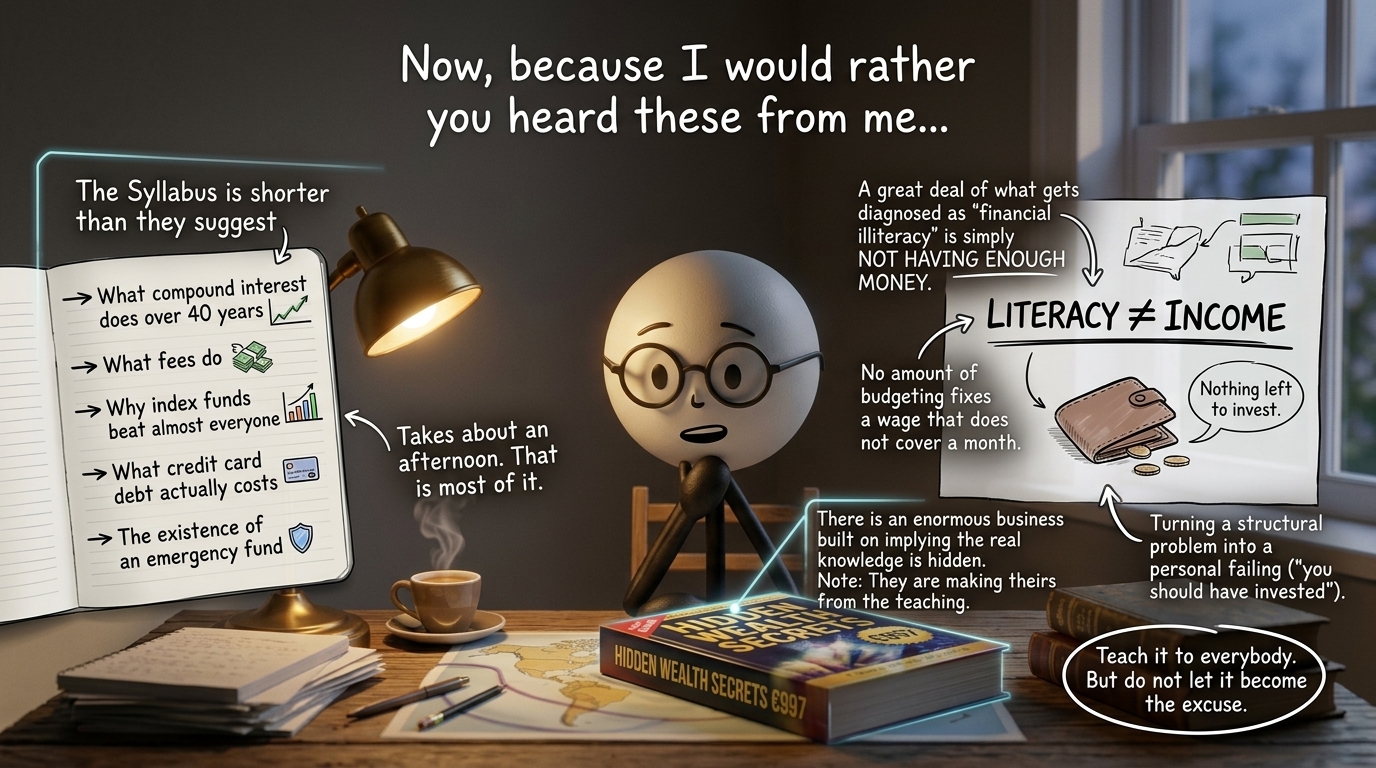
Now, because I would rather you heard these from me.
The syllabus is shorter than the industry suggests. The part that genuinely changes a life is dull and takes about an afternoon: what compound interest does over forty years, what fees do over the same period, why index funds beat almost everybody who charges you to beat them, what credit card debt actually costs, and the existence of an emergency fund. That is most of it. There is an enormous business built on implying that the real knowledge is hidden, advanced, and available for €997, and it is worth noticing that the people promising to teach you to make money are, without exception, making theirs from the teaching.
And literacy is not the same as income. This is the one I feel strongly about. A great deal of what gets diagnosed as financial illiteracy is simply not having enough money, and no amount of budgeting education fixes a wage that does not cover a month. Taught carelessly, this subject becomes a way of turning a structural problem into a personal failing — you should have invested — said to somebody who had nothing left to invest. Teach it to everybody. But do not let it become the excuse.
Back to the Chair
I have a particular interest in this, because my own trade is a perfect demonstration of the problem.
Hairdressing training is excellent at hairdressing. You learn cutting, colour, chemistry, anatomy, hygiene, and how to handle a person in a chair. What you are not taught, in any depth, is how to price. Or what your real hourly cost is once rent, products, insurance, taxes and the hours you are standing there with nobody in the chair are accounted for.
Which is why the salons that close are rarely the ones with bad hairdressers. They are full of good hairdressers who charged too little for too long, because nobody ever sat them down and showed them the arithmetic, and because undercharging feels like kindness right up to the moment it becomes insolvency.
I opened my first salon in 1991 with an engineering education, no business training whatsoever, and a confidence I now find touching. I learned the money the way most people in my trade do — afterwards, expensively, in public.
I’ve written before about what happens when education is optimised for throughput, and about what a classroom might look like once the machines properly arrive. This belongs with both. We have built a system that reliably produces people qualified to earn money and entirely unequipped to keep any of it.
So yes — teach it. Not because there is a secret, and not because a course will make anybody rich. Because the alternative is what happened to me, and to most people I know, and to the twenty-three-year-old with excellent hands who is about to sign a lease she has not costed.
The goal was never to learn how to catch today’s fish.
The Salon California Journal is a space for ideas, culture, and conversation from my chair in Brasschaat, Belgium. I write about beauty, technology, society, and the intersections between them.