Society
They Chose the Electric Shock
There are questions society is very good at answering, and one it cannot answer for you at all. The difficulty is that reaching it requires being alone with yourself, and we have built an entire industry to make sure that never happens.
“This is the only forty minutes all week when nobody can reach me,” a client said to me, settling into the chair with the particular sigh people make when they have stopped being available.
I said that was a slightly depressing recommendation for a haircut.
“No,” she said. “It’s the main one.”
And she is right, in a way I had never properly thought about. Once the cape goes on, your hands are underneath it. You cannot reach a pocket. You cannot check anything. For forty minutes you are looking at yourself in a mirror with nothing to do about it, and this has become, almost by accident, an unusual experience.
1654 the year Pascal diagnosed the whole problem in a single sentence
15 minutes participants were asked to sit alone with their own thoughts, and nothing else
67% of the men who chose to give themselves an electric shock rather than do it
40 minutes in my chair during which your hands are under a cape and the phone is unreachable
The Question Society Cannot Answer
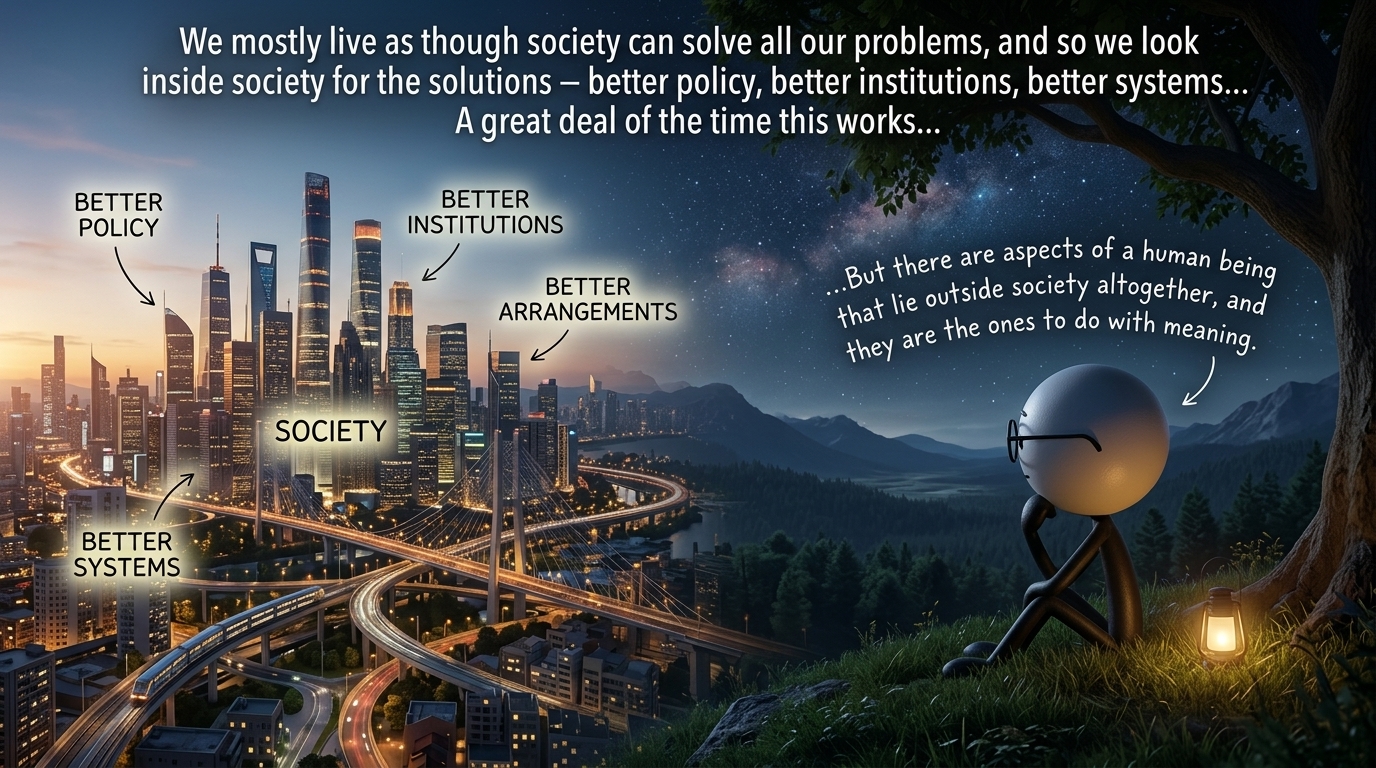
We mostly live as though society can solve all our problems, and so we look inside society for the solutions — better policy, better institutions, better systems, better arrangements between people. A great deal of the time this works, and I would not want to live in a century that had stopped trying.
But there are aspects of a human being that lie outside society altogether, and they are the ones to do with meaning.
Think of Robinson Crusoe, washed up on his island. Locked out of his civilisation, he encounters himself within the cosmos, and within his God. There is an essential self that sits outside the social arrangement, and its business is meaning — how you define it, for yourself, in the absence of anybody to agree with you.
Where there is a human being there is human spirit, and that aspect of a person needs defining in terms of meaning whether you conceive of it religiously, diagnostically, or atheistically. It does not go away because you decline to name it.
And it is a conversation every single individual has to arrive at alone. Nobody can have it on your behalf. There is no committee.
Except That Crusoe Rebuilt the Society
Here I want to complicate my own example, because the novel is more interesting than the image of it.
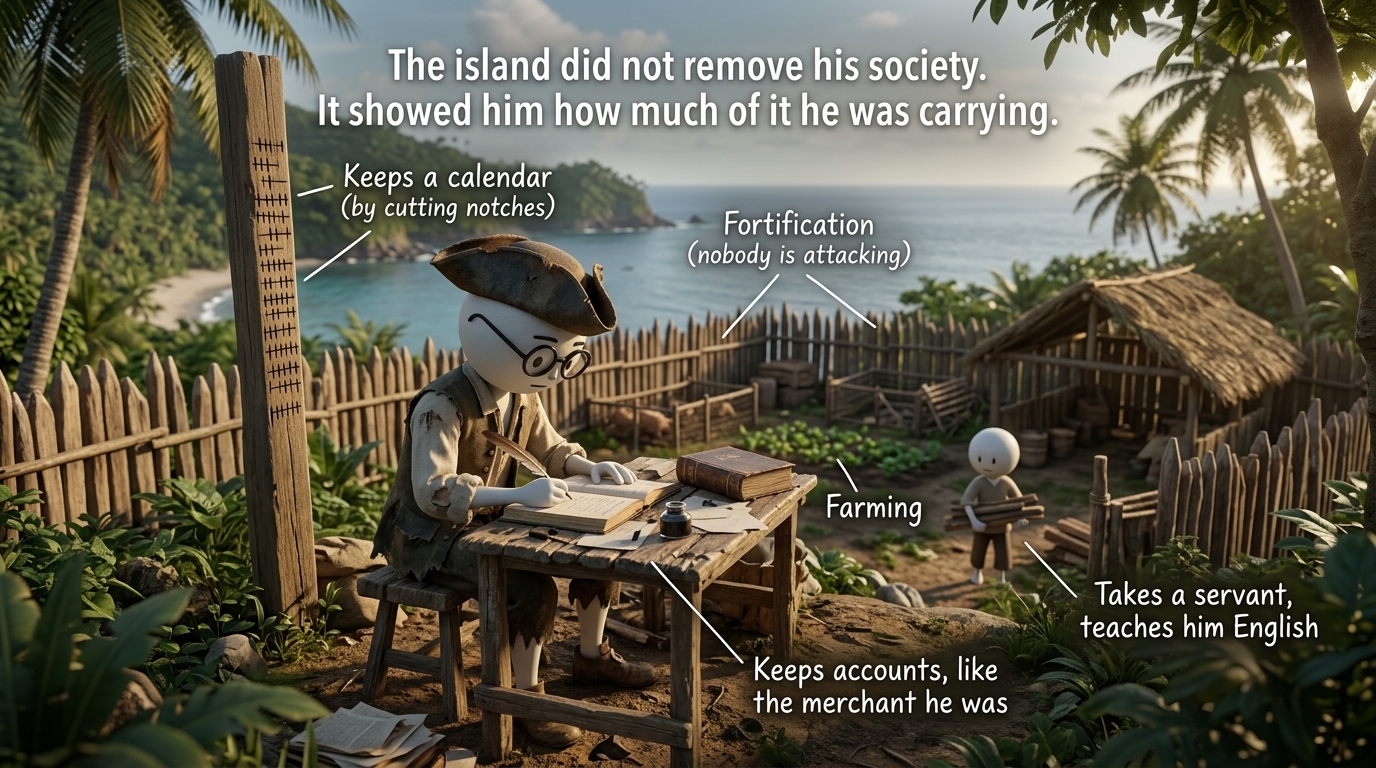
Crusoe does not strip society away on that island. He reconstructs it, immediately and compulsively. He keeps a calendar by cutting notches, which is to say he insists on a week. He builds a fortification nobody is attacking. He farms. He reads scripture. He keeps accounts, in the manner of the merchant he was. And when another human being finally arrives, Crusoe gives him an English name, teaches him English words, and makes him a servant.
He is alone for decades and remains, in every observable respect, a seventeenth-century Englishman.
Which does not demolish the point — it sharpens it. The island did not remove his society. It showed him how much of it he was carrying, and it gave him the silence in which to notice. That is the real function of the shore: not escape, but the removal of enough noise that you can finally hear what you brought with you.
Pascal Already Knew
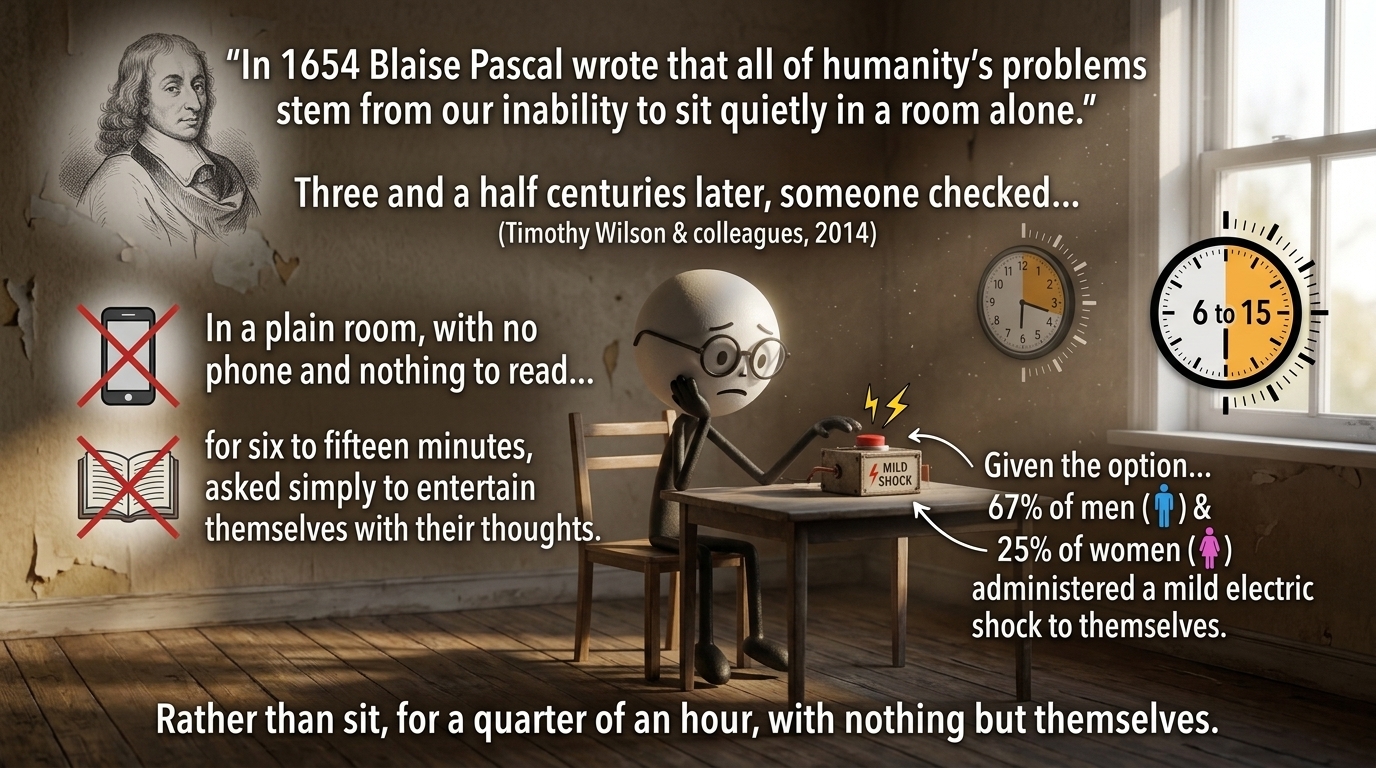
In 1654 Blaise Pascal wrote that all of humanity’s problems stem from our inability to sit quietly in a room alone.
Three and a half centuries later, somebody checked.
In 2014 Timothy Wilson and colleagues published eleven studies in Science in which participants were left in a plain room, with no phone and nothing to read, for between six and fifteen minutes, and asked simply to entertain themselves with their own thoughts. Most did not enjoy it. They enjoyed almost any mundane external activity more.
In one version, participants were given the option of administering a mild electric shock to themselves — a shock they had already tried, and which they had already said they would pay money to avoid experiencing again.
Sixty-seven percent of the men did it anyway. Twenty-five percent of the women. Rather than sit, for a quarter of an hour, with nothing but themselves.
I find that finding almost unbearably sad, and also completely believable, and I suspect you do too.
“When that signal is gone, you are not just alienated within the universe. You are alienated from yourself.” — And the cheapest way to lose a signal is to keep something louder playing over it.
The Noise Is Not an Accident
Which brings us to the part that is genuinely new.
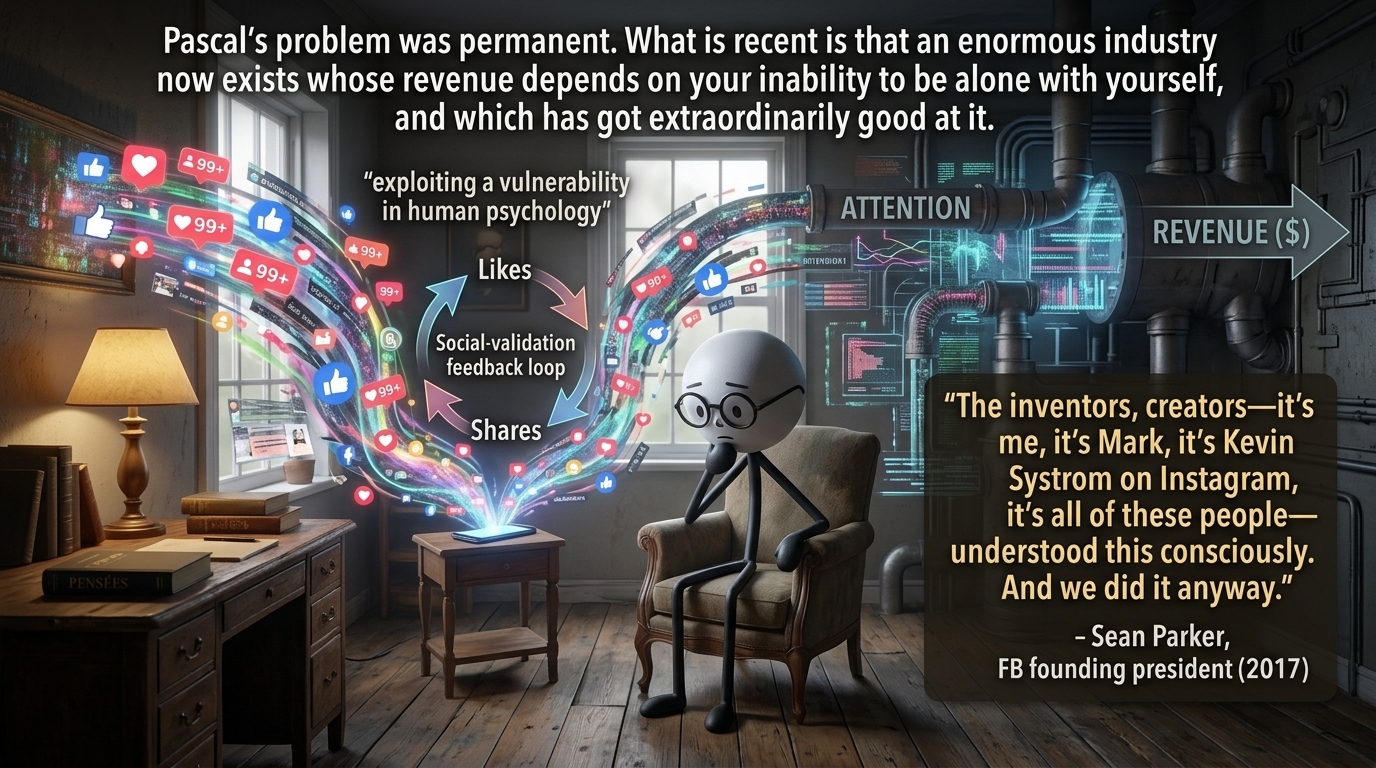
Pascal’s problem was permanent. What is recent is that an enormous industry now exists whose revenue depends on your inability to be alone with yourself, and which has got extraordinarily good at it.
You do not have to take my word for this. Sean Parker, Facebook’s founding president, said it in public in 2017: the company was built around “exploiting a vulnerability in human psychology,” a social-validation feedback loop. And then the line that should be carved over the door of the industry: “The inventors, creators — it’s me, it’s Mark, it’s Kevin Systrom on Instagram, it’s all of these people — understood this consciously. And we did it anyway.”
One correction, though, because the usual telling flatters everybody involved. This was not built by the smartest neuroscientists who ever lived. Very little neuroscience was required. What was required was A/B testing — millions of small experiments run continuously on live human beings, keeping whatever kept people scrolling and discarding whatever didn’t.
Nobody had to understand the mind. They only had to measure it, relentlessly, at a scale no laboratory could afford. Which I would argue is worse, because genius can be reasoned with and a feedback loop cannot.
One Caveat, Because It Matters
The shock study is the most quoted finding in this whole area and it is slightly over-told, including by me, four paragraphs ago.
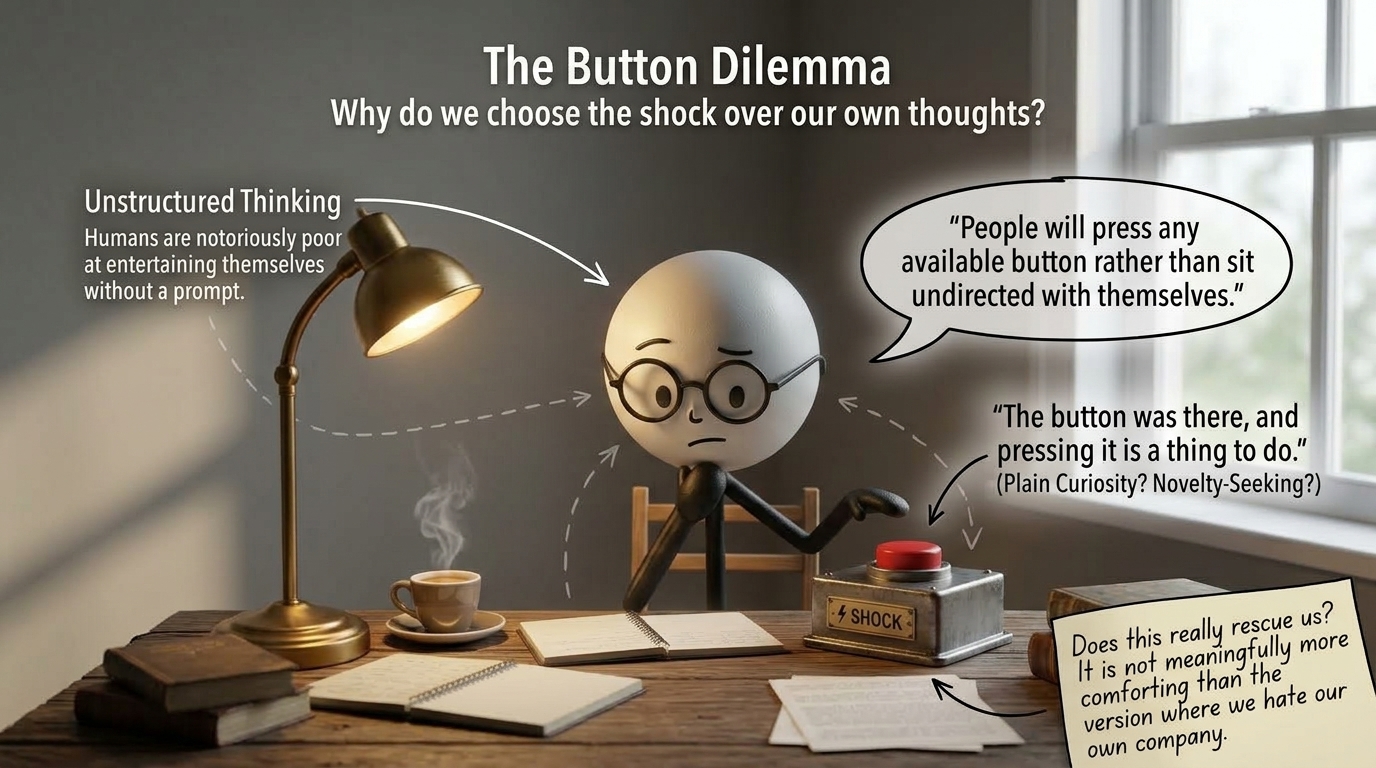
Researchers have since argued that choosing the shock may say less about the horror of one’s own thoughts than about plain curiosity — people are novelty-seeking creatures, the button was there, and pressing a button is a thing to do. Thinking may not be aversive so much as unstructured, and humans are notoriously poor at entertaining themselves without a prompt.
That is a real objection and I pass it on. But notice that it does not rescue us. “People will press any available button rather than sit undirected with themselves” is not meaningfully more comforting than the version where they hate their own company.
Back to the Chair
I’ve written before about what our devices are doing to the way we relate to each other. This is the other half of it, and the quieter half. The damage people notice is to their relationships. The damage they tend not to notice is to the relationship they have with themselves, because there is nobody on the other side of it to complain.
I am not going to recommend a retreat, or a digital detox, or a weekend in silence. Those are fine and I have never been on one, and I am suspicious of advice I have not taken.
What I have instead is the cape.
Forty minutes, roughly every six weeks, in which a person’s hands are occupied, their phone is out of reach, and there is a mirror directly in front of them. Nobody designed it as a contemplative practice. It is a practical consequence of needing both hands free to cut somebody’s hair.
But I have come to notice what happens in those forty minutes. People start talking, and after about ten minutes they stop performing, and somewhere after that a reasonable number of them say something they did not know they were going to say — often about something that has nothing to do with hair, and occasionally in a slightly surprised voice, as though somebody else had said it.
That is the signal. It was always there. It simply cannot be heard over anything.
And when it goes — when there is never a gap long enough for it to surface — you are not merely alienated within the universe.
You are alienated from yourself, which is a considerably longer journey home.
The Salon California Journal is a space for ideas, culture, and conversation from my chair in Brasschaat, Belgium. I write about beauty, technology, society, and the intersections between them.