
What the Algorithm Never Figured Out
Social media replaced the dinner table question. AI replaced the village elder. Neither came with a warranty for the things that actually break.
A client sat in my chair last week — a woman in her early forties, the kind of person who speaks in complete sentences and has opinions about olive oil. Between the toner and the rinse, she mentioned, almost as an aside, that she had not had a real conversation with her teenage son in six weeks. Not an argument. Not a disagreement. Just silence. He was in the same house, eating the same food. But he had moved, quietly and entirely, to somewhere she could not follow.
“He lives in his phone,” she said. “I don’t know who he’s talking to. I don’t know what he’s laughing at. I don’t even know who he is anymore.”
[Switches to serious face.] That is not a technology story. That is an attachment story. Technology is just the specific shape that particular problem is taking in 2026. And to understand why the shape matters, you have to start somewhere older.
5B+social media users worldwide in 2024
6+ hrsaverage adult daily screen time globally
47%of US teens say social media harms mental health
$600B+annual global digital advertising revenue
The Arrangement That Worked for Thousands of Years
For most of human history, the relationship between parents and children followed a simple pattern.
Children learned from their parents. They borrowed skills, values, confidence, and occasionally a healthy fear of making bad decisions. Then they would charge into the world convinced they knew everything. Reality would quickly prove otherwise. Bruised by experience, they would return home seeking comfort, advice, or sometimes just a meal and a sympathetic ear.
Then the process would repeat.
Failure. Reflection. Growth.
Over time, enough lessons accumulated to produce something rare and expensive called wisdom. The arrangement worked reasonably well for thousands of years. Every generation was, in a sense, an apprentice to the one before it — learning through proximity, through watching, through the ordinary friction of living alongside people who had already made most of the available mistakes.
Then technology arrived with a better offer.
“Parents stopped asking, ‘How was your day?’ Algorithms started asking, ‘Would you like another video?’ The algorithms won.” — This is not a criticism of algorithms. They were very good at their job.
The Most Successful Marketing Campaign in History
Social media’s original promise sounded genuinely noble. Connect people. Share ideas. Bring the world closer together. What it actually achieved was the remarkable feat of allowing an entire family to sit at the same dinner table while simultaneously existing on different planets.
People became busy constructing digital versions of themselves. These online personas were polished, filtered, inspirational, adventurous, and remarkably different from the individual sitting alone in sweatpants at two in the morning wondering why they felt unhappy. The gap between the curated self and the actual self has always existed. Social media just gave it a publish button and an audience of several hundred.
The business model was elegant in its simplicity. The platforms were free. The users were not.
Technology companies invited billions of people into their digital homes, observed every click, preference, insecurity, and desire, then packaged that information and sold access to advertisers. Humanity spent centuries protecting privacy as if it were a crown jewel, then voluntarily published breakfast, vacation photos, relationship status updates, and political opinions for strangers across six continents. According to Pew Research, nearly half of American teenagers now say social media has a mostly negative effect on their emotional wellbeing — and the majority of them continue using it anyway. History may eventually record this as the greatest marketing campaign ever conducted.
Then came advertisements. Then subscriptions. Then influencers. Because apparently it was no longer sufficient to compare yourself to your neighbors. Now you could compare yourself to carefully edited strangers from six continents at the same time.
The Attention Economy, Explained SimplyWhen a product is free, the product is you. The Center for Humane Technology has documented how platforms are engineered not to connect people but to capture attention — using the same psychological levers as slot machines. Outrage keeps people scrolling longer than joy. Comparison keeps people returning more reliably than satisfaction. The goal was never a healthier world. It was a longer session.
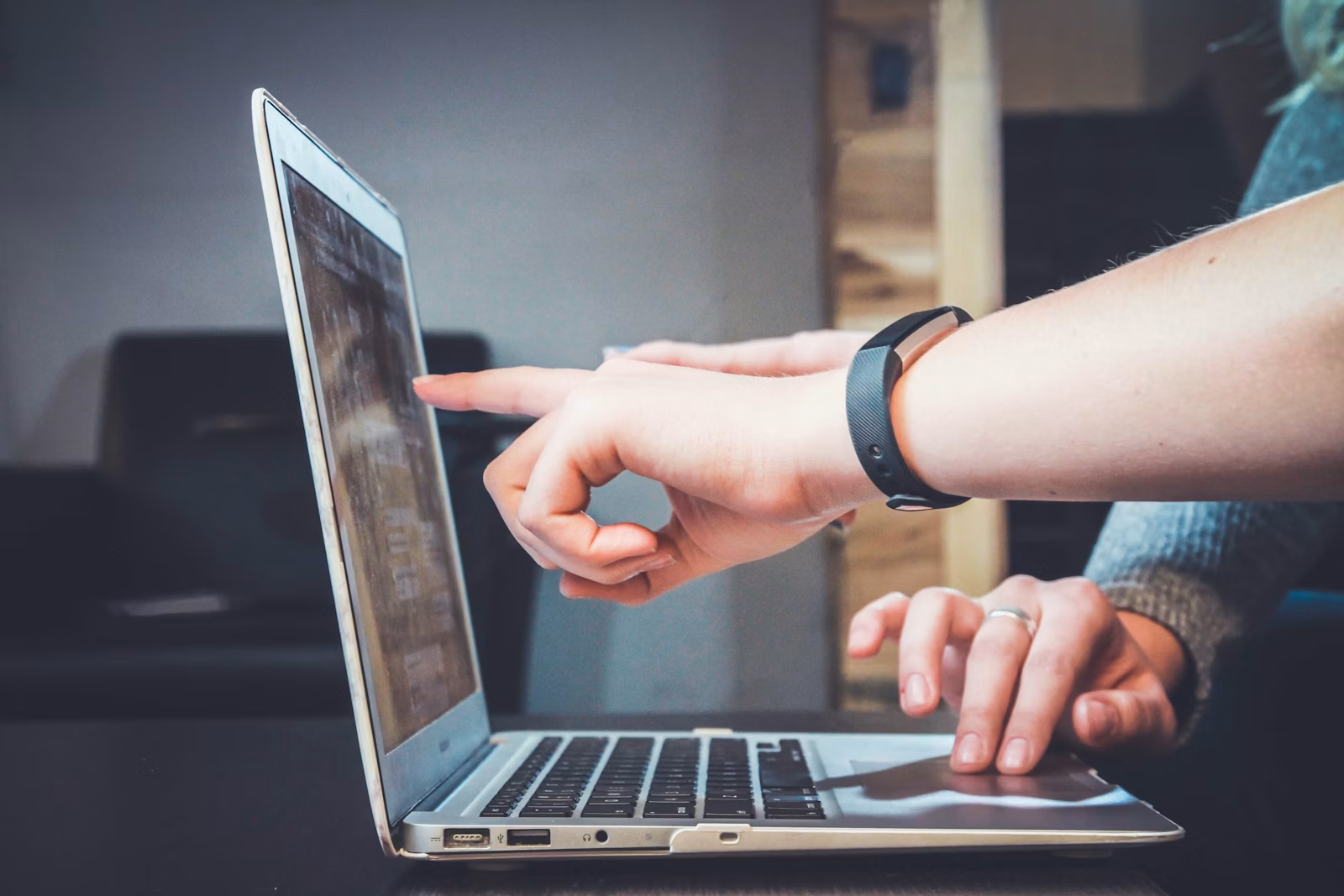
The device offers answers to every question except the ones that actually matter. Photo: Unsplash
The Village Elder in a Glowing Rectangle
And now arrives artificial intelligence. A curious development.
For generations, people turned to parents, grandparents, teachers, mentors, or trusted friends when they had questions. Today many turn to AI. Need advice? Ask AI. Need information? Ask AI. Need help writing a birthday card to your mother? Ask AI. At this rate, some people may eventually ask AI what they should ask AI.
The irony is difficult to ignore. The same species that spent millennia accumulating knowledge through trial, error, sacrifice, and discovery has now built machines capable of presenting that knowledge back to us in seconds. The village elder has been replaced by a glowing rectangle that never sleeps, never forgets, and never asks you to take out the trash.
Naturally, companies charge subscriptions for this privilege. This is not entirely unreasonable — building advanced technology costs money. Yet there is something quietly amusing about watching humanity collectively contribute centuries of knowledge, train the systems through constant interaction, and then receive a monthly invoice to access the results. A business model worthy of admiration, envy, or suspicion, depending on your perspective and the size of your inbox.
Despite All This, I Remain Optimistic
So where are we heading? Despite all of this, I remain optimistic. And I say that as someone who did not grow up with any of it — which may be why it reads, from the outside, as a stranger set of choices than it appears from within.
Human beings have survived every technological revolution so far. We survived printing presses that would supposedly ruin memory, novels that would corrupt youth, radio that would destroy conversation, television that would rot minds, and the internet that would somehow do all of the above simultaneously.
Each invention changed us. None replaced us.
The danger is not artificial intelligence. The danger is intellectual laziness. Every powerful tool tempts us to stop thinking for ourselves. A calculator can weaken arithmetic. GPS can weaken navigation. AI can weaken judgment if we allow it to do our thinking instead of assisting it. The American Psychological Association has documented the link between passive social media consumption and reduced wellbeing — it is not the technology itself that harms, but the posture we adopt toward it. Passive versus active. Consumer versus creator. Receiver versus participant.
The good news is that human beings are far more stubborn than any algorithm. Sooner or later, people recognize when convenience has become dependency. They adapt. They recalibrate. They learn. They always have.

What a Salon Chair Knows About This
The relationship between parents and children will not disappear. Neither will friendship, mentorship, or the particular quality of human attention that arrives when someone who loves you sits down and really listens. These things survived every previous invention because they provide something technology cannot deliver, regardless of how many parameters the model was trained on.
I see this in the chair. The client I mentioned at the beginning — she did not need information about her son. She had plenty of that. She needed someone to sit with the difficulty of it. To acknowledge that the silence in the same house was a specific kind of loss. That the distance was real even though the distance was three metres and a screen.
That is what we explored in a different register in our post on the distance between an expat and an immigrant — how proximity and belonging are not the same thing. You can be in the same room and be unreachable. You can be thousands of miles from home and feel completely seen. Technology tends to optimize for proximity. Human connection requires belonging.
The machine can answer a question. It cannot sit beside you after your heart has been broken. It cannot carry the particular weight of a shared family memory. It cannot love you.
At least not yet — and if that day ever arrives, humanity will undoubtedly find a way to charge a subscription for it.
The Salon California Journal is a space for ideas, culture, and conversation from my chair in Brasschaat, Belgium. I write about beauty, technology, society, and the intersections between them.
Leave a Reply