Happy 250th, America
Happy 250th, America: Let’s Roll the Tape
America just turned 250. Big birthday. Big fireworks. Before we light the candles and congratulate ourselves — let’s roll the tape.
A client noticed the small California flag I keep behind the chair. She’s asked about it before, but this week was different. “You must be watching all the 250th celebrations,” she said. “What do you make of it? From here?”
“From here,” I said, “you get a better view.”
She looked at me in the mirror. “Of what?”
“Of the whole thing. The part they show on television, and the part they tend to leave out.”
[Switches to serious face.] America just turned 250. Big birthday. Big fireworks. Before we light the candles and congratulate ourselves, let’s roll the tape.
250 years since the Declaration of Independence and the arguments it started
600,000+ Americans who died in the Civil War, eighty years after the founding
120,000 Japanese Americans sent to internment camps not for what they did, but for who they were
1969 the year humanity walked on the Moon, while still struggling to live together on this planet
1776. July 4. The Declaration of Independence proclaims that all men are created equal. At the same time, slavery remains legal and profitable across the colonies. Equality, apparently, arrived with terms and conditions.
1838. The Trail of Tears forces thousands of Native Americans from their land in a deadly march west.
1861. The Civil War begins. The central issue: slavery. The nation goes to war over the question of who counts as free.
1865. The war ends after more than 600,000 deaths. Days later, President Abraham Lincoln, the man who preserved the Union and ended slavery, is assassinated.
1877. A political compromise ends Reconstruction and clears the way for nearly a century of Jim Crow segregation. Progress takes one step forward, then politely holds the door open for the past.
1920. Women win the right to vote. White women, that is. Many Black women in the South still face barriers that keep them from the ballot box for decades.
1921. A white mob destroys the thriving Black community of Tulsa, Oklahoma, known as Black Wall Street. Hundreds are killed, and an entire neighbourhood is erased.
1929. The stock market crashes. Millions lose their jobs, their savings, and their homes. Wall Street sneezes, the country catches pneumonia.
1941. Japan attacks Pearl Harbor. America enters the Second World War.
1942. Over 120,000 Japanese Americans are sent to internment camps — not for what they did, but for who they were.
1945. The United States drops atomic bombs on Hiroshima and Nagasaki. More than 200,000 people die, most of them civilians. Victory arrives carrying an unbearable price.
1955. Fourteen-year-old Emmett Till is brutally murdered in Mississippi. His death shocks the nation and fuels the Civil Rights Movement.
1963. Four African American girls are killed when white supremacists bomb the 16th Street Baptist Church in Alabama. Months later, President John F. Kennedy is assassinated in Dallas.
1964. The Civil Rights Act outlaws segregation, at least on paper. Changing laws proves easier than changing minds.
1965. Peaceful marchers demanding voting rights are beaten by police in Selma on what becomes known as Bloody Sunday. Months later, the Voting Rights Act becomes law.
1968. Martin Luther King Jr. is assassinated while fighting for equality. Two months later, Robert F. Kennedy is assassinated as well.
1969. Neil Armstrong and Buzz Aldrin become the first humans to walk on the Moon. Humanity reaches another world while still struggling to live together on this one.

Another world reached in 1969. This one still a work in progress. Photo: Unsplash / NASA
1974. President Richard Nixon resigns rather than face impeachment over the Watergate scandal. Even the cover-up needed a cover-up.
2001. September 11. Nearly 3,000 people are killed in terrorist attacks. Two decades of war follow.
2003. The United States invades Iraq over weapons of mass destruction that are never found.
2008. The housing market collapses, wiping out millions of jobs and homes. In the same year, America elects its first Black president, Barack Obama. One chapter closes in foreclosure, another opens in hope.
2020. George Floyd is murdered by police. Millions fill the streets demanding justice.
2021. A mob storms the Capitol in an attempt to overturn a presidential election they lost. The peaceful transfer of power suddenly requires a reminder.
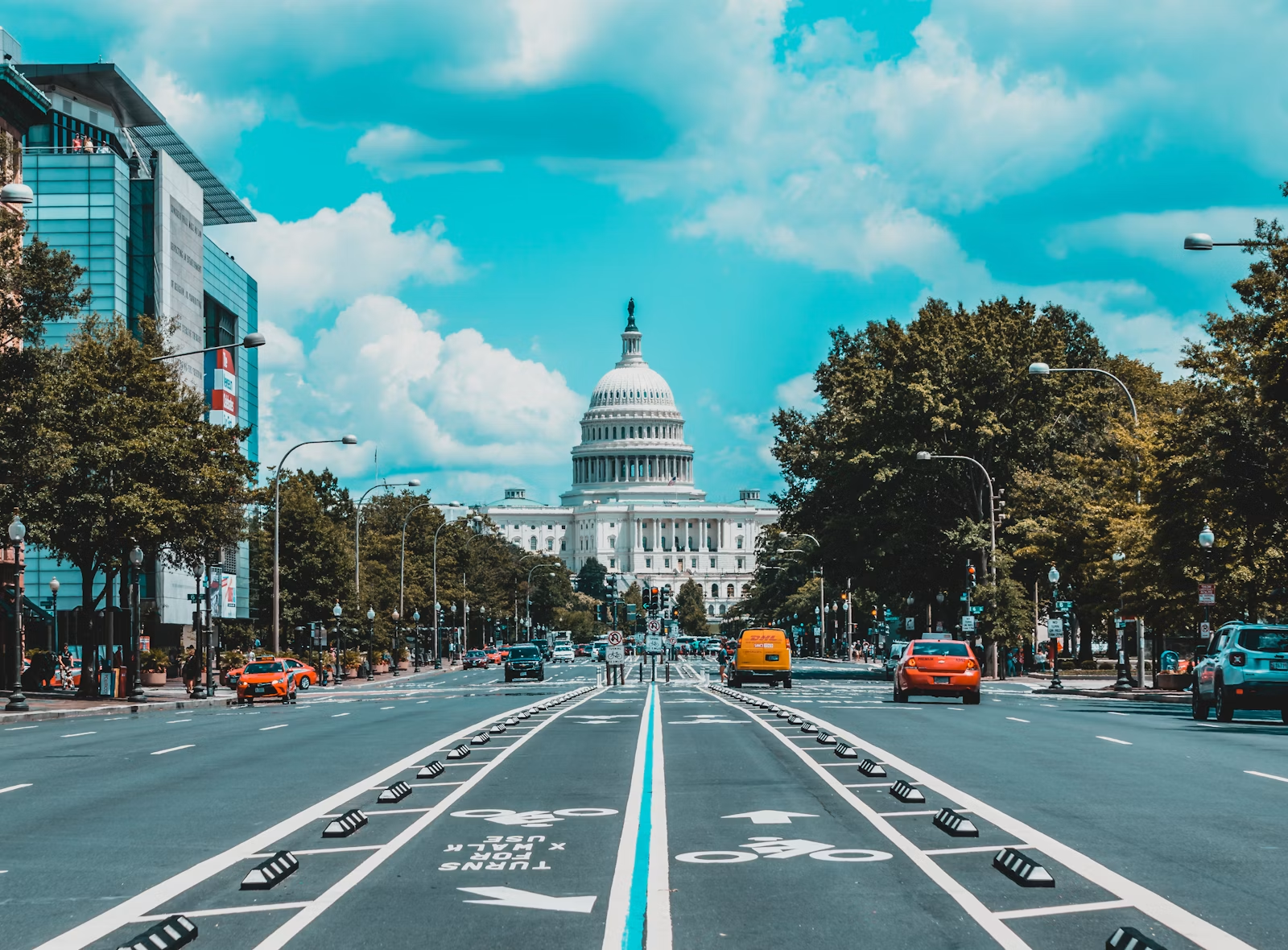
The building at the end of the avenue. Still standing. Photo: Unsplash
Today. Mass deportations dominate the headlines. Rights continue to be contested and rolled back. The arguments have changed. The divisions remain remarkably familiar.
“Two hundred and fifty years. Genuine progress. Extraordinary achievements. Spectacular failures. A nation that has spent a quarter of a millennium arguing with itself, often at full volume.” — And somehow still going. Happy Birthday, America.
Two hundred and fifty years. Genuine progress. Extraordinary achievements. Spectacular failures. A nation that has spent a quarter of a millennium arguing with itself, often at full volume.
That is not an insult. For a country built on a document that promised everything and delivered it slowly, partially, painfully, and never quite completely — the arguing is the point. The Library of Congress holds the archive of every generation that tried to close the gap between what was promised and what was delivered. They did not always succeed. They did not stop trying.
Happy Birthday, America.
Back to the Chair
My client left quiet — which, in my experience, is not the same as leaving sad. I’ve cut hair in California long enough to know that Americans absorb hard things differently than they get credit for. They argue loudly, mourn publicly, and then, usually, get back up. It’s annoying and admirable in roughly equal measure.
Watching from Belgium, from a distance I chose freely, I think what surprises Europeans most about America is not the darkness in the tape — history is dark everywhere — but the insistence on narrating it out loud. The commission reports, the public trials, the documentaries, the memorials. Other countries bury theirs more quietly. America tends to put a plaque on it.
That is not nothing. That is, in fact, quite a lot.
Two hundred and fifty years. Still arguing. Still going.
The Salon California Journal is a space for ideas, culture, and conversation from my chair in Brasschaat, Belgium. I write about beauty, technology, society, and the intersections between them.