
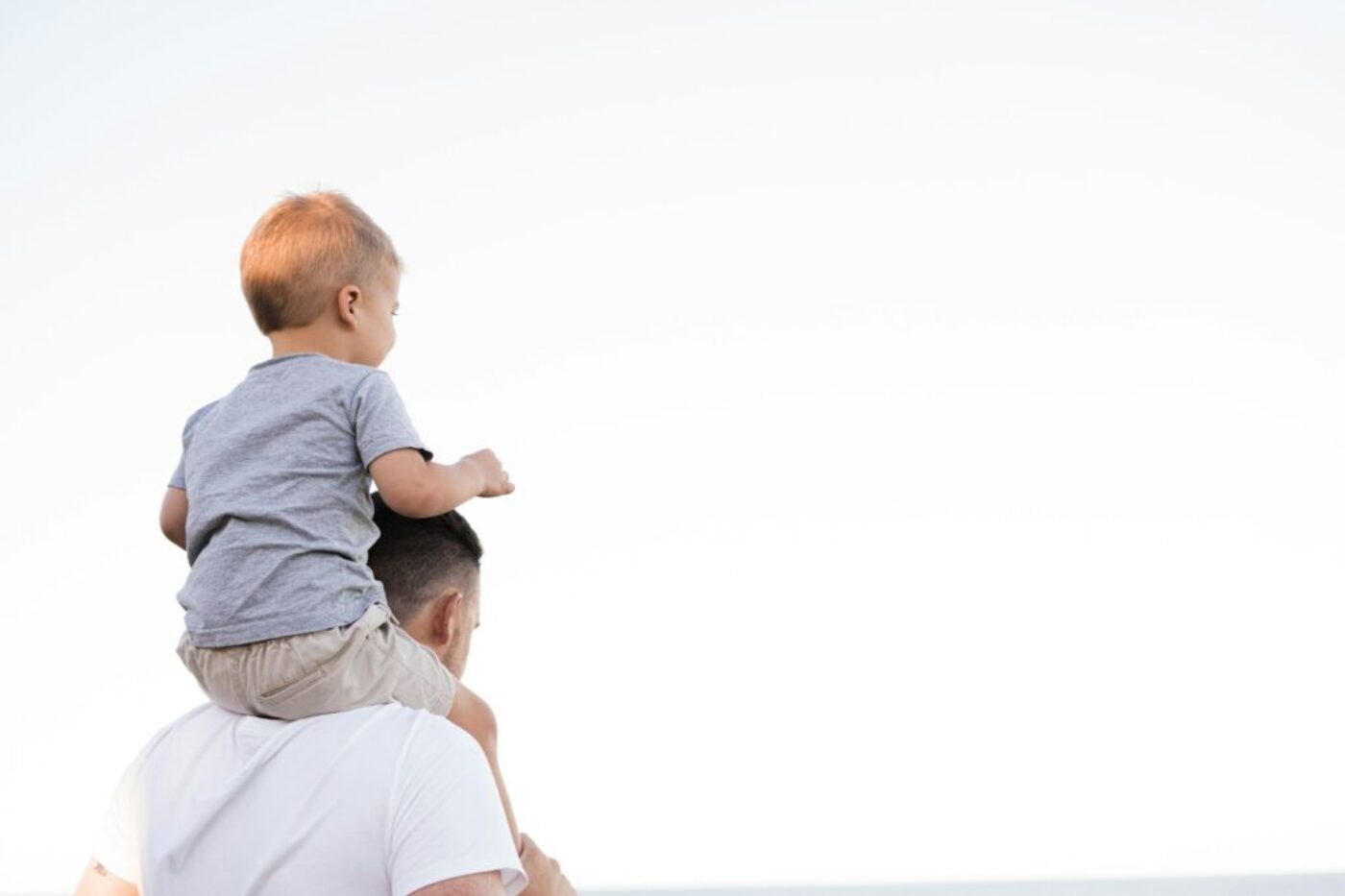
Fathers?
A Conversation That Started With a Nervous Dad in My Chair
A father brought his son in for his first proper haircut and got every part of it right. I couldn’t stop thinking about how rarely that man shows up on screen.
A father came in last week with his son, who looked to be about five and deeply suspicious of the entire enterprise. The father had clearly thought this through. He had brought a small toy car as a bargaining chip, negotiated the seat height like a diplomat, and crouched down to the boy’s eye level to explain — calmly, patiently, twice — exactly what was about to happen and why it would not hurt.
“You did this before?” I asked, mostly making conversation.
“No,” he said. “First time. I looked up how to do it properly last night.”
The boy sat through the whole thing without a single tear, mostly because his father stayed crouched beside the chair the entire time, narrating the scissors like a sports commentator covering a very low-stakes match. When it was over, the boy checked his reflection, nodded with the gravity of a man approving blueprints, and the father looked, for a moment, prouder than the haircut alone could explain.
I thought about that man for the rest of the day. Specifically, I thought about how rarely I have seen him anywhere except in my own chair.
[Switches to serious face.] Turn on a sitcom — almost any sitcom, from almost any decade of the last thirty years — and you will likely meet a different father entirely. He forgets the school play. He microwaves something that was never meant to be microwaved. He requires reminders to perform tasks a reasonably attentive teenager would manage unprompted. The mother rolls her eyes. The children exchange a knowing look. The audience laughs, because the joke has been told so often that everyone already knows the punchline before the scene starts.
Someone will say it’s just a sitcom. Just a cartoon. Just television. Perhaps. But children absorb stories long before they learn to analyse them, and lately, the story has been remarkably consistent.
2x more likely a TV mother is shown as competent versus the father
7 hrs. average daily screen exposure for children and teens
2-3x more household & emotional “mental load” reported by mothers versus fathers
1 in 3 fathers say media rarely portrays them accurately

The Father Who Used to Be in the Room
Older stories did not pretend fathers were perfect. They could be stubborn, strict, occasionally wrong about nearly everything that mattered. But they were rarely irrelevant. They were protectors, however imperfect. They carried weight, however clumsily. When trouble arrived at the door, someone looked to them, and they were expected to have something to offer — even if what they offered was simply showing up.
That version of the father has not vanished from real life. I meet him regularly, in my chair, in exactly the kind of unremarkable, undocumented moment that never makes it into a script — a man crouched at his son’s eye level, narrating scissors, getting it right because he looked it up the night before. He has just largely stopped appearing on the screen that shapes how the next generation imagines what a father is for.
What the Research Actually Shows
This is not simply a grumpy observation from a man with opinions and good lighting. The Geena Davis Institute on Gender in Media has spent years analysing exactly this pattern across thousands of hours of television and film, and its research consistently finds mothers portrayed as more competent, more emotionally grounded, and more central to family decision-making than fathers — who appear disproportionately as figures requiring patience, correction, or supervision.
None of this happened by accident or malice. Writers reach for what gets a reliable laugh, and the bumbling-dad joke reliably gets one — which is precisely what makes it durable. A joke that always lands never gets reconsidered. It simply gets repeated, season after season, until an entire generation has absorbed it as a kind of ambient weather rather than a choice someone made in a writers’ room.
“The mother carries the emotional weight of the household. The father becomes another item on her list.” — The plot of roughly four hundred consecutive sitcom episodes, summarised.

Photos: Unsplash
What Children Actually Absorb
Children do not watch television and produce a written critique afterward. They absorb it — quietly, cumulatively, without footnotes. They learn who gets listened to, who solves the problem, who carries the weight, and who exists mainly to be gently corrected by someone wiser standing just off to the side. The American Psychological Association has long documented how strongly children model the roles they repeatedly observe — in the home first, but in the surrounding culture immediately afterward, and at considerable volume. Seven hours a day of anything is not background noise. It is curriculum.
And lately, the curriculum has been oddly consistent. The mother is competent, composed, and emotionally fluent. The father is a likeable mess, one bad decision away from requiring adult supervision — adult supervision that, conveniently, the mother is always standing nearby to provide. Look closely and a pattern starts to repeat at home, too. How many young men grow up believing that rights arrive automatically while responsibilities remain conveniently optional? How many wives quietly admit, usually somewhere around the third glass of wine at a dinner party, that they feel less like a partner and more like a manager with unpaid overtime?
An Uneven Workload Wearing the Costume of Progress
Somewhere along the way, we rightly encouraged women to become stronger, more capable, more independent. That shift was overdue and remains, by any reasonable measure, a good thing. But somewhere in the same stretch of time, our collective expectations of men quietly slid in the opposite direction — not loudly, not as policy, just gradually, the way a chair settles half an inch into soft carpet until nobody remembers it used to sit higher.
Strength in one half of the household was celebrated. Strength in the other was treated as unnecessary, outdated, occasionally even faintly suspicious — as though competence and warmth in a father were a costume that might slip at any moment to reveal the sitcom version underneath. Researchers studying what sociologists now call the “mental load” — the constant, invisible work of noticing, planning, anticipating, and remembering everything a household needs — consistently find it distributed unevenly, with women carrying the larger share even in homes where both partners work full days and both would, if asked directly, describe the arrangement as equal.
The result of all this is not stronger women and stronger men.
The result is often stronger women, quietly carrying weaker men, while everyone involved insists — with complete sincerity — that the arrangement is fair.
And that is not equality. It is simply an uneven workload wearing the costume of progress.
The phrase did not originate in an academic journal — it spread through ordinary conversations between exhausted parents long before researchers gave it a name. What the research has since confirmed is the shape of the thing: it is not the dishes or the school run that exhausts people, but the constant, low-grade awareness that someone has to notice these things need doing in the first place — and that, in most households, one person has quietly become the someone. Pew Research has tracked this imbalance for years across modern dual-income households, and the gap, while narrowing, remains stubbornly wide.

What a Family Actually Runs On
A family functions best when both parents carry real weight — not identical weight, not weight measured with a ruler and reported at dinner, but weight that is genuinely shared and mutually trusted. A society tends to function the same way. It does not improve when one half rises by standing on the other. It improves when both halves bring their particular strengths to a table that is actually built to hold them, rather than competing quietly to see who can carry the entire table alone while smiling for the photo.
So perhaps the more useful question is not what happened to fathers. Perhaps it is: what happened to the stories that were supposed to show children what a father carrying real weight actually looks like — so that the boys in the audience might recognise the job when it eventually lands on them, and the girls might learn to expect a partner rather than train, in advance, to become a manager.
I touched a related thread in our piece on technology and human connection — the way children absorb far more from what they observe repeatedly than from what they are told once, deliberately, in a serious tone. The mechanism here is identical. Nobody sits a child down and explains what a father is for. The culture simply runs the same scene on a loop until the lesson installs itself quietly, without anyone ever appearing to teach it.
Back to the Chair
The father and his son left with a fresh haircut, a small toy car returned safely to a pocket, and the particular satisfaction of a mission completed without incident. At the door, the boy turned around, pointed at his own head, and announced that he now looked “like Papa.” The father’s expression in that moment was not bumbling. It was not clueless. It was not a man one bad decision from requiring supervision.
It was a man who had shown up, prepared, and gotten it right — quietly enough that no script would ever think to write him in.
I come from a place where fatherhood looked considerably less negotiable and a great deal more assumed — where the question of whether a father showed up was simply not a question anyone thought to ask. Which may be why I notice the absence here a little more readily than someone raised inside it. Some things travel well across borders. It would be a shame if this turned out to be one of the things that didn’t.
What happened to our fathers? Perhaps nothing happened to them at all. Perhaps they have been here all along — crouched at eye level, narrating the scissors, getting it right the night they looked it up — quietly waiting for someone to finally write the scene where that counts as the whole story.
The Salon California Journal is a space for ideas, culture, and conversation from my chair in Brasschaat, Belgium. I write about beauty, technology, society, and the intersections between them.