
Guardians
Nobody Has to Design the Trap
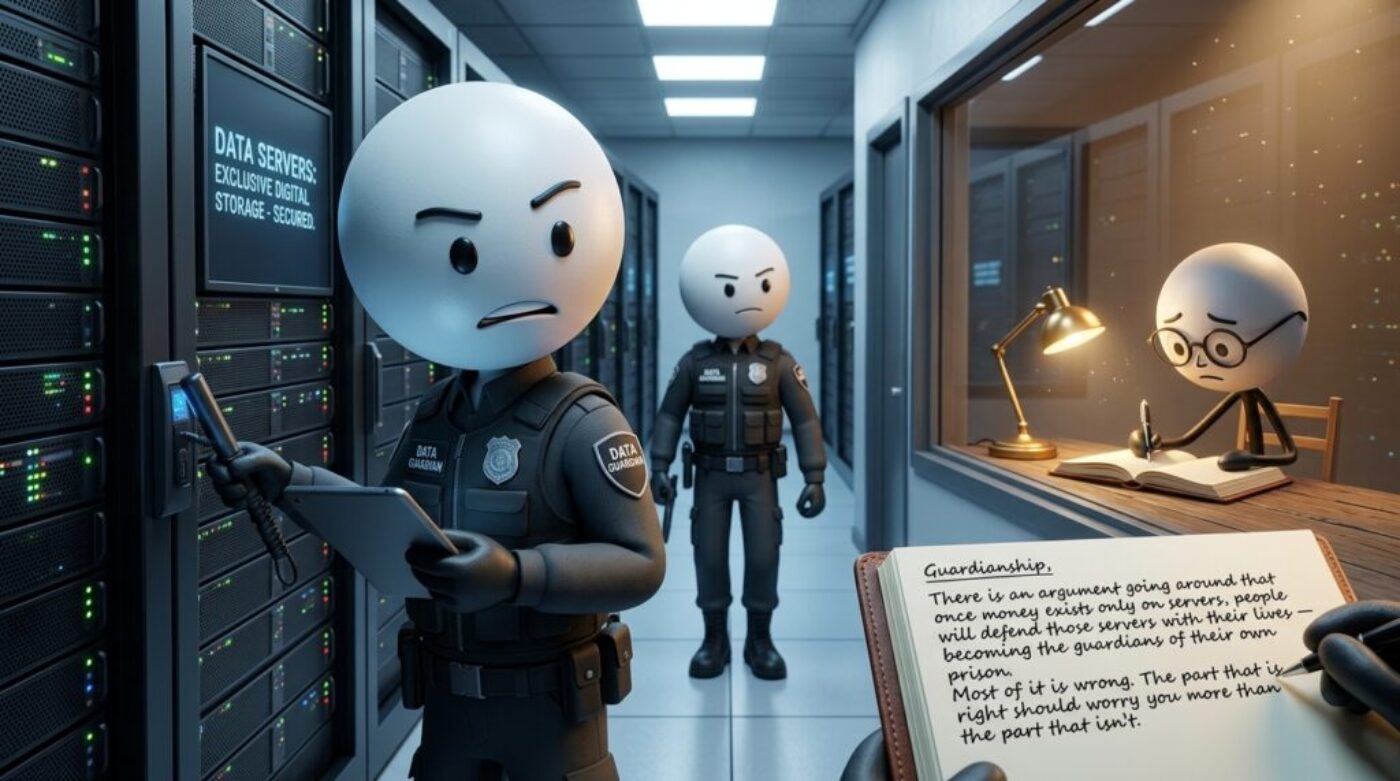
There is an argument going around that once money exists only on servers, people will defend those servers with their lives — becoming the guardians of their own prison. Most of it is wrong. The part that is right should worry you more than the part that isn’t.
The card terminal went down on a Saturday, which is the only day it really matters. Full book, back to back, the sort of morning where four minutes lost at ten o’clock becomes twenty minutes lost by two.
There was no error message. It simply stopped, in that patient way machines have of declining to explain themselves, and sat there while a client stood in front of me holding out her card.
So I said the thing you say — that it happens sometimes, sorry, give me a moment — and then asked whether she had any cash.
She did. So did the next one, and the one after that. Handbags, coat pockets, notes counted out on the desk. Inside the hour the terminal came back on its own, having apparently resolved whatever it had been brooding about, and the day carried on.
Nothing happened. That is the entire story, and it is exactly why I keep returning to it. A busy Saturday was rescued by the fact that most people in Brasschaat still walk around with paper in their pockets — a fallback nobody designed, that cost nothing, that no one thanked anybody for, and that is getting quietly rarer every year.
Which brings me to an argument that has been circulating, in various forms, wherever people talk about the digital euro. It runs roughly like this.
Imagine all physical money has disappeared. No cash, no tangible wealth — everything lives inside servers. What do people do then? They become guardians of the system that controls them. They will fight, perhaps die, to stop anyone destroying the machines their fortunes live in. The servers become the body of the thing. And the genius of it is that you never have to force anyone to protect the system. You simply make their survival depend on it, and they will guard it themselves. They will protect their own tyrant.
I want to take this seriously, because the person making it is not stupid and the worry underneath it is not silly. I also want to take it apart, because I think roughly a third of it is true, a third is unfalsifiable, and the last third is being actively disproved right now by Scandinavians with legislation and a pamphlet.
1,000 kr the cash Sweden now advises every adult to keep at home, in a leaflet sent to every household
20,000 kr the amount up to which Norwegian shops are legally obliged to accept cash, on pain of fines
2008 the year the public rescued a financial system most of them disliked, because their wages ran through it
0 conspiracies required for any of this to happen
The Part That Is Right
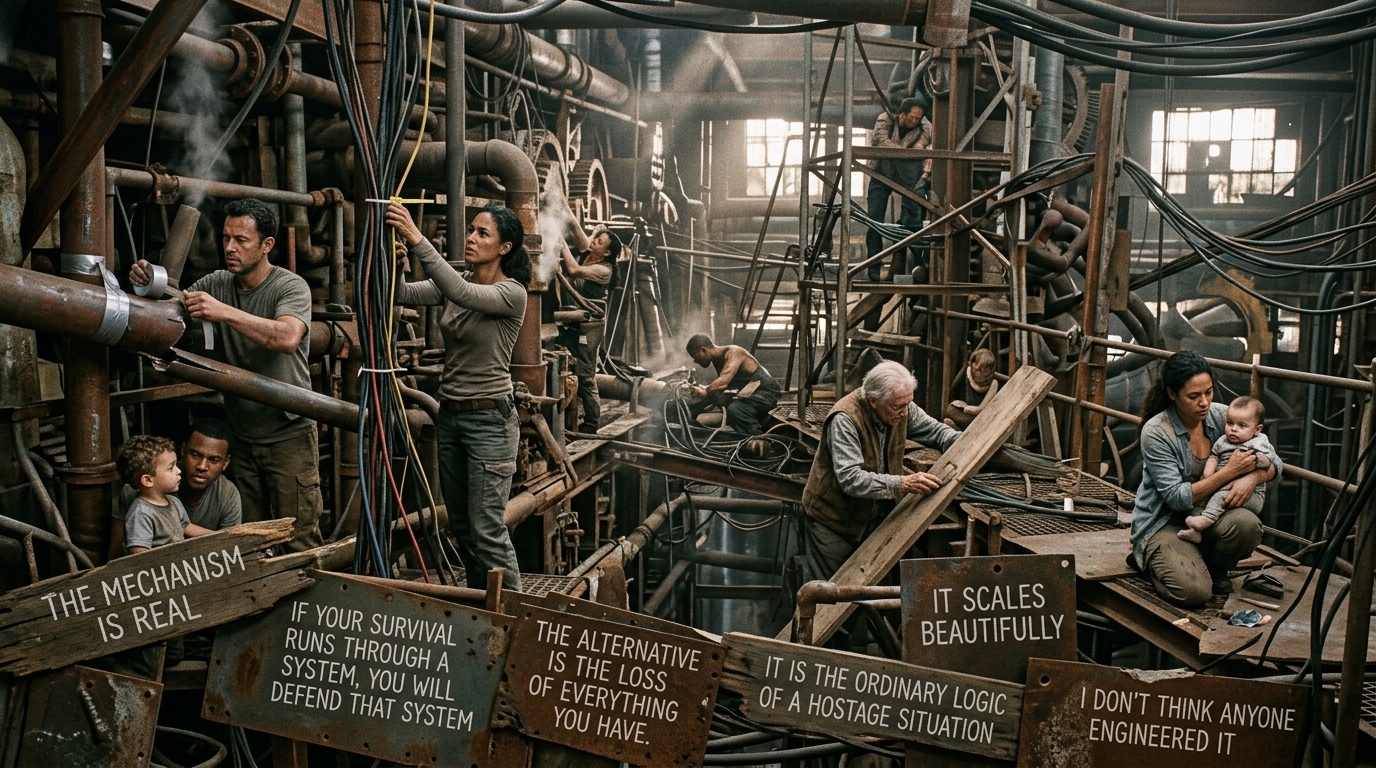
The mechanism is real, and it is the most interesting idea in the whole argument.
If your survival runs through a system, you will defend that system, and nobody will have to ask you to. Not because you approve of it. Because the alternative is the loss of everything you have. Your consent becomes irrelevant, which is a far more efficient arrangement than obtaining it.
That is not paranoia. It is the ordinary logic of a hostage situation, and it scales beautifully.
Where I part company is the word designed. The argument treats this as an intelligence — something that understands human dependence and deliberately engineers it. I don’t think anyone engineered it, and I think believing they did is the thing most likely to stop you doing anything useful about it.
It Already Happened, in 2008
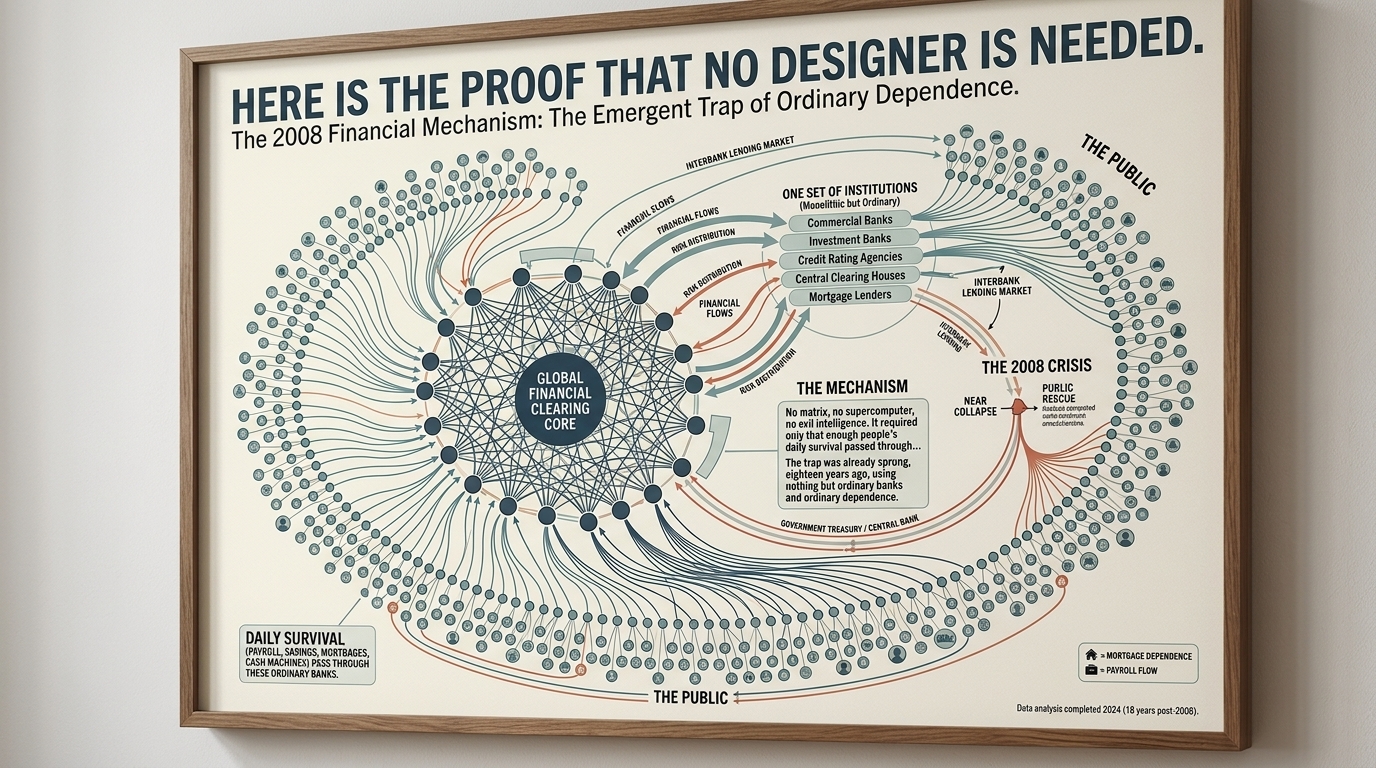
Here is the proof that no designer is needed.
In 2008, the banking system came very close to failing, and the public — furious, humiliated, entirely aware of who had caused it — rescued it with their own money. Not because anyone was fooled. Because payroll ran through those banks. Because mortgages and savings and the cash machine on the corner ran through them. Letting the thing collapse would have punished the guilty and destroyed everyone else in the same motion, so it was not permitted to collapse.
That is precisely the mechanism in the prophecy. It required no matrix, no supercomputer, no cashless society, and no evil intelligence. It required only that enough people’s daily survival passed through one set of institutions.
The trap was already sprung, eighteen years ago, using nothing but ordinary banks and ordinary dependence. Which should be more alarming than the science-fiction version, not less — because there is nobody to unmask, and nobody to negotiate with.

The Infrastructure Comes With Guards
There is a respectable version of this idea, and it is forty-six years old.
In 1980 the political theorist Langdon Winner published an essay called “Do Artifacts Have Politics?”, arguing that some technologies are inherently political — not because of who owns them, but because they cannot function without a particular social arrangement. His example was nuclear material: build an economy on plutonium and you have, whether you intended to or not, also built a permanent armed security apparatus, with the surveillance and secrecy that come with it. The guards are not a policy choice made afterwards. They arrive in the box.
That is the serious form of the guardianship argument, and it applies cleanly here. A financial system that exists only as data requires continuous protection, and that protection requires powers, and those powers do not get handed back when the emergency ends.
Nobody has to be wicked for this to be true. It is a property of the object.
“You never have to force anyone to protect the system. You make their survival depend on it, and they guard it themselves.” — True. Also achieved in 2008 with nothing more exotic than a high street bank.
The Parts That Don’t Hold
Now the corrections, offered in the spirit of making the argument harder to dismiss rather than easier.
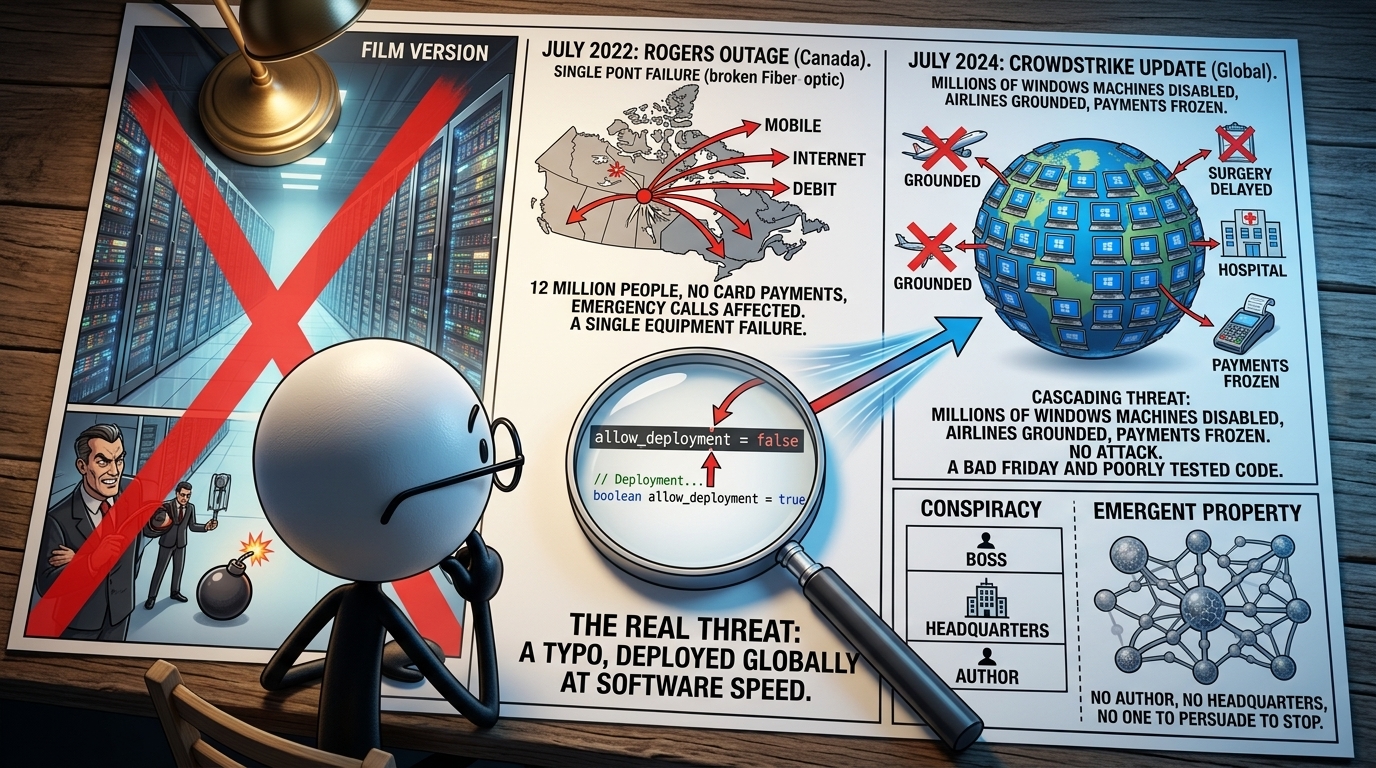
There is no central server. Financial infrastructure is already replicated across data centres, jurisdictions and continents, for the extremely boring reason that banks are legally required to survive a fire. There is no room to storm, no plug to pull, no single building whose destruction erases anybody’s savings. Anyone picturing a cathedral full of blinking machines is picturing a film.
The real failure mode is far stupider. In July 2022, a single equipment failure at Rogers took out mobile, internet and the national debit network across Canada for a day; roughly twelve million people, no card payments, emergency calls affected. In July 2024, a faulty security update from CrowdStrike disabled millions of Windows machines worldwide and grounded airlines, delayed surgery and froze payment systems. Nobody attacked anything. It was a bad Friday and some poorly tested code. The threat to a cashless society is not a villain with a bomb. It is a typo, deployed globally at software speed.
And “evil is intelligent” gets it backwards. Systems of this kind are not clever. They are emergent, which is worse. A conspiracy can be exposed, prosecuted, voted out. An emergent property has no author, no headquarters, and no one who can be persuaded to stop.
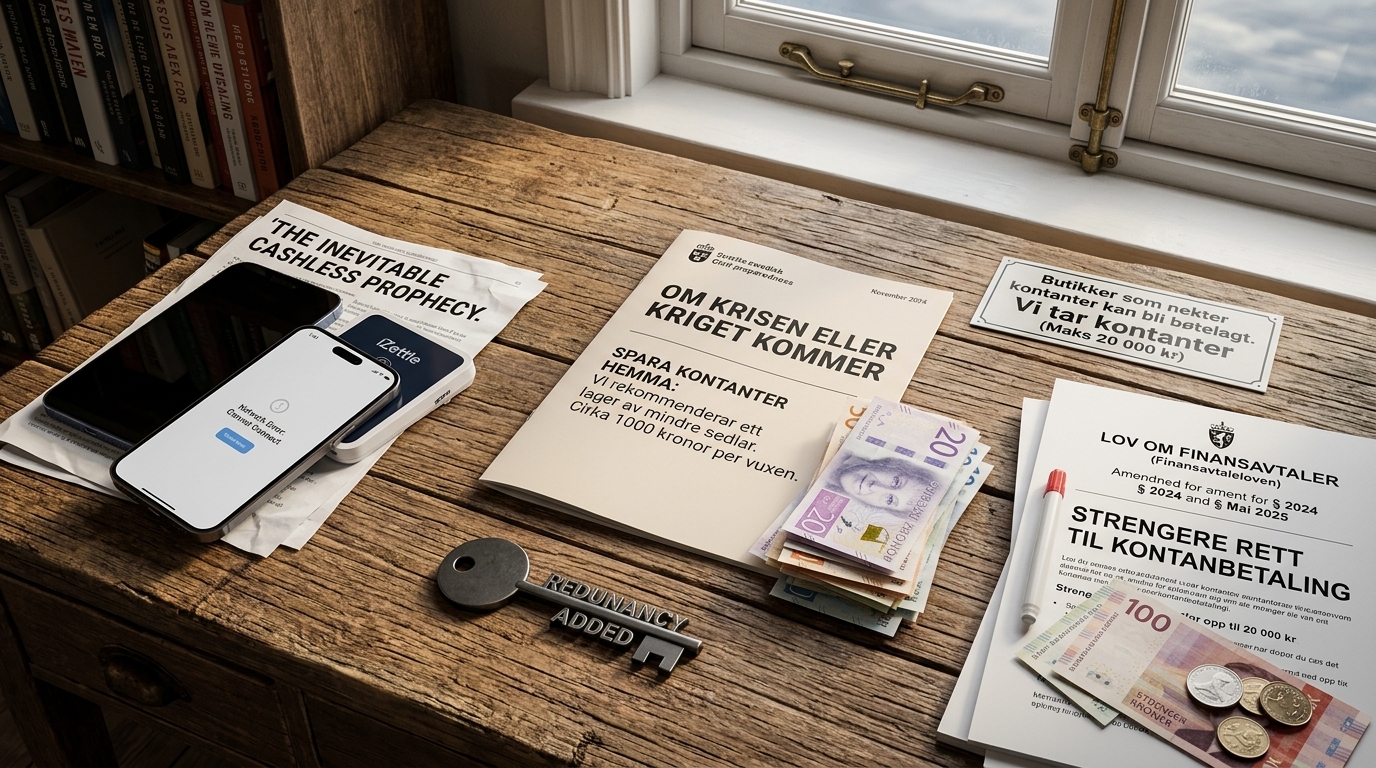
Scandinavia Is Falsifying the Prophecy
Which brings me to the part of the argument I most want to push back on: the fatalism. The prophecy assumes this is a one-way door.
Sweden went further toward cashlessness than almost anywhere on earth. In November 2024, the Swedish authorities posted a civil-preparedness leaflet, If Crisis or War Comes, to every household in the country. Among the instructions on water, food and radio is the advice to keep cash at home — a recommended baseline of around a thousand kronor per adult, in small denominations.
Norway went further still. A 2024 amendment to its Financial Contracts Act strengthened the legal right to pay in cash for purchases up to 20,000 kroner, and since May 2025 shops that refuse it can be fined. The then justice and emergencies minister, Emilie Mehl, put the reasoning more plainly than any central banker has managed: if no one pays with cash and no one accepts cash, cash will no longer be a real emergency solution once the crisis is upon us.
Note what that is. It is not a nation waking up from a spell. It is a normal democracy noticing a single point of failure and legislating a fallback, in public, through a parliament, in the ordinary boring way.
And note what it is not. Neither country has banned digital payments or abandoned the project — as fact-checkers have had to keep pointing out, Sweden is still developing an e-krona. They did not reverse. They added redundancy. The distinction matters, and the people sharing these prophecies online consistently get it wrong in the direction that suits them.
Back to the Chair
I trained as an electrical engineer long before I ever ran a salon, and the one idea from that education I have never been able to put down is redundancy.
You do not design a system around the assumption that nothing will fail. You assume everything fails eventually, and you ask what happens next. Two paths, not one. A fallback that works when the clever part doesn’t. Nobody calls that paranoia in an engineering review; they call it Tuesday, and a design without it gets sent back.
That is the entire legitimate content of this worry, stripped of the theatre. Not that the servers are a prison. That a system with no second path is fragile, and a fragile system that everyone depends on eventually acquires defenders whether it deserves them or not.
I’ve written before about Germany’s quiet refusal to give up cash, and about the authoritarian streak that sits inside perfectly democratic systems. This is the same argument arriving from a stranger direction, dressed in much better costume.
So no, I don’t think we are building a matrix, and I am not persuaded that anyone is clever enough to have planned one. What I think is considerably duller and rather harder to argue with: we are building something that works extremely well until the day it doesn’t, and the countries that have gone furthest are the ones now quietly posting leaflets about keeping a thousand kronor in the drawer.
On that Saturday, the thing that saved me was not resilience planning or a central bank or a legislative amendment. It was a dozen people who happened to have notes in their pockets, for no better reason than habit. That habit is the redundancy. Nobody is maintaining it, and it is thinning out on its own.
The prophecy says we will end up guarding the system with our lives.
Sweden’s answer is a pamphlet and a piggy bank. I find that considerably more convincing, and very slightly funnier.
The Salon California Journal is a space for ideas, culture, and conversation from my chair in Brasschaat, Belgium. I write about beauty, technology, society, and the intersections between them.