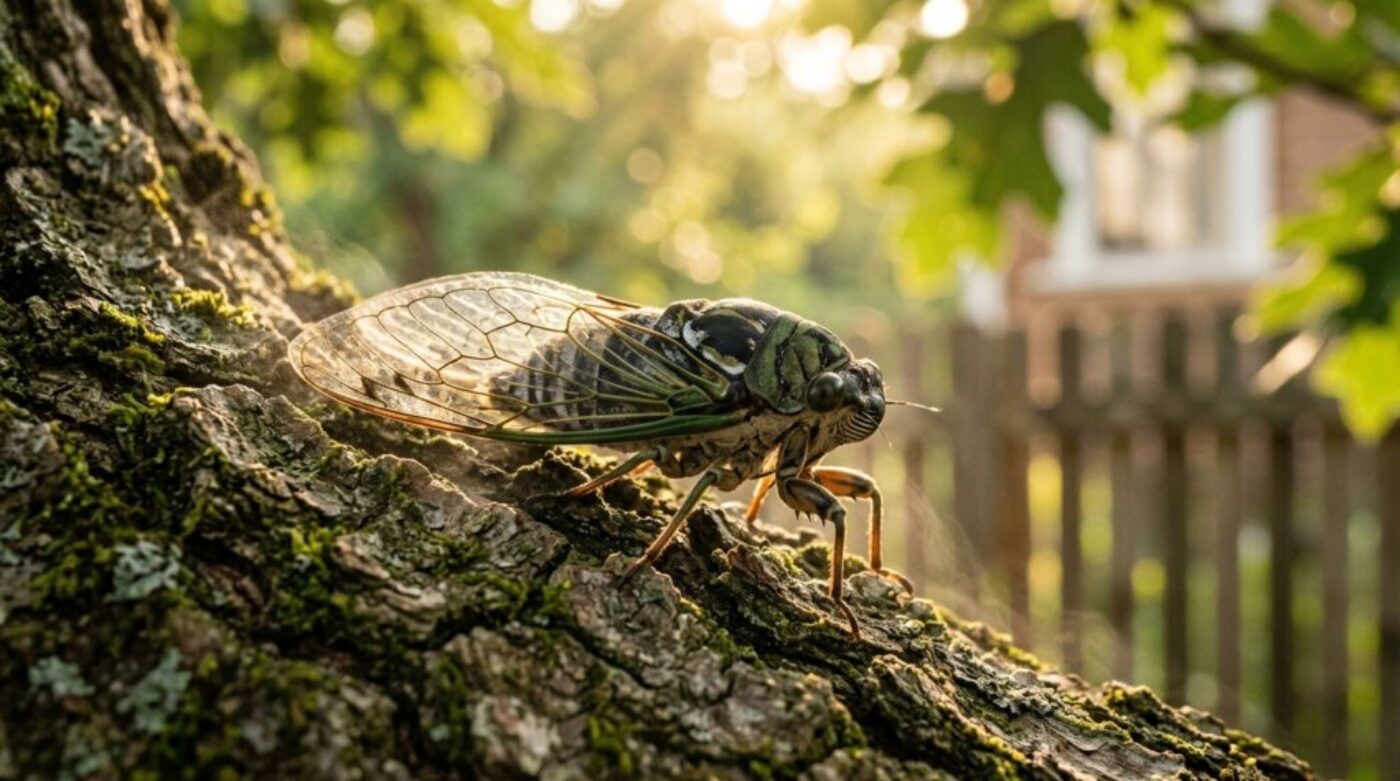
A cicada’s wing
No Poison. No Antibiotic. Just Geometry.
A cicada’s wing kills bacteria simply by touching them — not with chemistry, but with a field of spikes a thousand times thinner than a hair. And the engineered copy now works better than the original.
I spend my working life with a nanostructured biological surface and I had never once thought of it in those words.
The outside of every hair on your head is a cuticle — overlapping scales, laid down like roof tiles, each one a fraction of a micrometre thick. Almost everything I do professionally is a negotiation with that surface. Shine is those scales lying flat and reflecting light in the same direction. Tangling is scales catching on each other. Damage is scales lifted and broken away. Conditioner does not repair hair; it smooths the tiles down and fills the gaps between them.
It is, in other words, a job about geometry that everybody — including me, for thirty-odd years — describes in the language of chemistry.
Which is why a paper about a cicada’s wing has stayed with me since I read about it.
1932 the year an Austrian town issued its own money, deliberately designed to lose value if you held it
30% the unemployment rate it returned to once the central bank shut the experiment down
1 Sept 1933 the date that happened, on the grounds that only central government may issue currency
1 ski jump, built in the meantime, along with a bridge and a new water system
The Clanger Cicada
In 2012 a team led by the microbiologist Elena Ivanova published a study on the wings of Psaltoda claripennis, an Australian cicada with the excellent common name of the clanger.
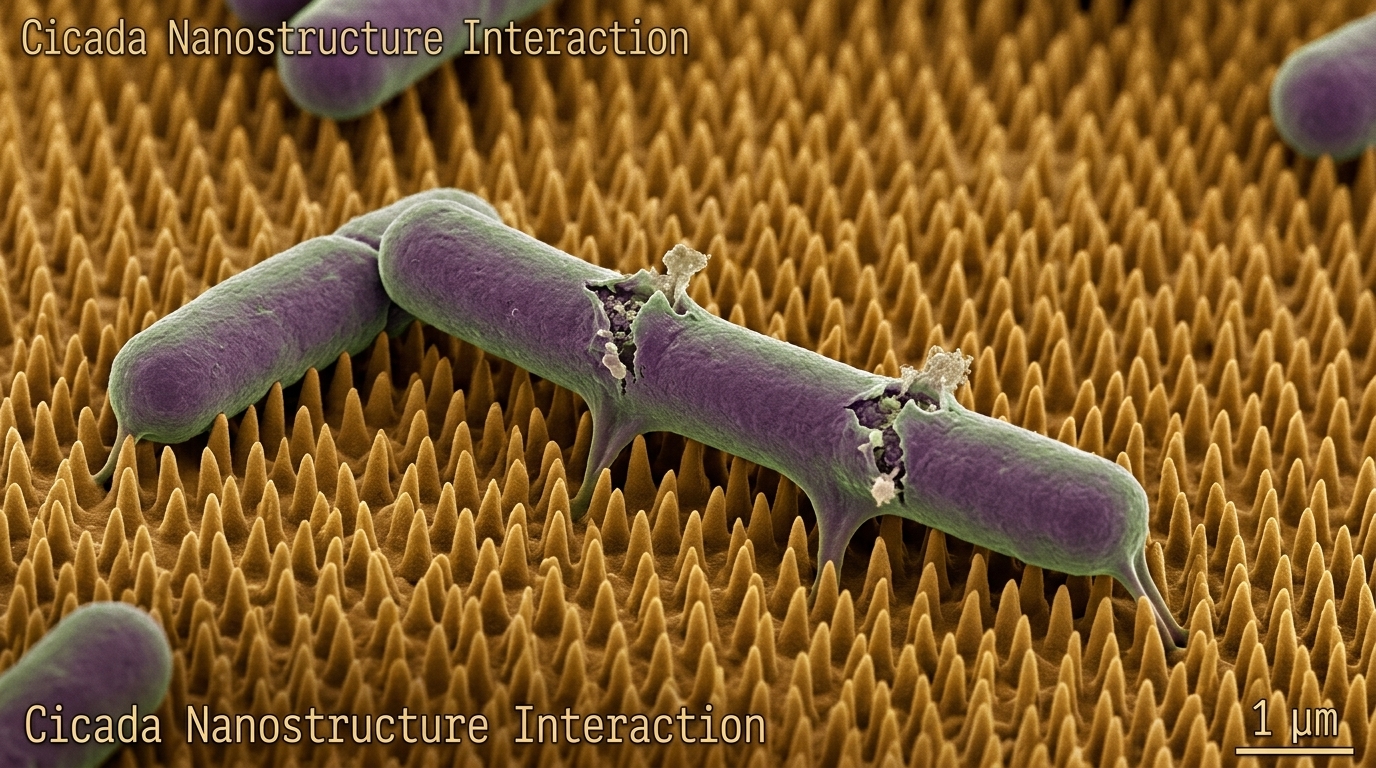
Its wings are covered in millions of microscopic spikes, each around 200 nanometres tall, arranged in a regular field. When a bacterium settles on that field, its outer membrane sinks into the gaps between the spikes and stretches across them — a sheet pulled over a bed of nails. The tension keeps rising until the membrane fails, and the cell dies.
The wing does not poison it. The wing does not do anything at all. The wing simply has a shape, and the bacterium destroys itself on the shape.
The Gold Experiment
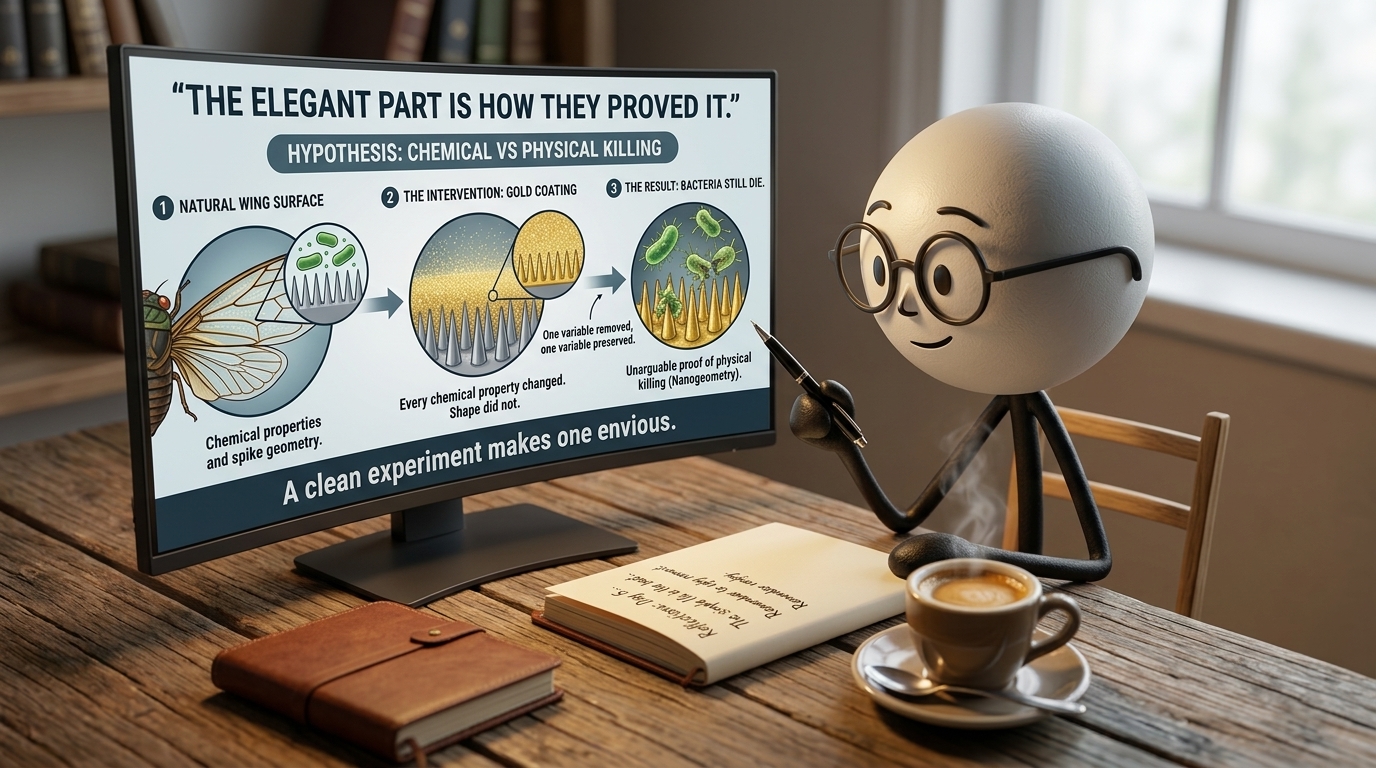
The elegant part is how they proved it.
If the killing were chemical — something in the wax or the protein of the wing surface — then changing the chemistry should stop it. So they coated the wings in a layer of gold about ten nanometres thick. Every chemical property of the surface changed. The shape did not: the gold was thin enough that the spikes kept their geometry underneath.
The bacteria still died.
That is one of those experiments so clean it makes you slightly envious. One variable removed, one variable preserved, and the answer sitting there unarguable at the end of it.
What It Doesn’t Kill
Here is where the story usually stops being told, and where it gets considerably more interesting.
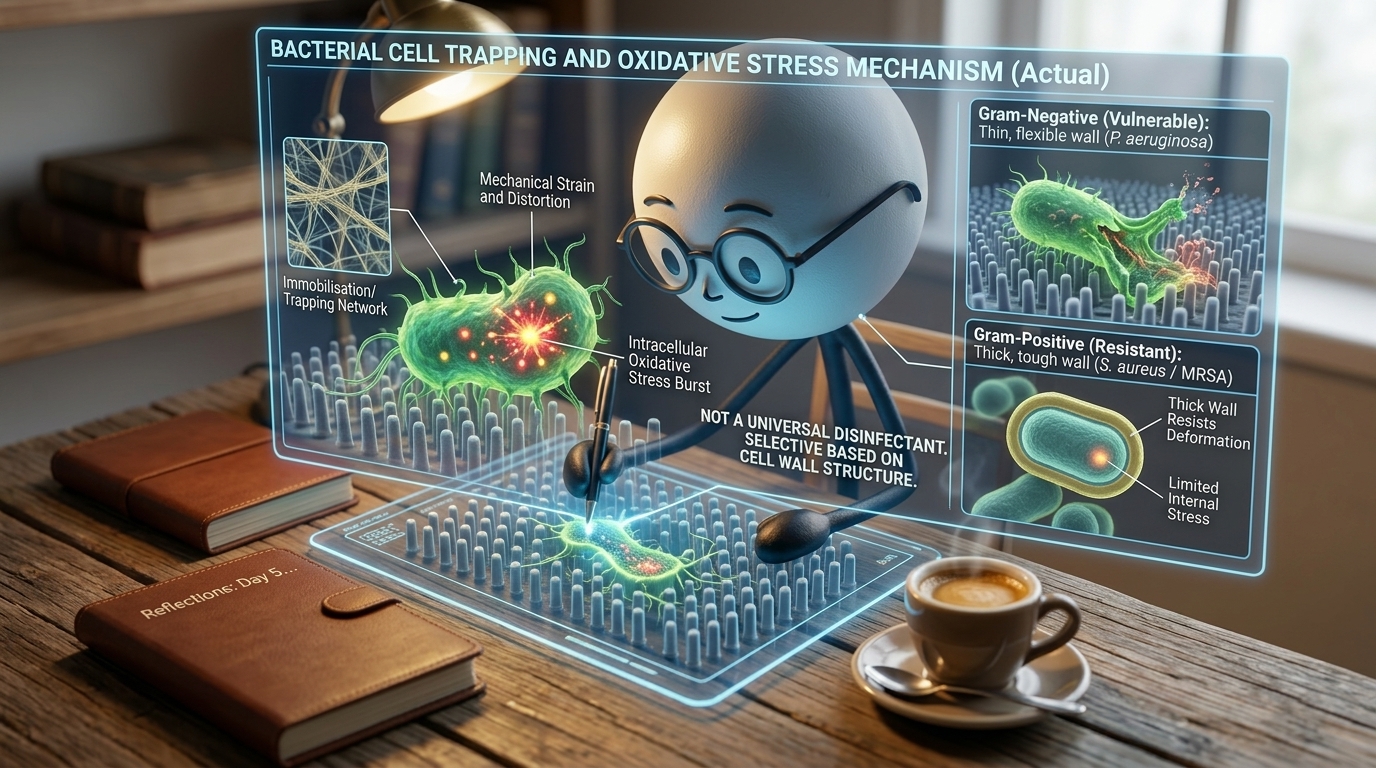
The cicada wing is selective. The bacterium in that original study was Pseudomonas aeruginosa — a Gram-negative organism, meaning a relatively thin and flexible cell envelope. Stretch it over a bed of nails and it gives way.
Gram-positive bacteria have a much thicker, tougher wall, and they resist this treatment far better. Which is awkward, because a great deal of what makes hospitals dangerous — staphylococcus, MRSA — is Gram-positive. The insect wing is not a universal disinfectant. It is very good against one family and much weaker against another.
And the mechanism itself has turned out to be messier than the bed-of-nails picture suggests. Later work found that nanopillar surfaces do not merely tear membranes — they also immobilise cells and trigger oxidative stress inside them. So “just physics” is a lovely line and not quite true. Nothing is applied to the bacterium, which is the part that matters. But the cell is not simply popped like a balloon; it is trapped, strained and chemically overwhelmed at the same time.
“The wing does not poison it. The wing does not do anything at all. The wing simply has a shape, and the bacterium destroys itself on the shape.” — Which is a very old idea in a very small package: let the structure do the work.
We Built a Better Wing
And now the twist, which is my favourite thing about this whole subject.
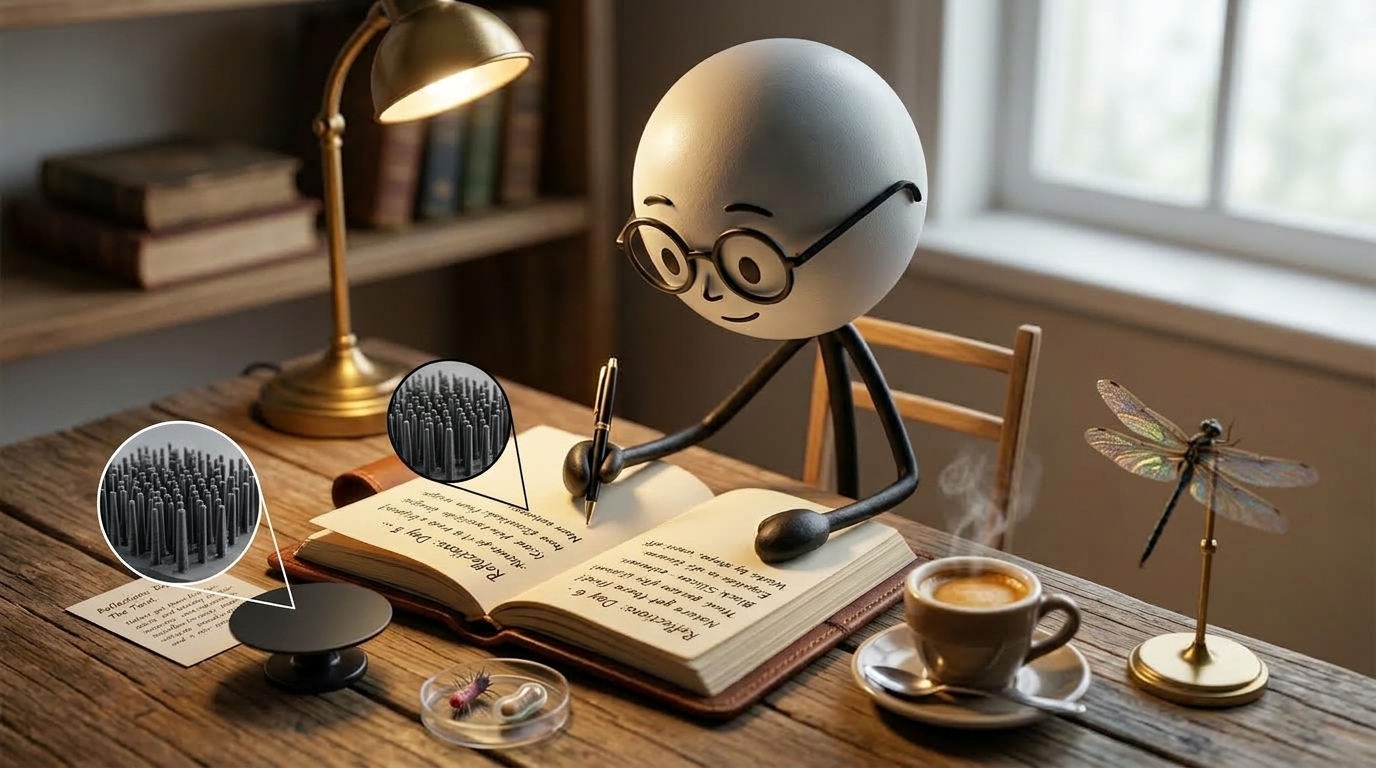
Once researchers knew what to look for, they found the same trick elsewhere in nature — dragonfly wings turned out to be more effective than cicada wings. Then they made their own. Black silicon, a material produced by etching silicon into a dense forest of pillars around 500 nanometres tall, is more bactericidal than either insect. Related techniques let engineers put similar structures onto metals and plastics — which is what makes this interesting for implants, catheters and hospital surfaces, where a coating that works by shape does not wash off, wear out or need reapplying.
So the usual telling — nature got there first, how humbling — is only half the story. Nature got there first, we copied it badly, and then we beat it. The cicada was not the solution. The cicada was the hint that a solution existed.
One more honest note. The hopeful claim is that bacteria cannot evolve resistance to a shape, because there is no molecular target to mutate. It is a good argument and probably mostly right. It is not a guarantee. Evolution has no obligation to attack the target we have in mind, and a bacterium that grows a stiffer envelope, or hides inside a film of its own making, has routed around the geometry without ever confronting it.
Back to the Chair
The question the cicada leaves behind is the obvious one: what else has nature already invented that we have not noticed?
And the answer, historically, is nearly everything, usually found by someone looking at something else. Velcro came from a Swiss engineer picking burrs off his dog. Self-cleaning surfaces came from the lotus leaf. Passive cooling came from termite mounds — and from Persian engineers, who worked out how to make ice in a desert with nothing but a dome, a wind tower and a very good understanding of the night sky.
What all of those share is the thing I find genuinely useful. In every case, the solution was not a substance. It was an arrangement.
Which brings me back to the tiles.
Everything that happens to hair — shine, tangle, frizz, the reason wet hair squeaks, the reason damaged hair will not reflect light no matter what you put on it — is a question of whether several million microscopic scales are lying flat or standing up. The industry sells this as chemistry, in bottles, with ingredient lists. It is mostly geometry. I have spent decades working on a surface I could not have described to you accurately until fairly recently.
I’ve written before about a colour that does not exist outside your head, and about knowledge that disappears because nobody writes it down. This is the third member of that family — things sitting in plain sight, doing something remarkable, waiting for somebody to look at them properly.
Nature built a weapon into an insect wing and left it lying around for four hundred million years.
It took us until 2012 to pick it up.
The Salon California Journal is a space for ideas, culture, and conversation from my chair in Brasschaat, Belgium. I write about beauty, technology, society, and the intersections between them.