

Neuroarchitecture
Why Artists Faced North
What if architecture were about more than mathematics, physics and aesthetics? Ceiling height appears to change how abstractly you think. A window facing trees once sent surgical patients home sooner than a window facing a wall.
There is one thing in a salon you cannot fake, and it is not the furniture.
Hair colour lies under the wrong light. A tone that looks perfect under warm tungsten walks out of the door, meets daylight on the pavement, and turns into something nobody ordered. Every colourist in the world knows this and every one of us has been caught by it at least once. It is the reason the serious part of the job migrates, without anyone deciding, toward the window.
So I have spent a working life paying unusually close attention to light — not for the mood of it, but because the light is a measuring instrument and a bad one gives you the wrong answer.
Which is why I was pleased to discover there is now a whole discipline devoted to taking this seriously.
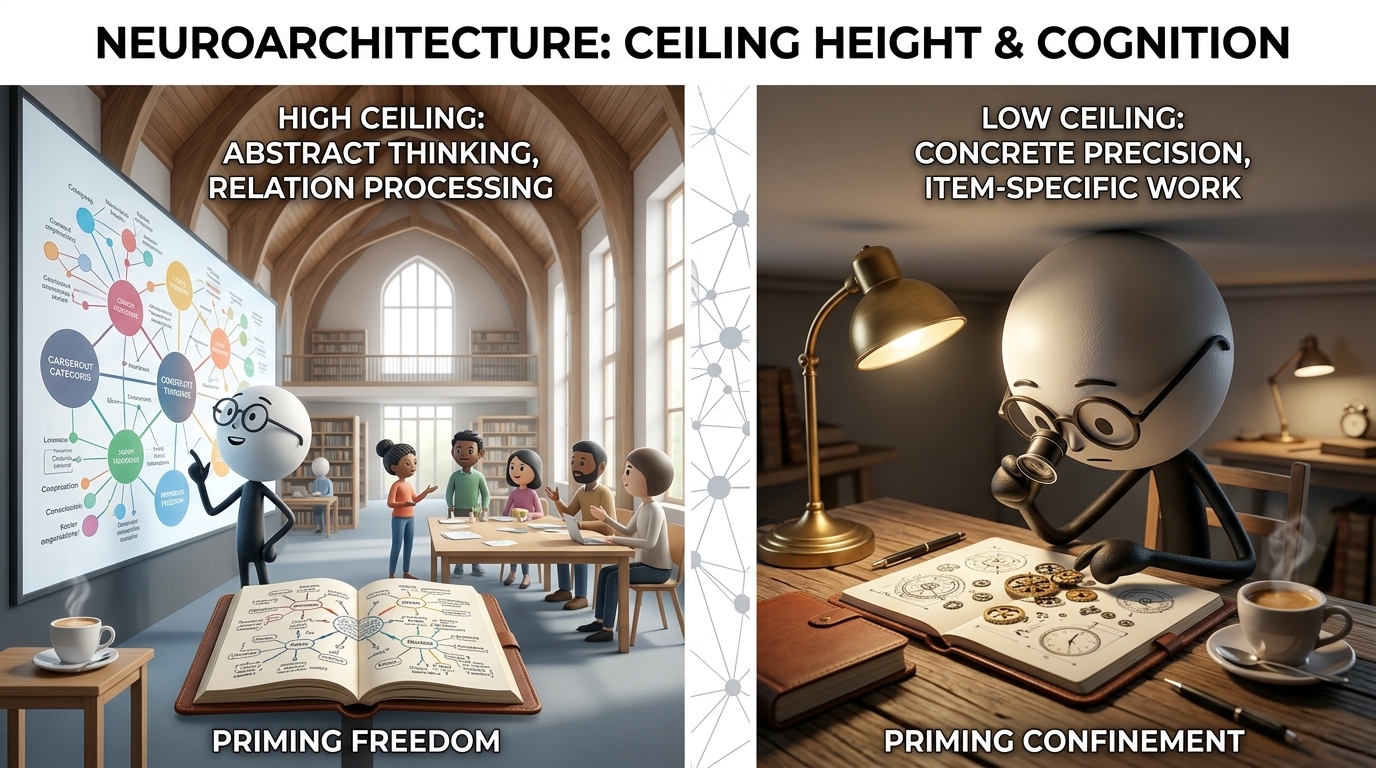
10 ft the ceiling height that pushed people toward abstract thinking, against eight feet for concrete detail
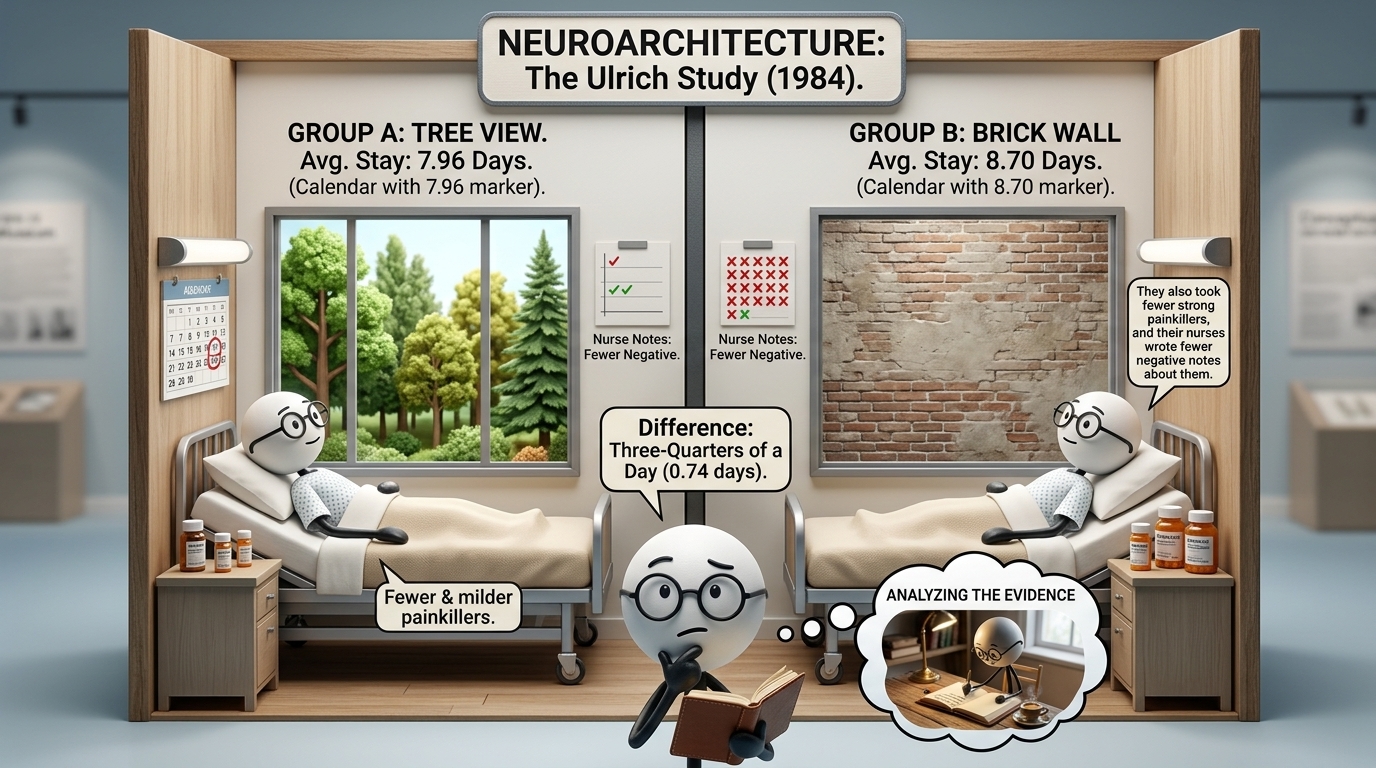
7.96 days in hospital for surgical patients whose window faced trees
8.70 days for the matched patients whose window faced a brick wall
1 wall, which is what most windows in most flats have been pointed at since housing became a yield calculation

What Neuroarchitecture Asks
Neuroarchitecture sits where neuroscience meets spatial design, and it asks a simple question: how does the environment we build affect the way our brains feel, think and behave?
Not metaphorically. Measurably, if possible. There are four elements where the evidence has got interesting.
The Cathedral Effect
Start with the ceiling.
Walk into a space with a high ceiling and you may find yourself feeling more open, expansive, freer to think. There is a reason a cathedral does not feel like a corridor, and the reason is not entirely spiritual.
In 2007 Joan Meyers-Levy and Rui Zhu ran three experiments in rooms that differed only in ceiling height — ten feet against eight. People in the taller rooms did more relational, abstract processing: connecting things, thinking in categories. People in the lower rooms did more item-specific, concrete processing: detail, particulars, the thing in front of them.
Their proposed explanation is priming. A noticeably high ceiling activates the concept of freedom. A noticeably low one activates confinement. And whichever concept is activated leaks sideways into how you handle the task on the desk.
Notice that neither is better. Low ceilings are not a design failure — they are where concentration, intimacy and close work live. Nobody wants to do detailed accounts in a cathedral, and nobody wants to have an idea in a cupboard. The mistake is building everything to one height and expecting the whole range of human activity to happen in it.

Why Artists Faced North
Then light, which is where the folklore turns out to be physics.
The traditional artist’s studio faces north, and this is usually explained as taste. It isn’t. In the northern hemisphere a north-facing window never receives direct sunlight at all. Everything coming through it is diffuse skylight — which means the colour temperature barely shifts, the intensity barely shifts, and no shadow travels across your work between morning and evening.
You are not choosing north light because it is beautiful. You are choosing it because it is stable, and a painter judging a colour needs the same conditions at four o’clock as at ten.
South light is the opposite and just as useful for different reasons: strong, direct, constantly moving, remaking the atmosphere of a room hour by hour. Marvellous for living in, hopeless for matching a colour.
Both also reach further than mood. Daylight is the principal signal setting our biological clock, which means the light in a room is quietly negotiating with when you will be alert and when you will sleep, and it is doing that whether or not anyone consulted an architect.
The Window That Sent People Home Sooner
The fourth element — views of nature — has the most famous study in the entire field behind it, and it is worth telling properly because the usual retelling oversells it.
In 1984 Roger Ulrich published a paper in Science with a title that sounds like a throwaway: “View through a window may influence recovery from surgery.” He had found a hospital where patients recovering from the same operation were assigned to rooms on either side of a corridor. One side looked out at a small stand of trees. The other looked at a brick wall.
Twenty-three patients on each side, matched for age, sex and circumstance. The patients facing trees went home after 7.96 days. The patients facing the wall went home after 8.70 days. They also took fewer strong painkillers, and their nurses wrote fewer negative notes about them.
Three quarters of a day. That is the whole finding, and I want to be precise about it because it is usually repeated as though trees cured people. They did not. But consider what the variable was. Not a drug, not a procedure, not a member of staff. Which way the bed happened to be facing.
“You don’t need to understand neuroscience to know that one room is peaceful and another makes you want to leave.” — The research is not telling you something new. It is telling you that you were right, and roughly how much.
Materials, and the Thinner Ice
Which brings me to the element with the weakest evidence and the loudest marketing.
Wood, stone, plants and water are held to produce calm and connection, and a room in warm timber certainly makes a different impression from one in raw concrete. I believe it. I have built my own room around it. But the research here is a good deal thinner than the research on light and views — smaller studies, softer measures, and a large commercial industry with an interest in the answer coming out a particular way.
So: probably true, not yet proven to the same standard, and anyone quoting you a percentage for how much calmer wood makes you is selling flooring.

How Much of This to Believe
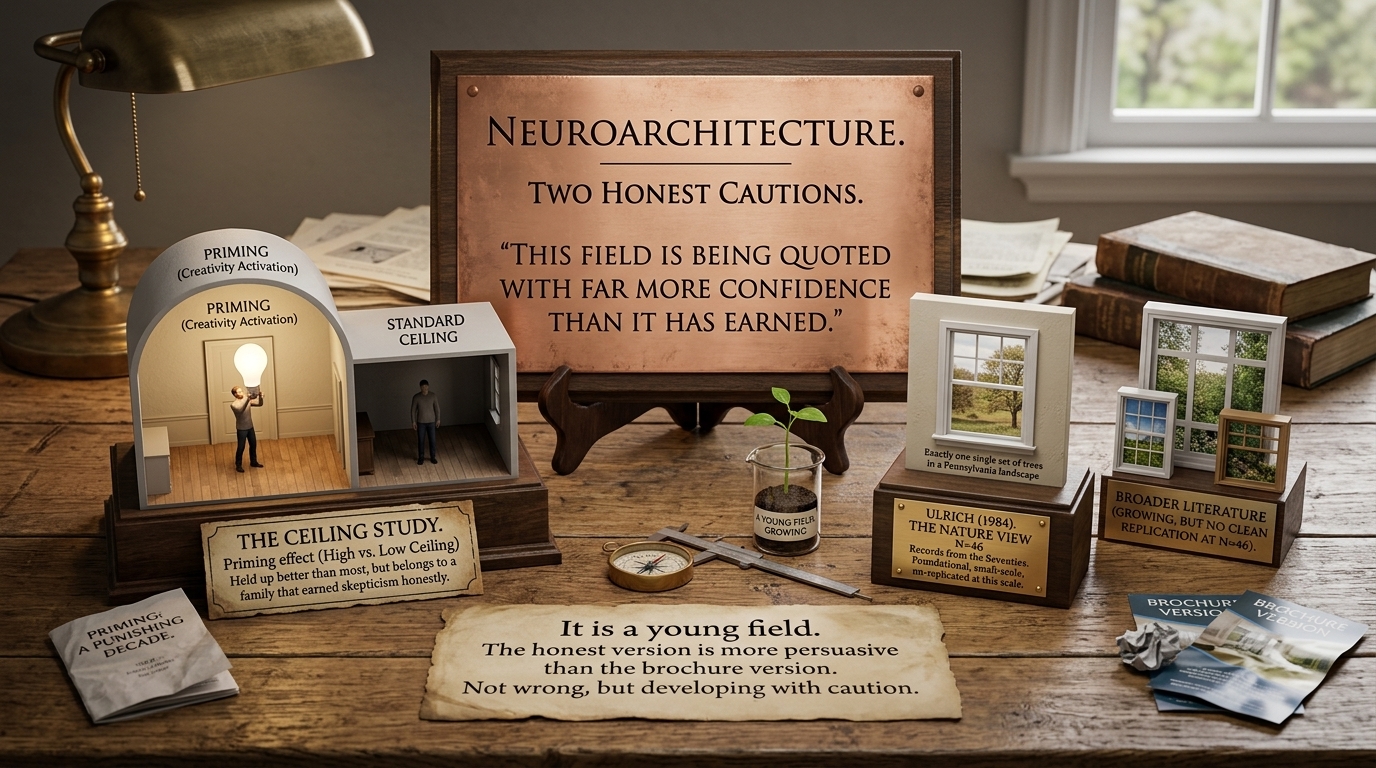
Two honest cautions, because this field is being quoted with far more confidence than it has earned.
The ceiling study is a priming study. Priming — the idea that an activated concept quietly steers unrelated behaviour — has had a punishing decade in psychology, with a long list of famous results failing to replicate. The ceiling finding has held up better than most and has been repeated in various forms, but it belongs to a family that earned its scepticism honestly, and anyone citing it should know that.
And Ulrich is twenty-three pairs of patients. One hospital, one operation, records from the seventies, a single set of trees. It is the foundational study of evidence-based healthcare design and it is also very small, and nothing at that scale has cleanly replicated it. The broader literature on nature exposure has grown up around it and mostly points the same way, which is reassuring. But the famous number rests on forty-six people in Pennsylvania.
None of this means the field is wrong. It means it is young, and that the honest version is more persuasive than the brochure version.
Back to the Chair
Here is the part that unsettles me slightly.
Every one of these findings was available to anyone paying attention, centuries before there was a word for it. Painters worked out north light without a single lux meter. Monasteries put the refectory under a low vault and the nave under a high one, and nobody wrote a paper about processing styles. Builders in hot places put a window where the tree was.
Then, somewhere in the twentieth century, we industrialised building, and a great deal of that knowledge was quietly discarded — not because it was disproved, but because it was expensive, and because nobody could produce a number for it. Now we are producing the numbers, at considerable cost, to re-establish things a fifteenth-century mason could have told you for free.
I wrote recently about the cognitive cost of rooms built entirely from right angles, and before that about a colour that exists only inside your head. This is the same territory: the gap between what we experience and what we can explain, which is usually much wider than we think and almost always in the same direction.
My own room has two large windows, a tree outside doing something different every week of the year, a wooden floor, a heavy weathered table, and warm light rather than even light. None of that was research. It was preference, and a little bit of stubbornness, and knowing where I needed to stand to see a colour properly.
So the next time you walk into a space and feel immediately good without knowing why, stop and look around. The ceiling. The light. The materials. The view. The proportions.
The answer is generally sitting right in front of you, and it has usually been there longer than the vocabulary for it.
The Salon California Journal is a space for ideas, culture, and conversation from my chair in Brasschaat, Belgium. I write about beauty, technology, society, and the intersections between them.