
Right Angles
We Have Forced Every Object Into a Rectangle
There may be a hidden cognitive cost to the rigid geometry that dominates modern architecture. The question is not whether right angles are bad. It is whether an environment built almost entirely out of them is asking our brains to work harder than necessary.
When I opened my own salon in La Jolla in 1991, I could not leave the walls alone. The room I had taken on was the usual thing — a rectangle, four straight walls, a concrete floor, corners exactly where corners go. I painted one wall yellow and the wall facing it purple, left the other two a neutral grey, and then, for reasons I would have struggled to defend in front of a bank manager, painted a pattern around the perimeter of the floor.
Each styling station got a full-length mirror and a cabinet. That was the whole design. It cost very little and took a long weekend.
What clients said, over and over for eighteen years, was that they liked how simple it was. How clean.
Which I have thought about a great deal since, because simple is not quite what I had built. I had built a rectangular box and then spent a weekend putting variation back into it, and people experienced the result as restfulness and gave the credit to the tidiness.
90° an angle that appears almost nowhere in the environments our visual system was shaped by
1.3–1.5 the fractal dimension range people consistently prefer — the roughness of clouds, coastlines and branching trees
300,000+ years of practice at reading forests, rivers and rock, against roughly two centuries of grids
1991 the year I painted a pattern around a concrete floor without being able to say why
What We Actually Evolved Among
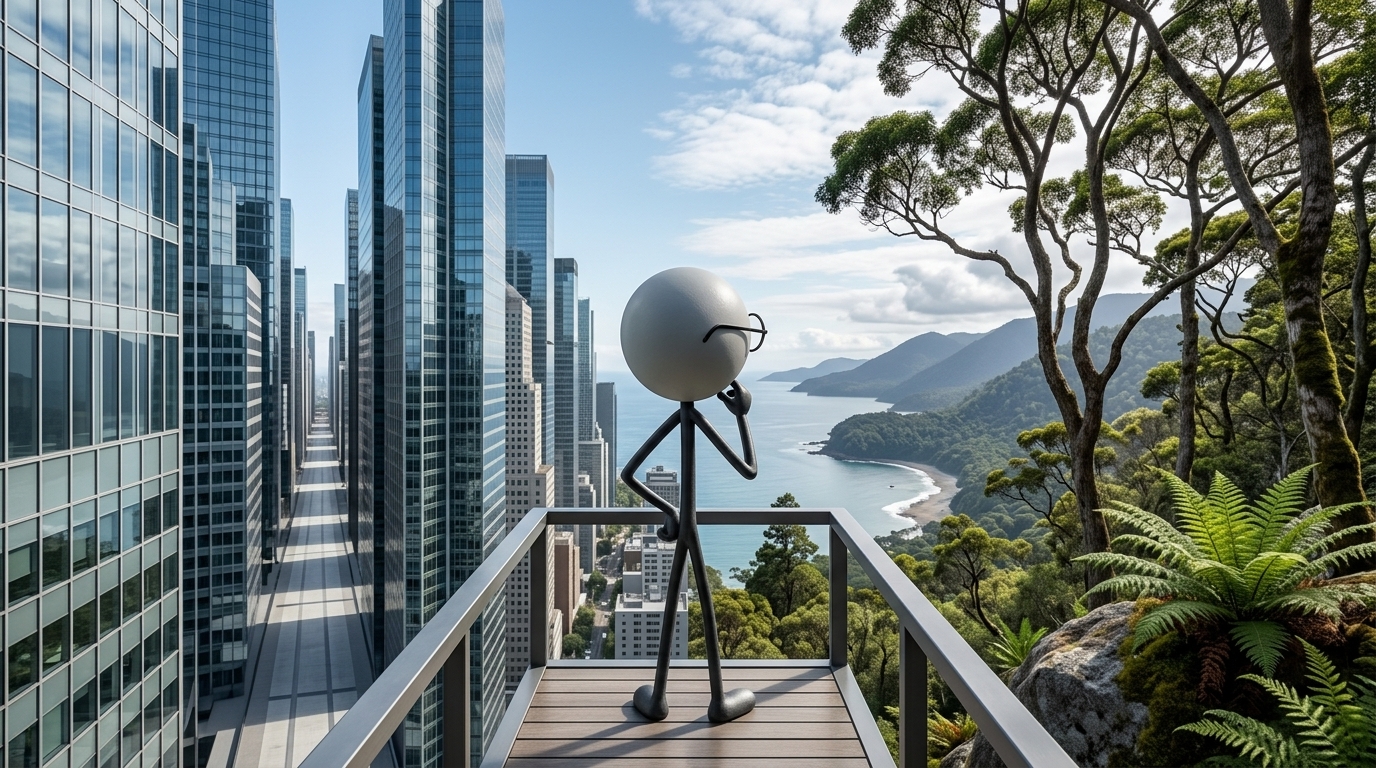
According to Agnieszka Olszewska-Guizzo, a landscape architect and neuroscientist who studies the relationship between the built environment and the brain, the straight lines, sharp corners, repetitive patterns and rigid symmetry that characterise much contemporary architecture can demand more cognitive processing than the organic forms found in nature.
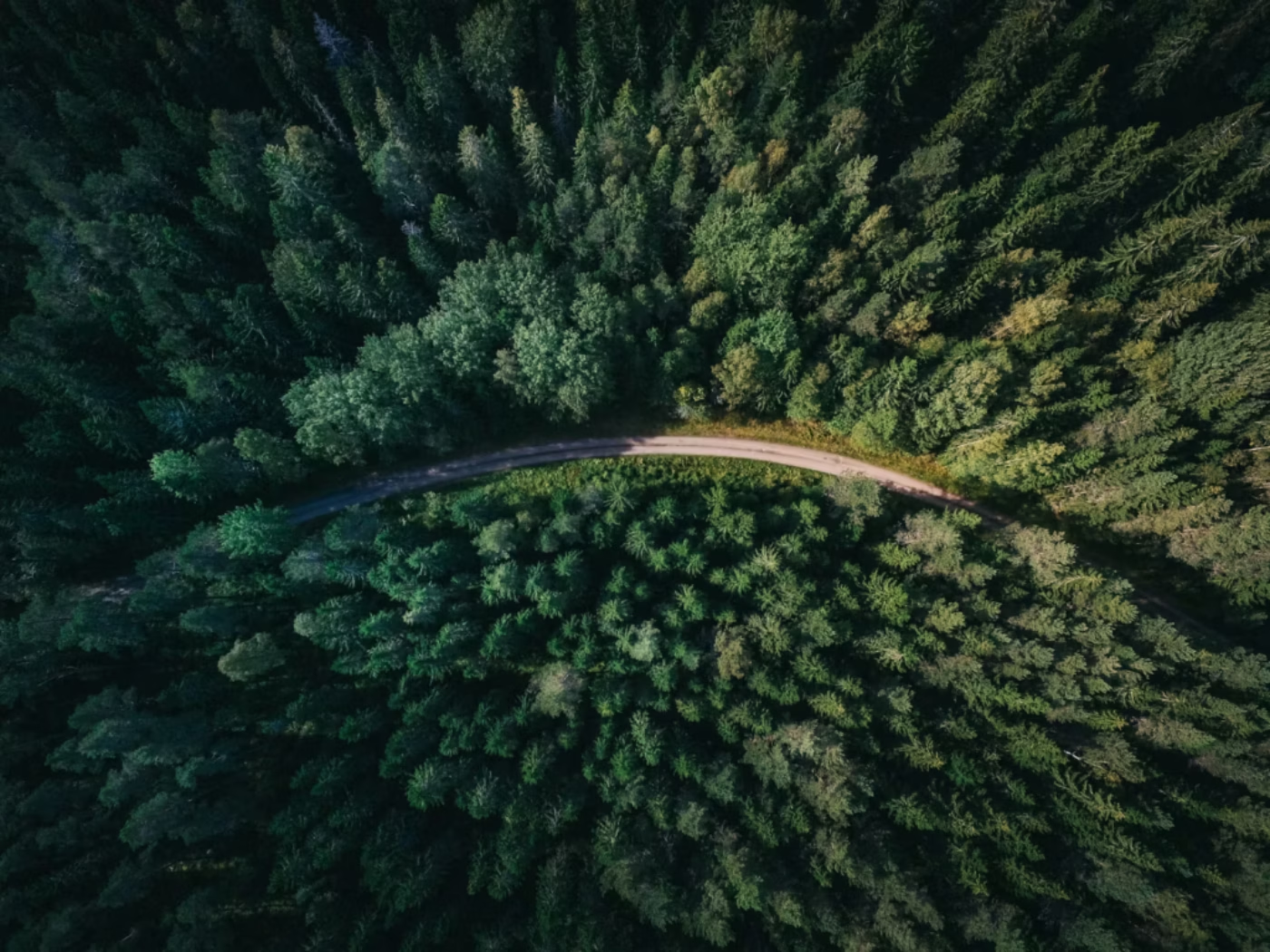
The distinction is subtle but important. Our brains did not evolve in environments made up of grids, corridors, right angles, glass façades and perfectly aligned surfaces. For hundreds of thousands of years, humans lived primarily among landscapes shaped by natural processes: forests, mountains, rivers, coastlines, grasslands, rocks, clouds and vegetation.
Those environments contain abundant curves, irregularities, branching structures and fractal patterns — the same basic geometries repeating at different scales. The branching of a tree. The structure of a fern. The shape of a coastline. The changing patterns of clouds.
Order Without Repetition
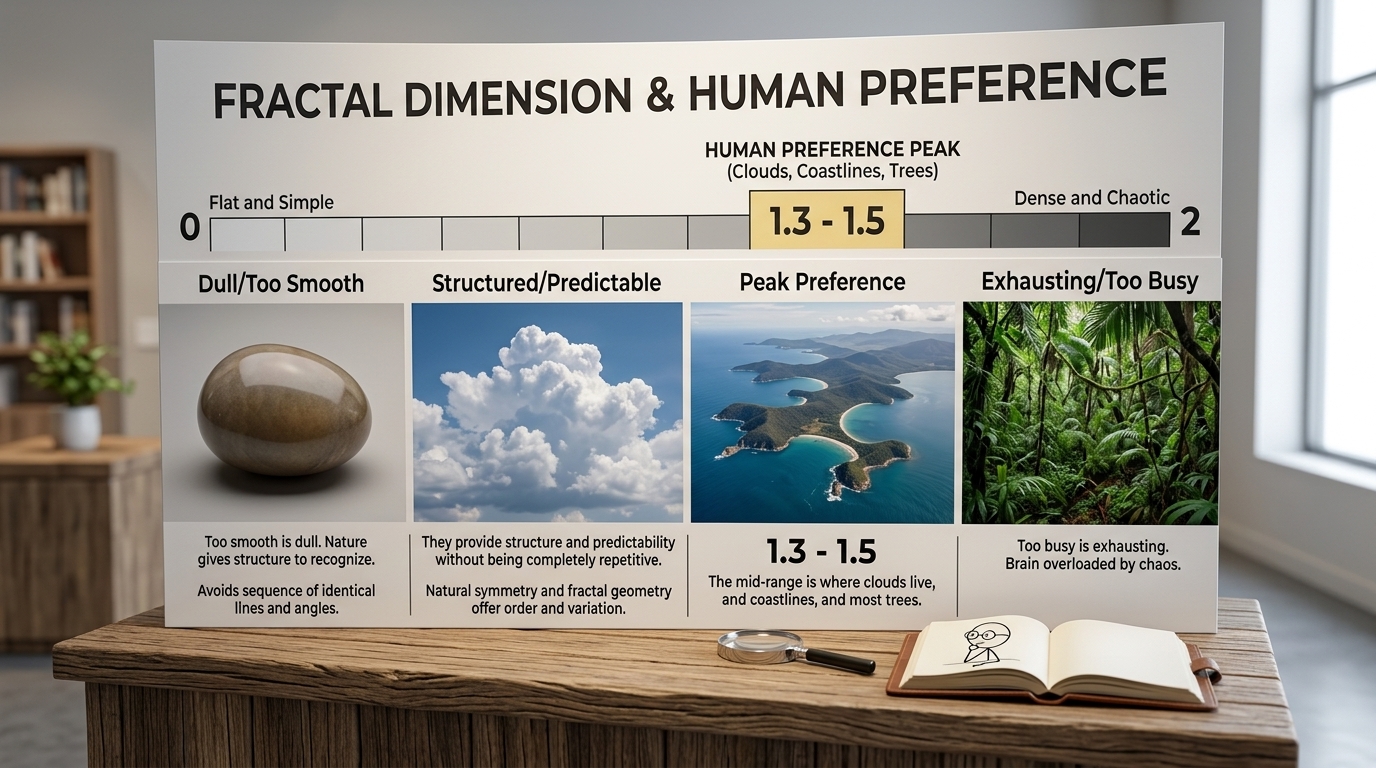
Research into environmental perception suggests that many of these natural patterns are relatively easy for the visual system to process. They provide structure and predictability without being completely repetitive. Natural symmetry and fractal geometry offer a degree of order, but they also contain variation.
In other words, nature tends to give the brain something it can recognise without forcing it to process an endless sequence of identical lines and angles.
There is a number attached to this, which I find oddly satisfying. Fractal roughness can be measured as a dimension, running from flat and simple to dense and chaotic, and human preference does not rise in a straight line — it peaks in the middle, around 1.3 to 1.5. Too smooth is dull. Too busy is exhausting. The mid-range is where clouds live, and coastlines, and most trees.
The Office Does the Opposite
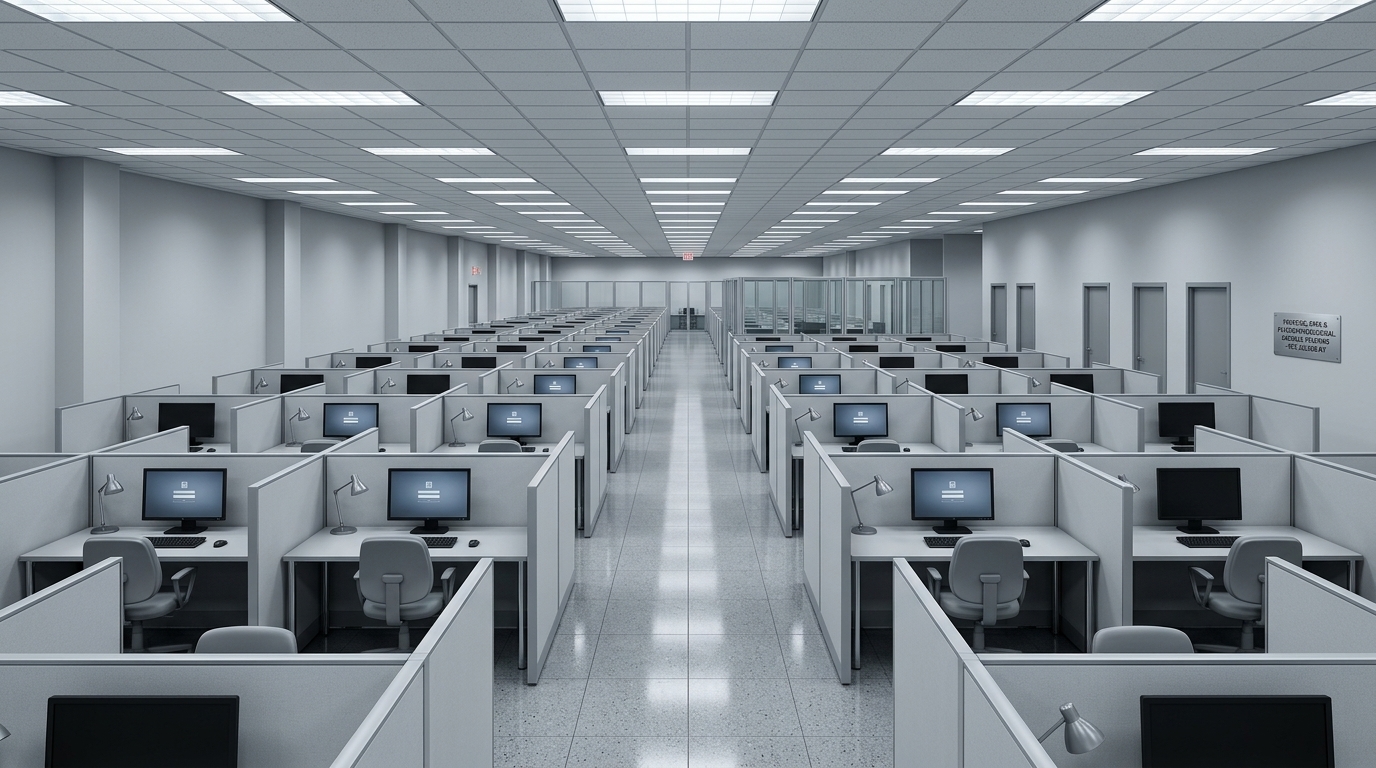
Consider an office composed almost entirely of straight walls, rectangular rooms, hard surfaces, repetitive ceiling grids, uniform lighting and 90-degree intersections. Every element is orderly and functional, and there may be very little visual variation anywhere in it.
The result is an environment that can feel perceptually monotonous while still requiring the brain to continuously interpret artificial boundaries, spatial divisions and repetitive visual information. Boring and effortful at once, which is a genuinely impressive combination to have engineered by accident.
There is at least one study that caught this happening outside a laboratory. The neuroscientist Colin Ellard walked people along a New York street wearing sensors that track physiological arousal. In front of a long blank building frontage, his participants bottomed out — physiologically bored, and reaching for words like bland and monotonous. One block away, in front of small shopfronts with open doors and a great deal to look at, the same people lit up. Same city, same weather, minutes apart.
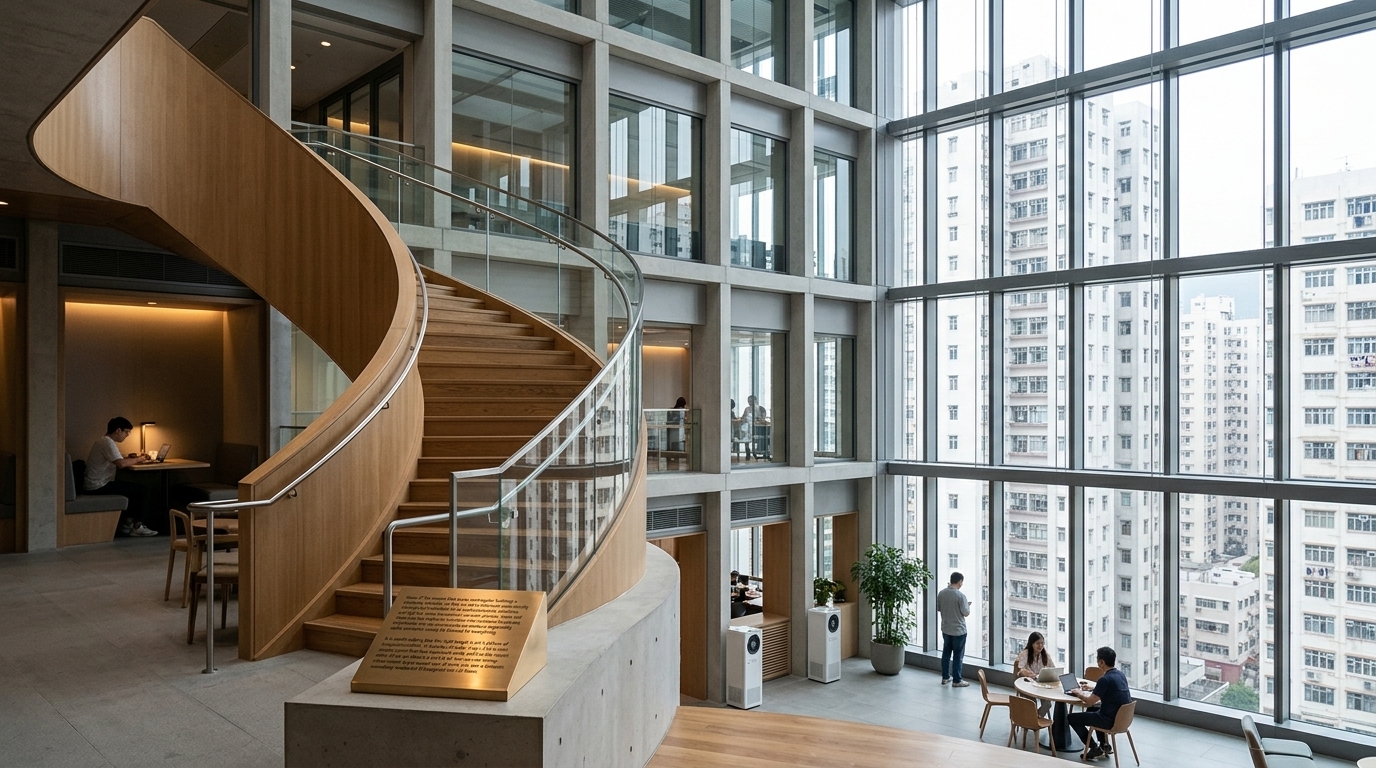
“Nature tends to give the brain something it can recognise without forcing it to process an endless sequence of identical lines and angles.” — The load is small, unannounced, and paid every hour you are in the room.
Walls Cannot Be Blamed for Everything
None of this means that every rectangular building is inherently stressful, or that curved architecture automatically makes people healthier.
The human brain is remarkably adaptable, and lighting, noise, temperature, crowding, privacy, views and the simple ability to control your own surroundings all shape how a space is experienced. Architecture is annoyingly complicated, because apparently walls cannot simply be blamed for everything.
It is worth adding that the right angle is not a failure of imagination either. It is cheap, it stacks, it tiles, it fits the most people onto the least expensive land, and it is the reason most of us can afford a roof at all. Curves cost money. Irregularity costs money. Every square box in every city was a decision somebody made with a budget in front of them.
Why the Plants Are Not Just Decoration
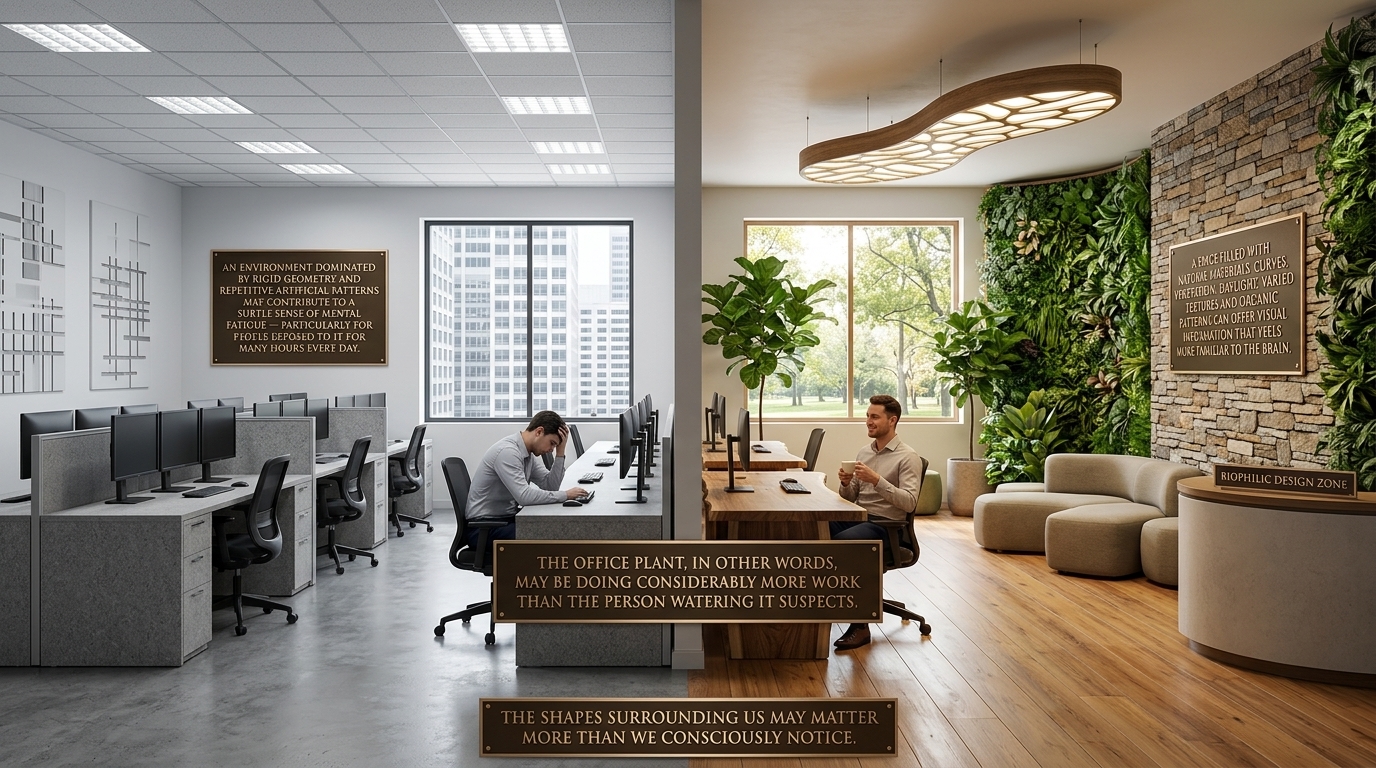
The larger point is that the shapes surrounding us may matter more than we consciously notice.
A space filled with natural materials, curves, vegetation, daylight, varied textures and organic patterns can offer visual information that feels more familiar to the brain. An environment dominated by rigid geometry and repetitive artificial patterns may contribute to a subtle sense of mental fatigue — particularly for people exposed to it for many hours every day, which is to say most people, most days.
Which helps explain why bringing elements of nature into buildings is not merely an aesthetic trend. Plants, timber, natural stone, daylight, curved forms, views of vegetation and patterns drawn from natural structures introduce exactly the complexity and variation that highly standardised interiors have engineered out.
The office plant, in other words, may be doing considerably more work than the person watering it suspects.
Back to the Chair
After spending most of human history surrounded by forests, rivers, rocks and open landscapes, we have built environments where nearly every surface is straight, every corner is precise, and every object has been forced into a rectangle.
I studied architecture for two years in San Diego before life took the decision out of my hands — enough to be dangerous at a dinner party, nowhere near enough to design a building. I’ve written since about why Mies van der Rohe was never the minimalist everyone takes him for, and about Álvaro Siza’s concrete sail in Lisbon, which hangs in a curve because the curve was the entire point. The great architects of the straight line were never arguing that the world should contain nothing else. That was their imitators, on smaller budgets, with fewer ideas.
My salon in Brasschaat is a rectangular room, because almost every room is. I have not knocked a curve into a single wall, and I am not going to suggest you do either. Nobody has to demolish anything.
But I notice that I have done the same thing here that I did in La Jolla, with different materials. There, it was a yellow wall facing a purple one and a pattern painted around a concrete floor. Here in Brasschaat, it is a heavy, large, weathered wooden table surrounded by four styling chairs, a wooden floor I never got round to resurfacing, a long narrow colour-mixing table I custom designed with curves for the back of the salon and the same curves carried into the wooden desk at the front, two large glass windows to take in the view of a tree standing outside that does something different every week of the year, and warm light instead of even light.
The walls are still straight. Almost nothing else is.
Both times, it was instinct. Both times, what people actually said was that the room felt simple.
So the question was never whether right angles are bad. It is whether a room built almost entirely out of them is quietly asking more of the people inside it than it needs to — and whether the answer is as cheap as a tin of paint, one curved edge, and leaving the floor alone.
The Salon California Journal is a space for ideas, culture, and conversation from my chair in Brasschaat, Belgium. I write about beauty, technology, society, and the intersections between them.