
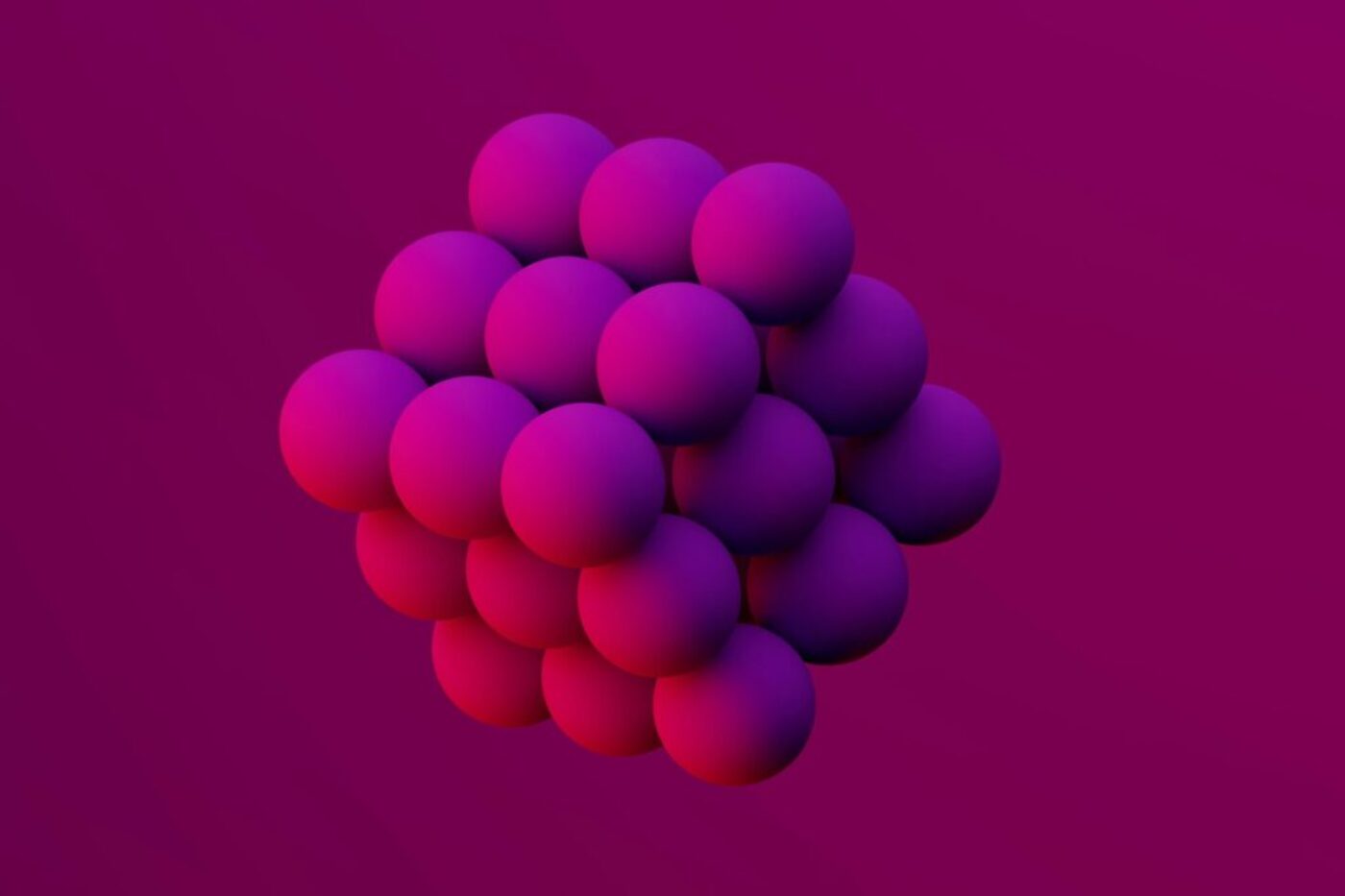
Magenta Does Not Exist
You Are Making It Up Right Now.
There is a color you see almost every day — on screens, in flowers, in logos — that does not correspond to any wavelength of light. Your brain invents it, every single time. And once you understand how, you will never look at anything the same way again.
A client arrived last week with a photo on her phone and the expression of someone who had already made the decision and was only informing me of it. The photo was of hair in a shade somewhere between pink and purple — loud, confident, unmissable. “Magenta,” she said. “Can you do it?”
“I can,” I said. “Although I should tell you something about that color first.”
“That it’s too much?”
“That it doesn’t exist.”
She lowered the phone. “It’s right here on the screen.”
“And it still doesn’t exist. You’re inventing it right now. So am I. That’s the interesting part.”
I first learned this in a library in San Diego, in 2007, during my two years of architecture studies — before the move to Belgium ended them. Each student in one project was assigned one of the five senses to explore through architecture. Mine was sight: design a space, or a series of spaces, that would evoke and enhance the experience of seeing. The internet then was thin, and there was certainly no AI waiting to answer every curious question, so I spent hours among the shelves, digging through books on perception, vision, and color. What I found completely changed the way I thought about the world.
[Switches to serious face.] There is a color you see almost every day that does not correspond to any single wavelength of light. Your brain manufactures it on the spot, every time. And pulling on that thread unravels something much bigger: color itself is not out there in the world at all.
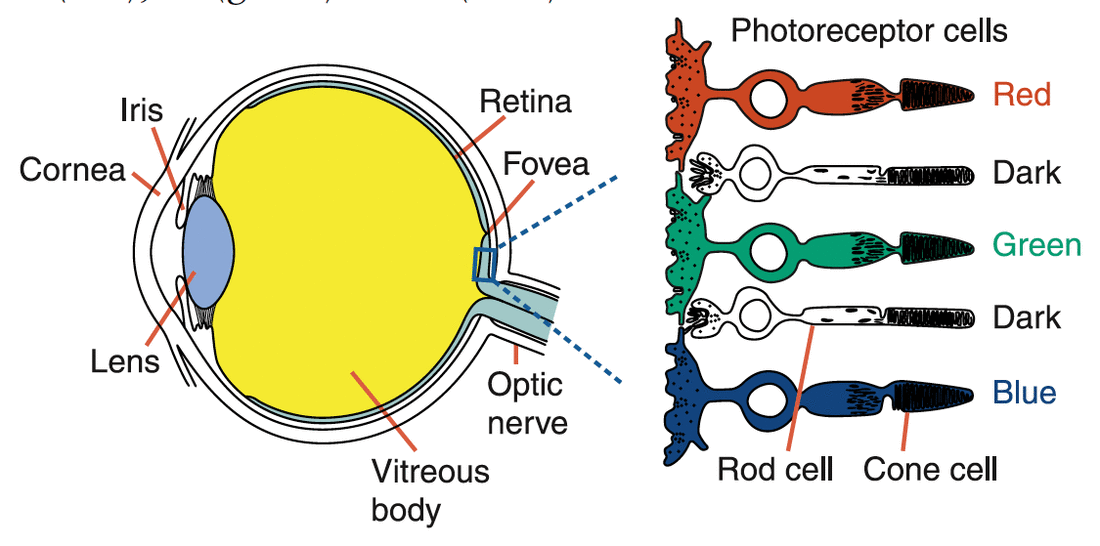
3 types of cone cells at the back of your retina — roughly tuned to red, green, and blue — from which your brain builds every color you have ever seen
380–700 nmthe approximate range of wavelengths your eyes can detect — the entire visible spectrum, from violet to deep red
~ 1 milliondistinct colors the average human eye can tell apart — some estimates run far higher
0 wavelengths of light that are magenta — it appears nowhere in the spectrum, and yet you see it constantly
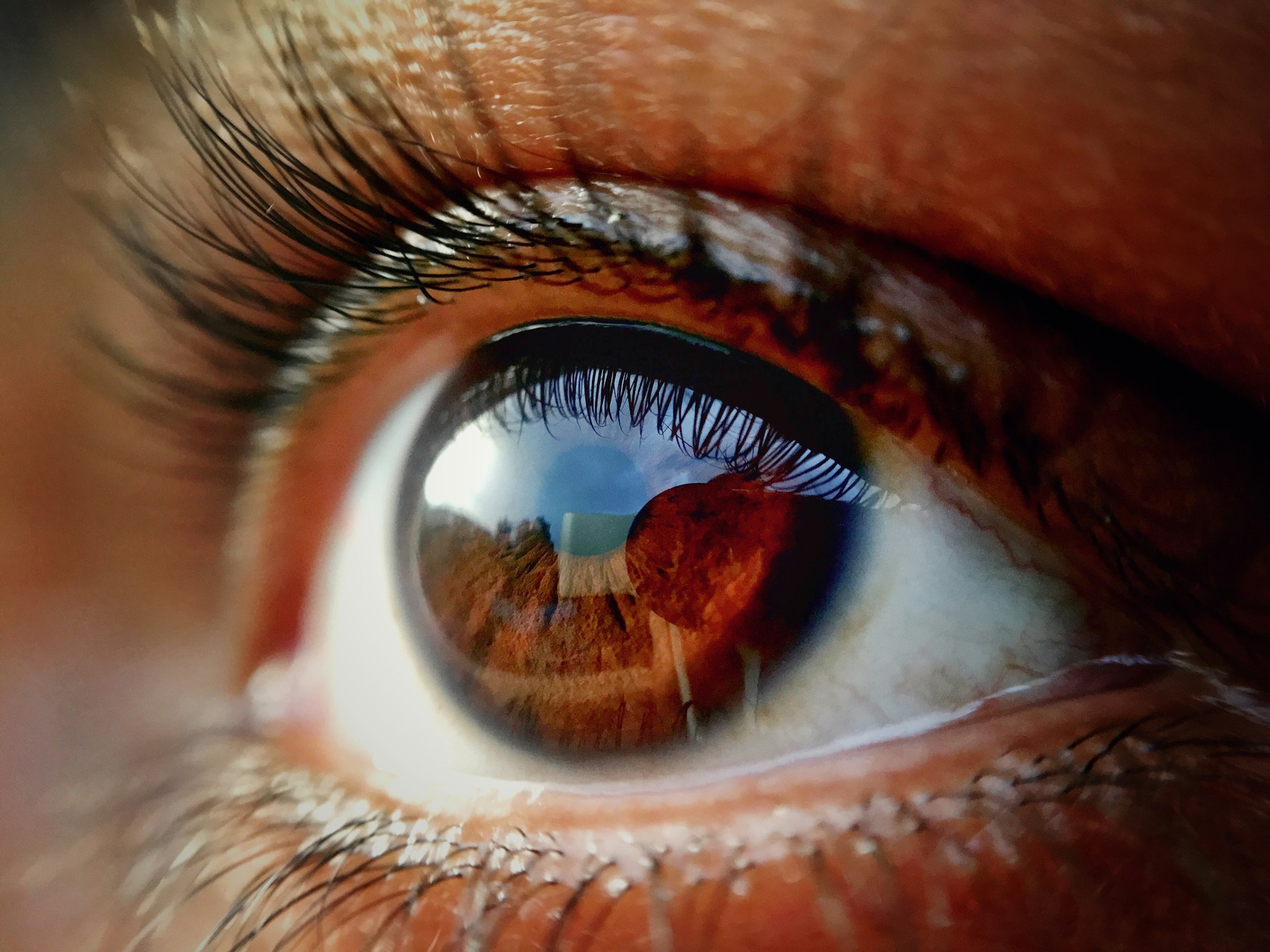
Light Has No Color
Let’s start with the broader truth, because it is stranger than the headline.
Light itself has no color. It is electromagnetic radiation traveling through space at different wavelengths, and those wavelengths are not inherently red, blue, or green. They are just physical properties — numbers, essentially, describing how the wave moves. Calling a wavelength “red” is like calling a radio frequency “jazz.”
Color only comes into existence when light reaches your eyes. At the back of your retina sit three types of cone cells, each sensitive to a different range of wavelengths — roughly corresponding to red, green, and blue. Three signals. That is all your brain receives. From those three signals it constructs the entire spectrum of color you experience: every sunset, every painting, every questionable hair decision of the 1980s.
Which means an apple is not actually red. It reflects certain wavelengths of light, your eyes detect them, and your brain interprets them as red. The color isn’t in the apple. It’s in your perception.

Photos: Unsplash
Try to Find Magenta in a Rainbow
Now consider magenta — that vivid pinkish-purple my client was holding up on her phone.
Try to find it in a rainbow.
You can’t.
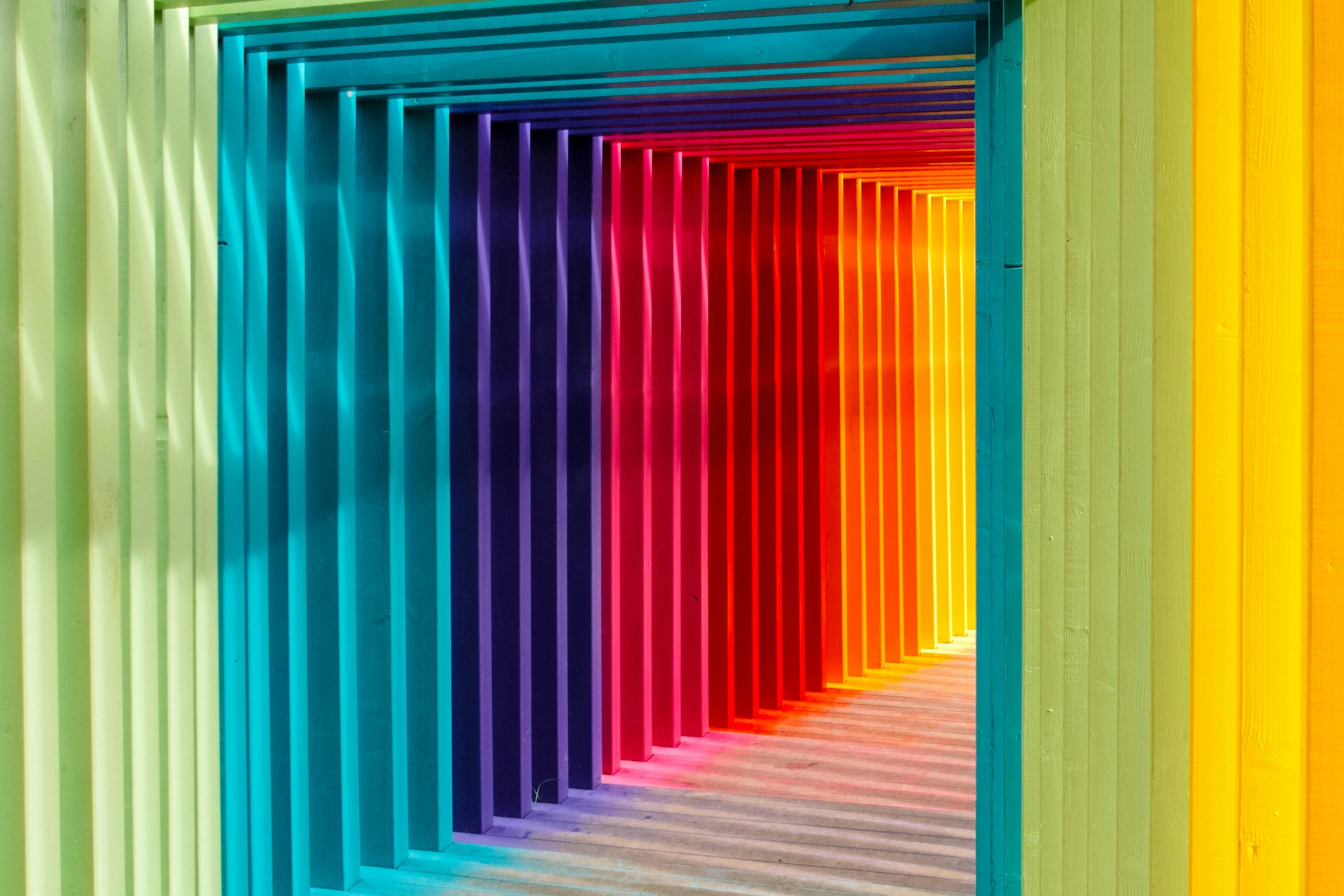
A rainbow is sunlight split into its component wavelengths, laid out in order: red, orange, yellow, green, blue, violet. Every color in that arc corresponds to a specific wavelength of light. Magenta is not there. Not hiding between two bands, not squeezed against an edge. Absent. Unlike red or green or blue, magenta has no single wavelength of light. It does not exist as one specific color in the visible spectrum.
So how do you see it?
The Color Your Brain Invents
When your eyes receive strong signals for both red and blue, but very little or no green, your brain faces a problem. Red sits at one end of the spectrum. Blue sits near the other. The honest average of the two would be green — the one signal conspicuously missing. So your brain does something remarkable: it invents a completely new perception to fill the gap. It bends the spectrum into a circle, joins the two loose ends, and produces a color that no wavelength of light can make on its own.
That color is magenta. A diplomatic solution to a sensory dispute — and you see the result on screens, in flowers, in artwork and logos, every day of your life, without the slightest suspicion that your brain is composing it live.
“The color isn’t in the apple. It’s in your perception.” — Which is also true of the rainbow, the screen you are reading this on, and every head of hair that has ever left my salon.
Black and White Are Strange Too
Once you accept that magenta is an invention, the edge cases of color start to look different as well.
Black is not a color of light. It is what you perceive when there is no visible light reaching your eyes at all — not a signal, but the absence of one. Your brain renders that absence as something you can point at and name, which is quietly absurd if you think about it for too long.
White is the opposite. When all the visible wavelengths arrive together, your brain does not report a crowd. It blends the entire spectrum into a single clean perception and calls it white. One is everything at once, the other is nothing at all, and your mind serves both to you as if they were just two more shades on the chart.
The Deep End
Philosophers have been arguing about where color actually lives — in objects, in light, or in minds — for centuries, and the argument is far from settled. The Stanford Encyclopedia of Philosophydevotes a long entry to the problem of color, and it reads like a detective story in which every suspect has an alibi. On the science side, the National Eye Institute explains how the eye’s photoreceptors turn light into the signals the brain works with. The physics is settled. The philosophy is not. The gap between the two is where magenta lives.
Photos: Unsplash
The Universe Isn’t Colorful. You Are.
So the world around you is not filled with colors waiting to be discovered. It is filled with light — colorless, patient, indifferent light — and your brain translates that light into the rich, saturated experience you call reality. Every color you have ever seen was rendered privately, for an audience of one, inside your own head.
Color is not a property of objects. It is an experience created inside your mind.
“In a very real sense, the universe isn’t colorful. You are.” — The conclusion I carried out of a San Diego library in 2007, and have never managed to put down since.
That library project, by the way, asked me to design a space that would enhance the experience of seeing. I remember sitting there realising that the real assignment had reversed itself: the space I was supposed to be studying was behind the eyes, not in front of them. Architecture could shape the light. Only the visitor could supply the color. Nineteen years later, I have still not found a better description of what design actually is.
Back to the Chair
The client went through with the magenta, in case you were wondering. It suited her. She sat in the chair afterwards, turning her head slowly in the mirror, admiring a color that exists nowhere in the physical universe, and said, “So no one has ever actually seen this.”
“Everyone who looks at you will build it themselves,” I said. “Personally. On the spot.”
“That,” she said, “is the best thing anyone has ever told me about a hair color.”
I touched a related thread in a previous piece on the spotlight effect and the audience your mind invents — the discovery that a surprising amount of what feels like the outside world is manufactured on the inside. Color turns out to be the most literal case of all. The light is real. The wavelengths are real. The magenta is yours.
Somewhere in a library in San Diego there is probably still a shelf of books on perception with my fingerprints on them. I never finished the degree. The assignment, apparently, finished me — because nineteen years later, a client shows me a phone and I am right back among those shelves. I did the only sensible thing available. I mixed the color that doesn’t exist, and charged for it as if it did.
The Salon California Journal is a space for ideas, culture, and conversation from my chair in Brasschaat, Belgium. I write about beauty, technology, society, and the intersections between them.