Termites
The Termites Aren’t Charging Us Royalties
An architect in Harare built a tower cooled the way a termite mound is cooled. It uses about a tenth of the energy of a conventional building. And biologists have since established that termite mounds do not work the way he thought.
I was at a gathering recently when someone mentioned termites, and I immediately remembered a conversation I once had with a client back at the La Jolla salon.
It reminded me of one of the great ironies of architecture: sometimes the best architect in the room is an insect.
In Zimbabwe, an architect named Mick Pearce looked at a termite mound and had a thought that architects, engineers and humans in general rarely have.
What if the termites are better at this than we are?
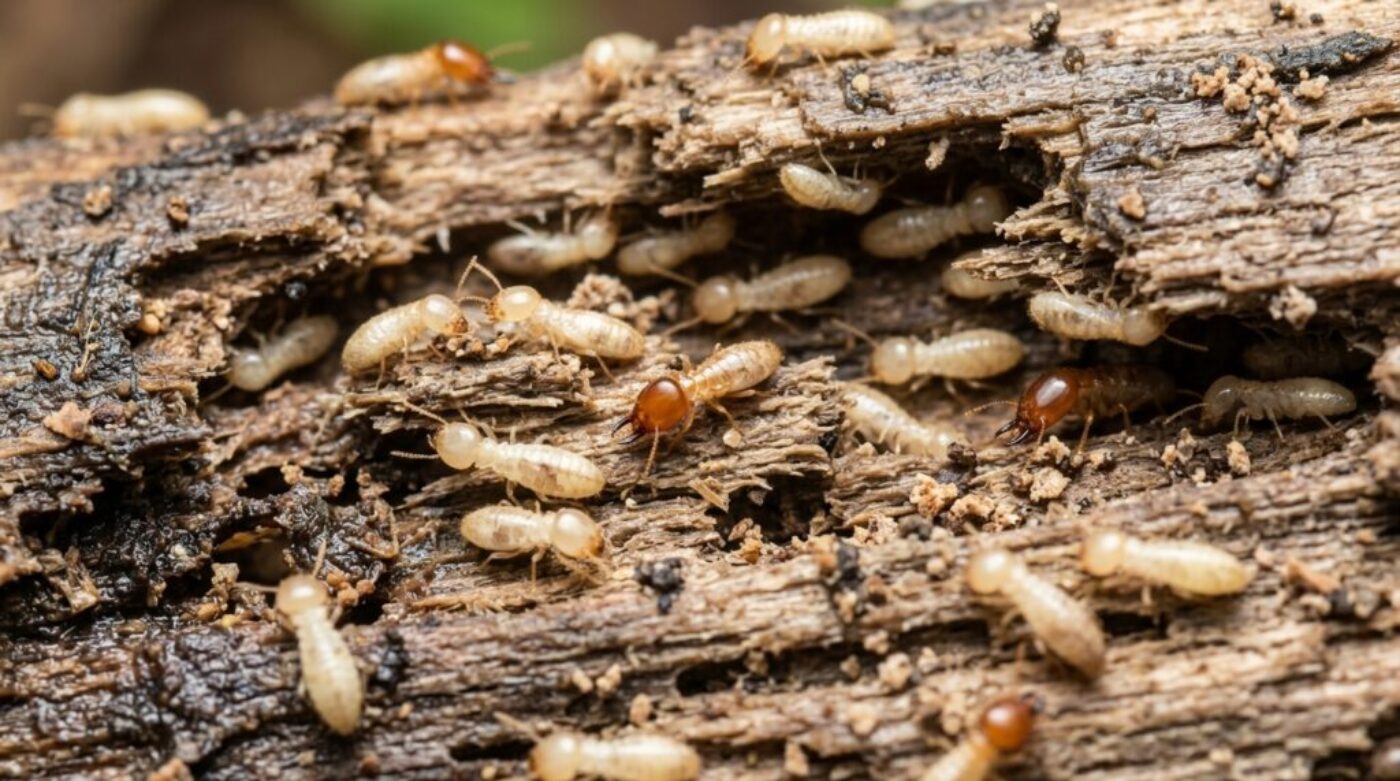
Termites have been building climate-controlled structures in brutal heat for roughly fifty million years, and somehow managed it without installing a single air-conditioning unit. No compressors. No refrigerant. No electricity bill. No maintenance contract politely informing them that their system has failed catastrophically.
So Pearce studied them.
50 m years termites have been doing this, without once convening a working group
1996 the year the Eastgate Centre opened in Harare, before biomimicry had conferences
~10% of the energy a comparable conventionally cooled building would use
$3.5 m saved up front by not buying the air-conditioning plant in the first place
Let’s Use the Building
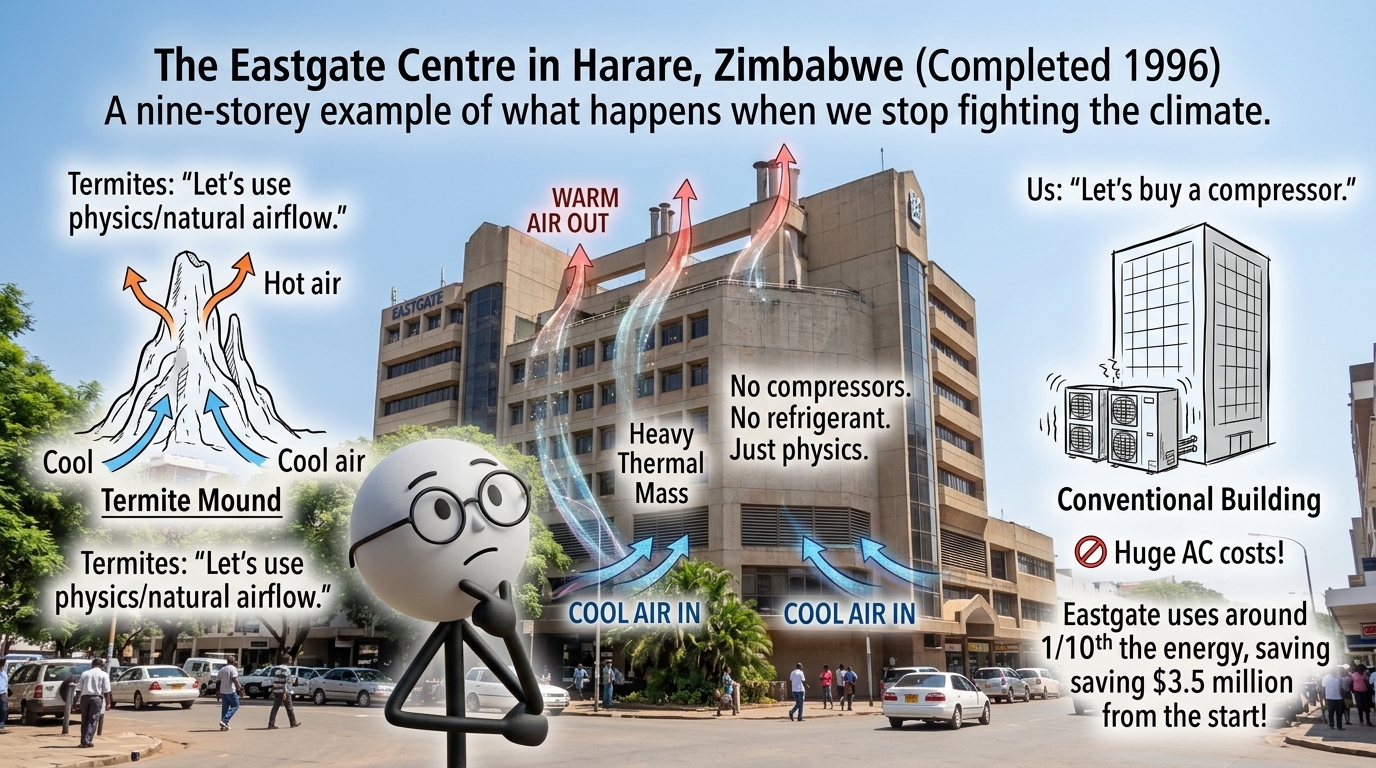
The result was the Eastgate Centre in Harare, completed in 1996 — long before biomimicry became fashionable enough to have conferences, consultants and probably a corporate slide template.
It is a nine-storey example of what happens when we stop fighting the climate and start paying attention to it.
The principles Pearce worked from are simple enough to explain in a paragraph: thermal mass, ventilation, convection and controlled air movement. Hot air rises and escapes through chimney-like passages. Cooler air is drawn in lower down. A heavy structure absorbs and releases heat slowly, which keeps the inside steady while the outside does whatever it likes.
Translated into a building, it works like this. At night, cool air is drawn in through vents at floor level and chills the concrete mass. During the day, that stored coolness bleeds back into the occupied rooms while warm air rises and leaves through the stacks at the top.
No compressors. No refrigerant. No mechanical cooling army working around the clock.
Just physics. And inconveniently for us, physics appears to work: the building reportedly uses around a tenth of the energy of a comparable conventionally cooled one, and not buying the air-conditioning plant saved something like three and a half million dollars before anyone switched anything on.
Termites looked at the problem and said, essentially, let’s use the building.
We looked at the problem and said, let’s buy a compressor.
Now the Awkward Part
Here is where the story gets better than the version everybody tells, including the version I would have told you last month.
Termite mounds are not air conditioners.
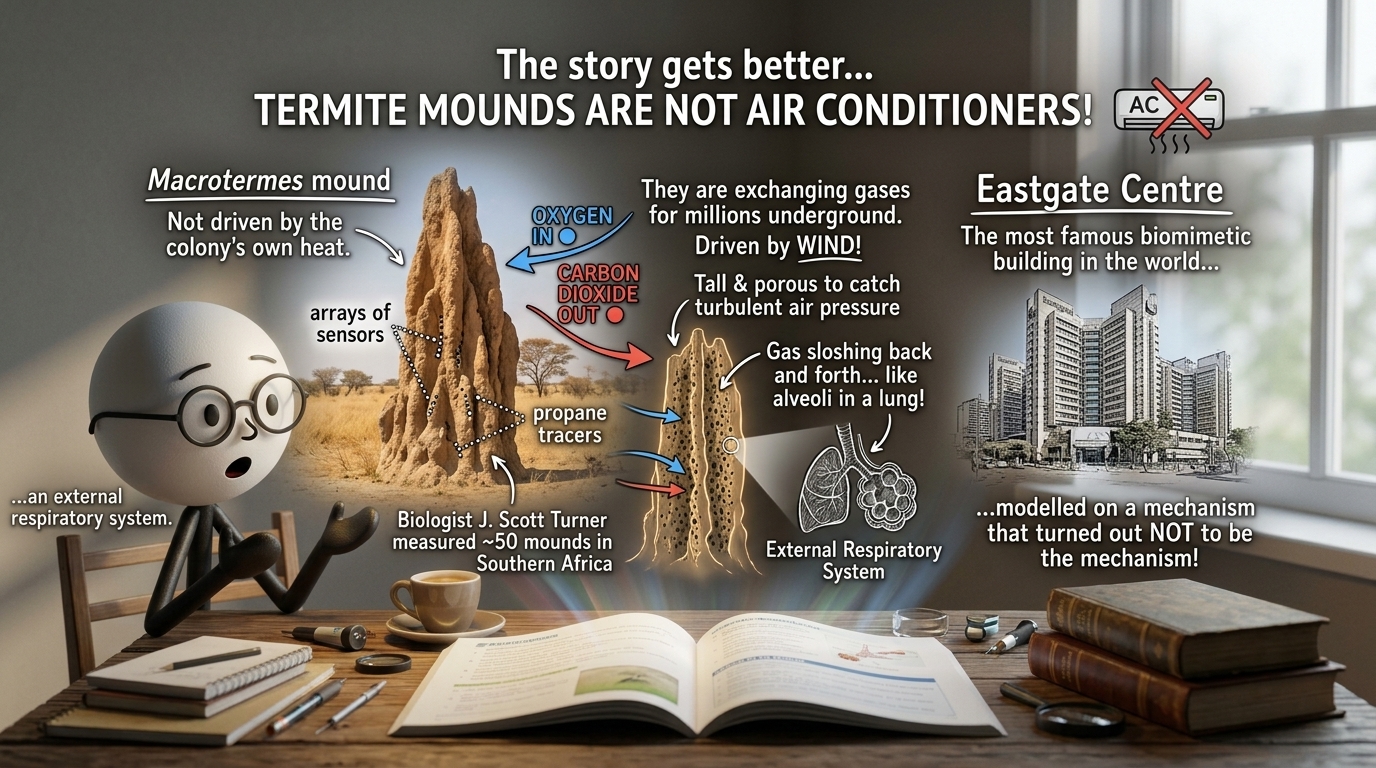
The biologist J. Scott Turner spent years actually measuring them — propane tracers, arrays of tiny sensors, something like fifty mounds in southern Africa — and found that Macrotermes mounds are not primarily regulating temperature at all. They are exchanging gases. Oxygen in, carbon dioxide out, for a colony of millions that would otherwise suffocate underground.
And the air is not being driven by the colony’s own heat rising through a chimney. It is driven by wind. The mound is built tall and porous to catch turbulent air pressure outside, which sloshes gas back and forth through its permeable walls, rather in the manner of alveoli in a lung.
Turner’s description is the one that has stayed with me. Not a crude air conditioner, but a wildly complicated external respiratory system.
Which means the Eastgate Centre — the most famous biomimetic building in the world, in every textbook, on every slide — was modelled on a mechanism that turned out not to be the mechanism.
“The mounds weren’t crude air conditioners so much as a wildly complicated external respiratory system.” — J. Scott Turner, having gone and measured, which remains the most underrated research method available.
And the Building Works Anyway
This is the part I cannot stop turning over.
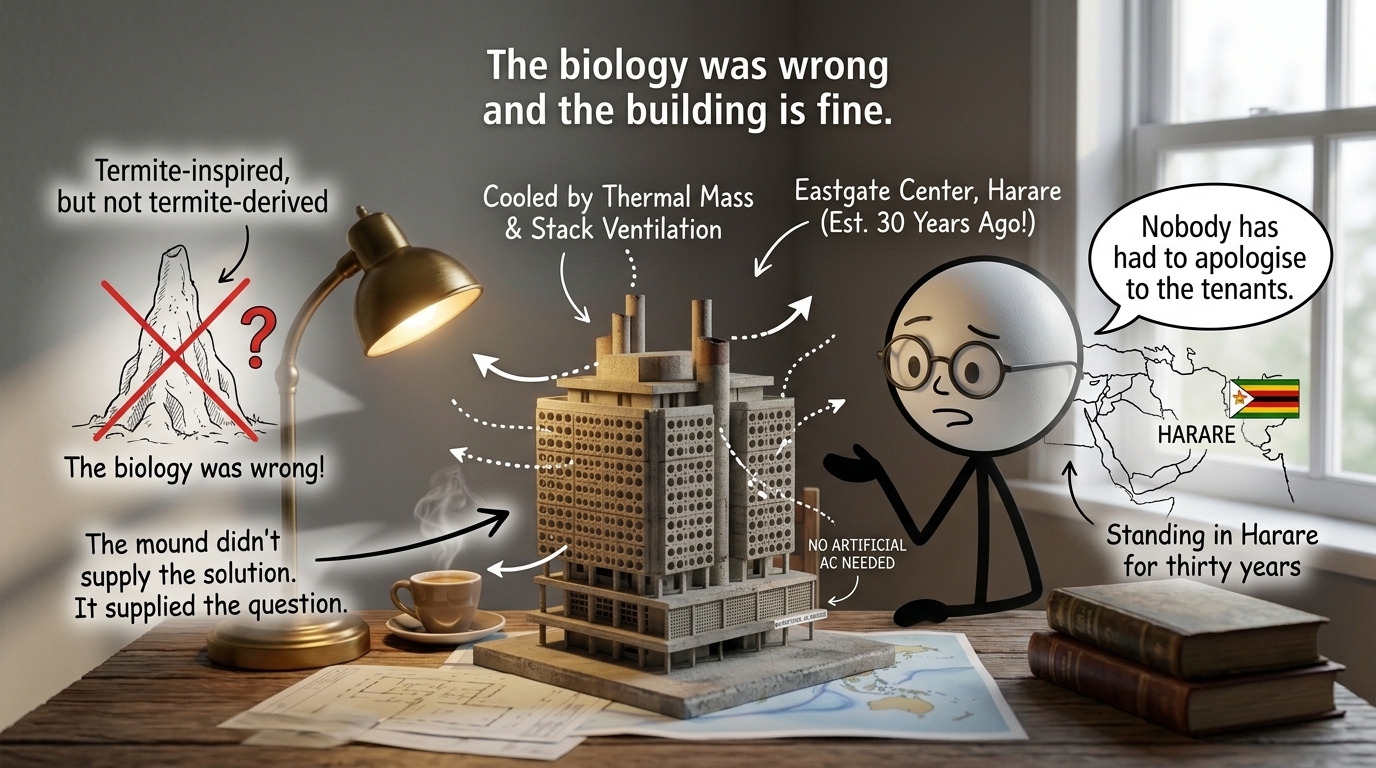
The biology was wrong and the building is fine. It has been standing in Harare for thirty years, cooled by thermal mass and stack ventilation, costing a fraction of what its neighbours cost to run. Nobody has had to apologise to the tenants.
Turner himself is generous about it: Eastgate is termite-inspired rather than termite-derived, and Pearce succeeded because he approached an engineering problem imaginatively, not because he had decoded an insect.
And that is a far more useful lesson than the one usually drawn. Biomimicry is not downloading nature’s blueprint. Nature is not publishing. What actually happened is that a man looked at a structure in the heat, asked why it worked, got the answer partly wrong, and in the process arrived at thermal mass and night purging — which are excellent ideas on their own merits and would have worked had termites never existed.
The mound did not supply the solution. It supplied the question. That turns out to be most of the job.
Meanwhile
The Eastgate Centre was designed with principles understood long before computational fluid dynamics, airflow simulation and the software that can now model all of it to extraordinary precision.
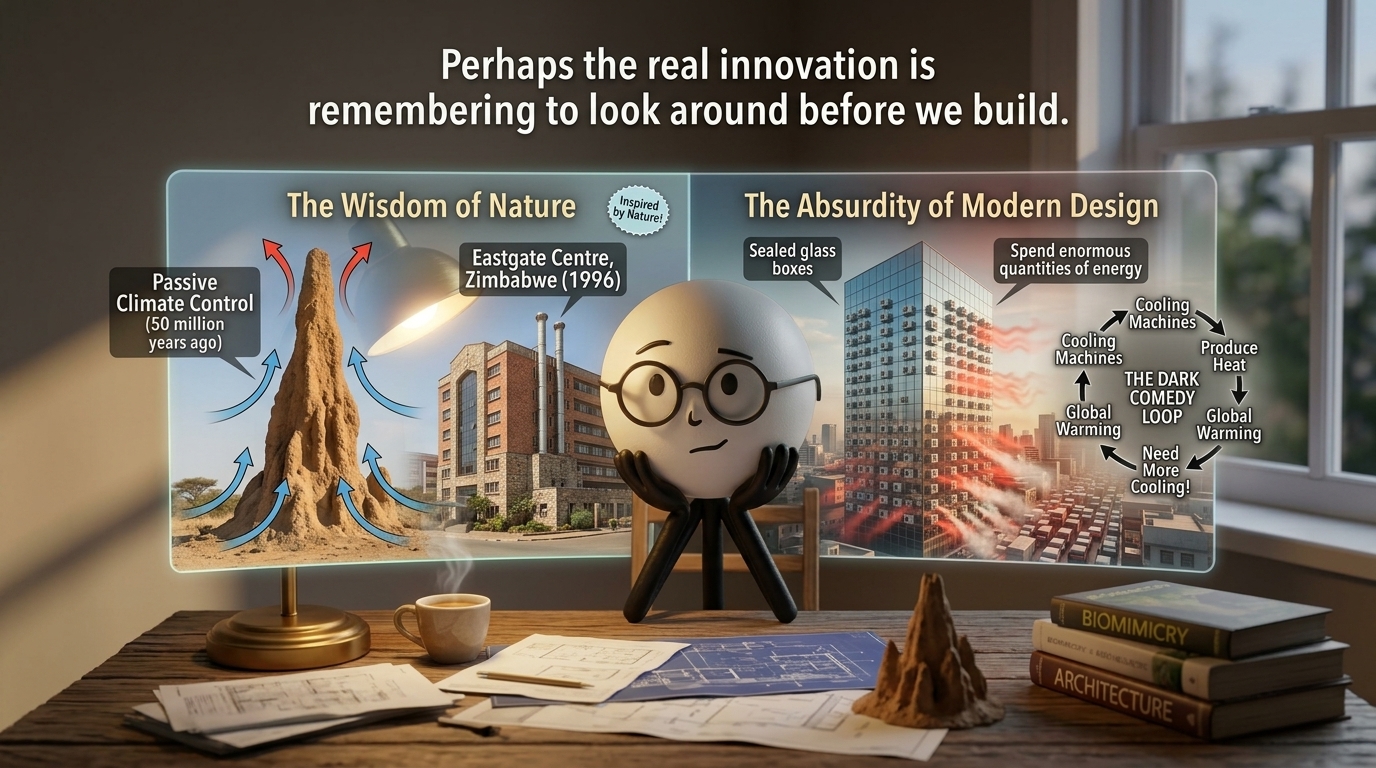
And yet, in hot climates, we still routinely build sealed glass boxes and then spend enormous quantities of energy making them survivable.
Air conditioners and electric fans together account for something like a tenth of all the electricity used on earth, and demand for cooling is expected to climb steeply as the planet warms — which is a loop with a certain dark comedy to it, since the machines keeping us cool are helping to produce the heat.
The absurdity is difficult to miss. The termites worked out passive climate control roughly fifty million years ago. An architect in Zimbabwe paid attention in the early nineties. The building opened in 1996. And here we are, decades on, still installing compressors everywhere and congratulating ourselves on the sophistication of the machinery.
Perhaps the real innovation is not inventing better machines. Perhaps it is remembering to look around before we build them.
Back to the Chair
What my client in La Jolla told me, all those years ago, was that termites keep the inside of the mound at a steady, comfortable temperature.
I believed that for about thirty years. It is a very good fact, and it is the version almost everybody has.
And it is, as we have just established, not quite what the termites are doing.
So I have been carrying a slightly wrong idea around since the nineties, acquired in a salon chair in California, and I only found out it was wrong because I sat down to write this. Which is, more or less, how my entire education has worked.
I’ve written elsewhere about the Persian engineers who made ice in a desert with a mud dome, a wind tower and a very good understanding of the night sky — the same trick, two and a half thousand years earlier, and also without a compressor. Put the two side by side and a pattern appears that I find slightly embarrassing on our behalf. In both cases the solution was not a device. It was an arrangement: mass, shape, orientation, and the patience to let the night do some of the work.
We did not lose that knowledge because it was disproved. We lost it because electricity made it unnecessary, and then we built a century of buildings on the assumption that the power would always be cheap and always be there.
Which brings me to the only line in this whole subject I would put on a wall.
The termites aren’t charging us royalties. They are not asking for credit, a consultancy fee, or a slide at the conference. They are simply out there, in the heat, running the oldest working climate system on the planet — and getting it slightly differently right than we thought, which is the most natural thing in the world.
The Salon California Journal is a space for ideas, culture, and conversation from my chair in Brasschaat, Belgium. I write about beauty, technology, society, and the intersections between them.