
Change
There Is No Customer Service Department for Life
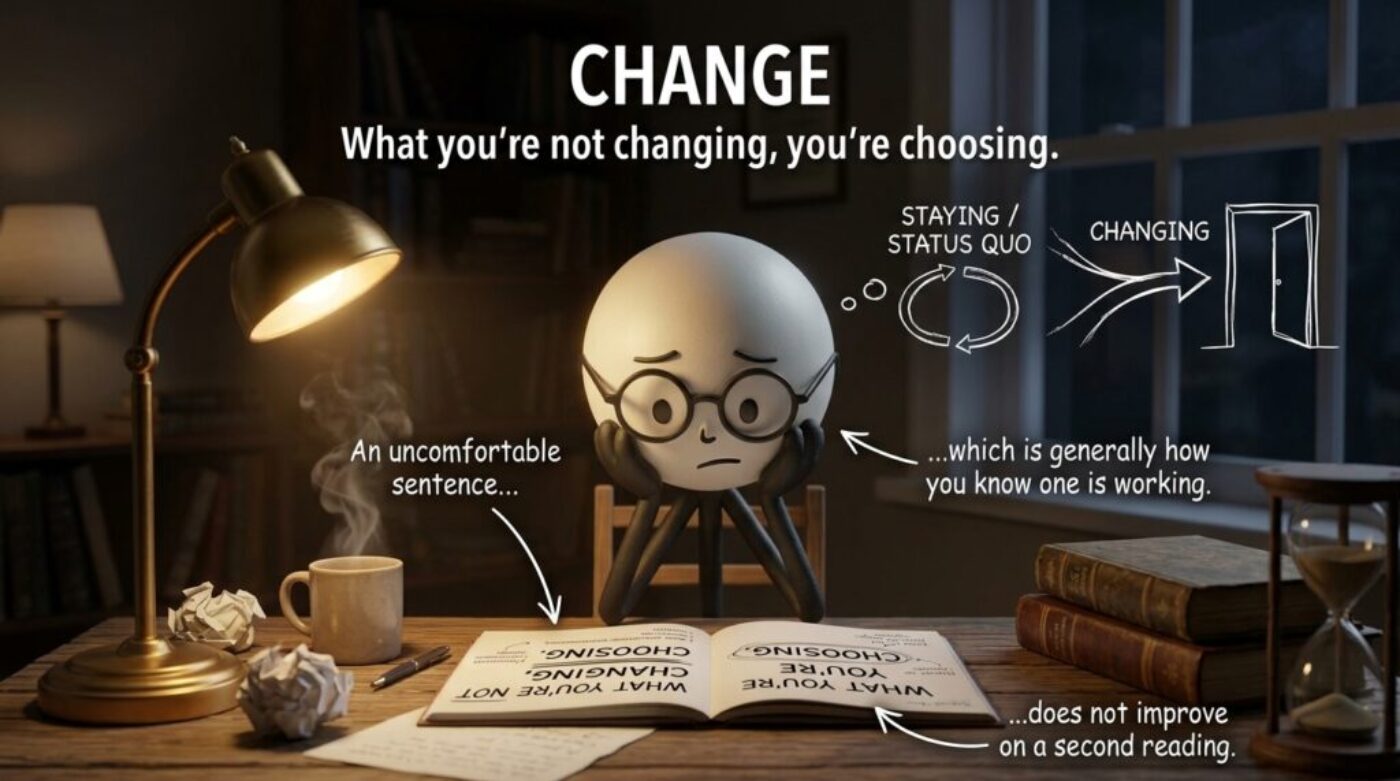
What you’re not changing, you’re choosing. It is an uncomfortable sentence, and it does not improve on a second reading, which is generally how you know one is working.
“I’m leaving that job,” a client told me a few weeks ago. “This year. Definitely this year.”
I said that sounded like a good plan.
Then she caught my eye in the mirror, which is where all the honest conversations in a salon happen, and said: “I’ve told you this before, haven’t I.”
I didn’t answer, which is of course an answer.
“How long?”
And here is the peculiar thing about my job. I knew. Not approximately — fairly precisely, because I have seen this person every six weeks for a very long time, and I was present for every single instalment.
I told her it had been a while. It seemed kinder than arithmetic.
5 years, the standard running time of the sentence “I really have to get out of that job”
6 weeks between instalments, in my own professional experience of listening to it
94 studies finding that what actually works is not wanting it more, but a small dull plan
3–5 business days you will wait for a better existence after filing your complaint
You’re Participating in It
So, listen to this:
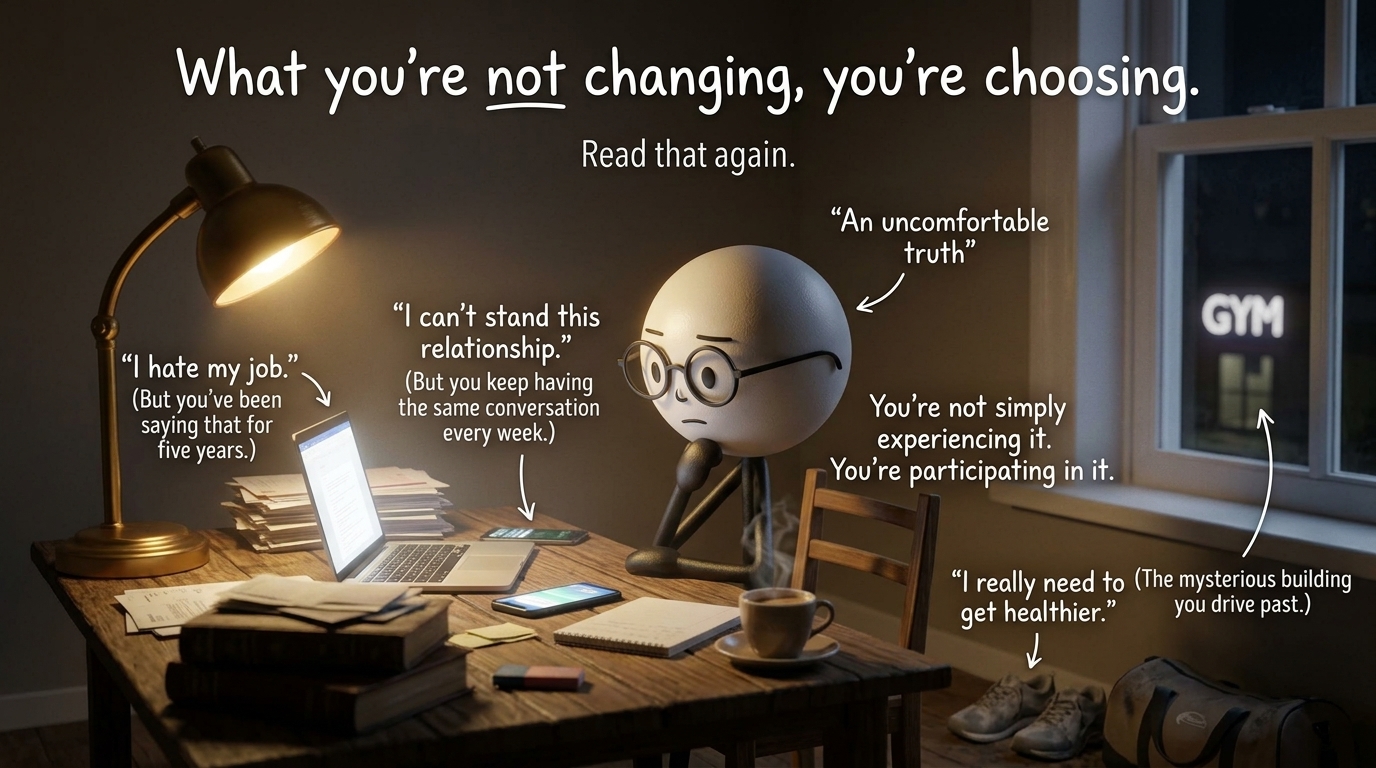
What you’re not changing, you’re choosing.
Read that again.
What you’re not changing, you’re choosing.
That might be one of the most uncomfortable truths you’ll ever hear.
Because if there is something in your life you keep complaining about, but you keep doing nothing about, then you are not simply experiencing it.
You’re participating in it.
Your relationship. Your friendships. Your body. Your health. Your job. Your habits. Your environment.
“I hate my job.” But you’ve been saying that for five years.
“I can’t stand this relationship.” But you keep having the same conversation every week.
“I really need to get healthier.” And somehow the gym remains this mysterious building you drive past.
The Better Question
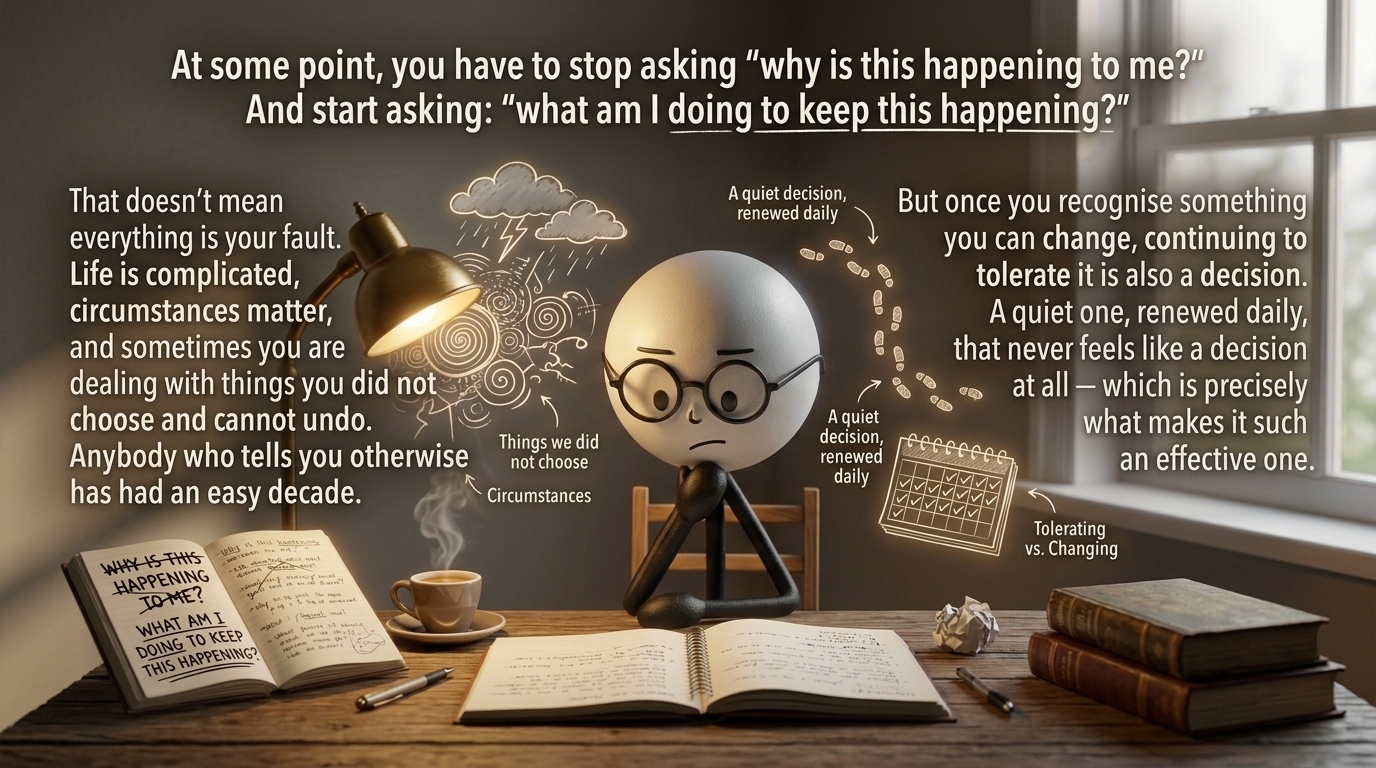
At some point, you have to stop asking “why is this happening to me?”
And start asking: “what am I doing to keep this happening?”
That doesn’t mean everything is your fault. Life is complicated, circumstances matter, and sometimes you are dealing with things you did not choose and cannot undo. Anybody who tells you otherwise has had an easy decade.
But once you recognise something you can change, continuing to tolerate it is also a decision. A quiet one, renewed daily, that never feels like a decision at all — which is precisely what makes it such an effective one.
Change One Thing
You don’t need to transform your entire life tomorrow.
Change one thing. Make one different decision. Take one uncomfortable step.
And if it helps, there is a reliable method for this, which I am sorry to report is extremely boring.
It is not motivation. Motivation is weather — it arrives in January, behaves beautifully for eleven days, and is never heard from again. What works, across ninety-four studies and some eight thousand people, is a formula with no romance in it at all:
If situation X happens, then I will do Y.
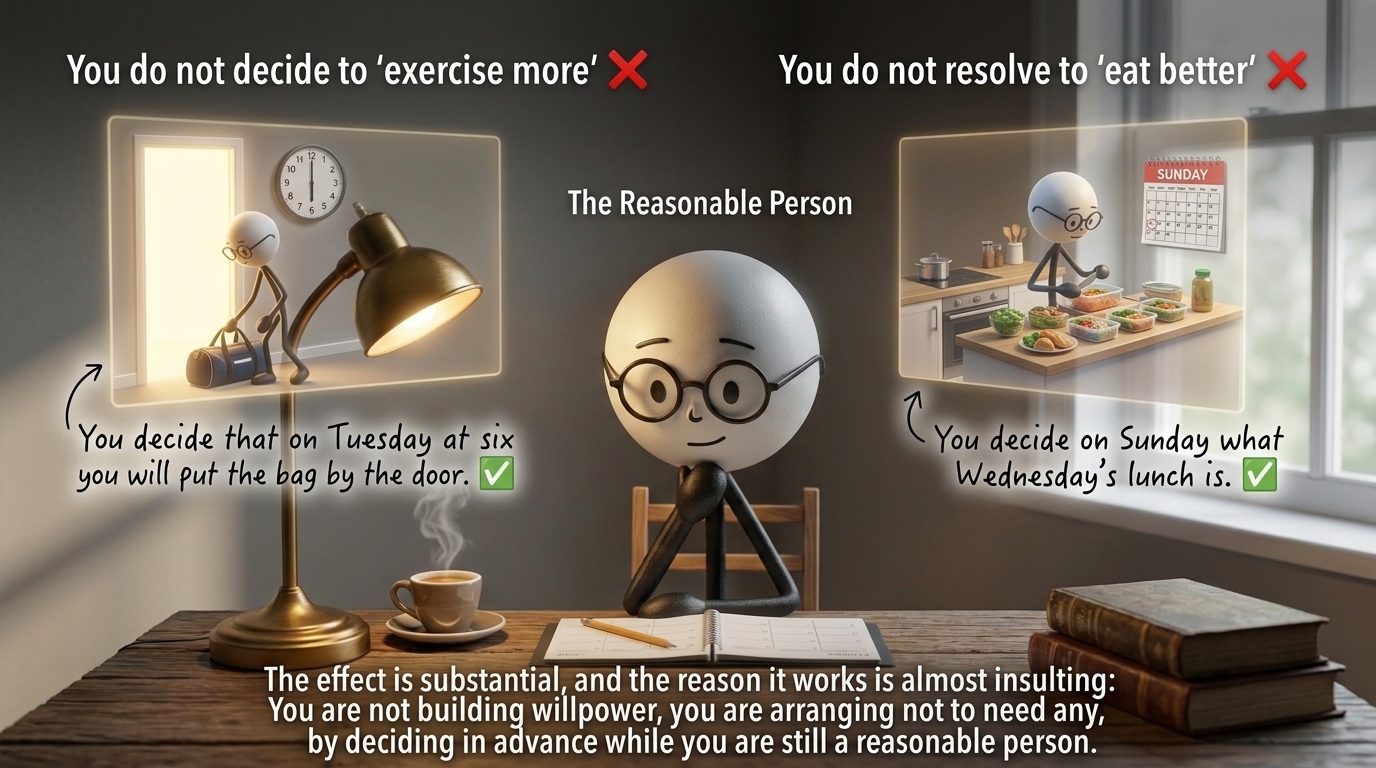
You do not decide to exercise more. You decide that on Tuesday at six you will put the bag by the door. You do not resolve to eat better; you decide on Sunday what Wednesday’s lunch is. The effect is substantial, and the reason it works is almost insulting: you are not building willpower, you are arranging not to need any, by deciding in advance while you are still a reasonable person.
Because your life doesn’t usually change when you want something different.
It changes when you finally start doing something different.
Back to the Chair
The reason I hear so much of this is not that I give good advice. It is the mirror. Forty minutes, side by side, nobody obliged to make eye contact, and people say things they would not say across a table.
And what I have noticed over thirty-odd years is that almost nobody needs telling what to change. They know. They have known for ages. They can describe the problem with a precision that would impress a consultant — the history, the causes, and a complete account of everything that has so far prevented them from doing anything about it.
What is missing is never the diagnosis. It is Tuesday at six.
I’ve written before about how little anybody is actually watching you, which matters here, because a surprising amount of not-changing is really just not wanting to be seen starting badly. Nobody is looking. Start badly. Badly is where everything starts.
Complaining can tell you what’s wrong. It just can’t fix it.
And unfortunately there is no customer service department for life, where you file a complaint and wait three to five business days for a better existence. No queue. No hold music. No cheerful voice explaining that your situation is important to them.
There is only you, the thing, and a Tuesday.
My client, incidentally, comes back next week. I have no idea what she is going to say, and I would not bet against either outcome. But she asked the question out loud, in front of a witness, which in 45 years of listening I have come to regard as the most reliable early sign there is.
The Salon California Journal is a space for ideas, culture, and conversation from my chair in Brasschaat, Belgium. I write about beauty, technology, society, and the intersections between them.