

Vangelis
Accused of Stealing Four Notes, Vangelis Brought Synthesizers Into the High Court
He never properly learned to read music and refused to write it down. Then a courtroom asked him to prove that four notes in the most famous theme of the decade were his — and he answered the only way he knew how.
The man who taught me to cut hair never explained anything. I would ask how he knew to take that section at that angle, and he would say “look” — and then do it again, slowly, while I stood there hoping my eyes were better than my ears. That was the whole lesson. There was no theory. There was a shoulder to watch over.
Last month a client asked me why I was cutting into her fringe the way I was. I opened my mouth to give her the technical answer, and what came out was “watch.” Thirty years, three countries, and a great deal of professional development later, I have become exactly the same unhelpful teacher, and I have made my peace with it.
Some things can only be proved by doing them again in front of somebody.
Which brings me, by a slightly unusual route, to a courtroom in London in 1987, and to a Greek composer who had just been accused of stealing four notes.
4 the notes at issue in the trial — F–G–A–G, a figure musicians call “the turn”
£ 200,000 the costs the claimants were ordered to pay after he won
12 years between Blade Runner reaching cinemas and its score getting an official release
0 Academy Award ceremonies he attended, including the one where he won
Nails in the Piano
Evangelos Odysseas Papathanassiou was born in Agria, on the Greek coast, in March 1943, into a country in the middle of an occupation. By four he had found the family piano, and had begun putting things inside it — nails, kitchen pans, whatever the house offered — to hear what the strings would do about it.
This is usually told as a charming anecdote about a musical child. I think it is the whole man in one sentence. He was not learning the piano. He was conducting an inquiry into it, and the piano was not consulted.
He never properly learned to read music, and later actively refused to. Not because he couldn’t have — he had every opportunity — but because he was convinced that the notation stood between the feeling and the sound, and that whatever survived the trip onto the page was not the thing he had heard. It is the kind of position that sounds like an excuse until the person holding it wins an Oscar, at which point it is repositioned as a philosophy.
Vagos, and the Band That Detonated
He surfaced publicly in 1963 with The Forminx, a Greek beat group in which he played keyboards under the name Vagos and wrote most of the material. Nine singles, a Christmas EP, genuine local fame, and by 1966 it was over, largely because he had stopped being interested.
In 1968 he set out for London with Demis Roussos and Loukas Sideras. They never arrived. Work permits and a complication over a bandmate’s military service left them stuck in Paris, which is the sort of misfortune most people would take, and they signed with Philips as Aphrodite’s Child. “Rain and Tears” sold more than a million copies. They were, briefly, one of the biggest groups in Europe.
So here is a band at the absolute peak of its commercial powers, whose keyboard player responds to the situation by proposing a double concept album about the Book of Revelation.
That album was 666. Its most notorious passage features the actress Irene Papas in a spiralling ritual chant that the legend insists ran to thirty-nine minutes before it was cut to roughly five. The label was alarmed and sat on the release. Vangelis declined to soften it. Salvador Dalí is said to have wanted to build a spectacle around it, which tells you which audience it found. The band tore itself apart during the recording and split in 1971. The record came out in 1972, to a group that no longer existed, and is now regarded as a classic.
He had traded the biggest band in Europe for an apocalypse nobody had ordered. He appears to have considered this a fair swap.
The Room on Hampden Gurney Street
In 1975 he built Nemo Studios, in a building off Marble Arch in London, and this is the part that actually explains the career.
He wired keyboards, synthesizers and percussion into a single connected system so that he could reach anything without getting up, without arranging a session, and above all without stopping to write anything down. He was not building a studio to record music in. He was building an instrument the size of a room, so that the gap between having the idea and hearing it out loud approached zero.
Out of that room came Heaven and Hell in 1975, excerpts of which Carl Sagan later used for Cosmos — which is why a generation who could not name the composer can hum him on request. And out of it came his method for film: watch the scene, feel it, play. Sometimes an entire passage in a single pass, in real time, against the picture.
Composers with conservatory training have described this as either liberating or appalling, depending largely on how their morning went.

Photos: Unsplash
Synthesizers for 1924
Then he was handed a film about British runners at the 1924 Olympics — tweed, chapel, gravel tracks, moral seriousness — and scored it with electronic synthesizers.
On paper this is a terrible idea. Everything about the material asks for strings and brass and a certain kind of English restraint. What he wrote instead was slow, wide, synthetic and strangely weightless, and rather than making the film feel modern it made it feel unstuck from time altogether, which turned out to be exactly what a story about running toward something needed.
In March 1982 it won the Academy Award for Best Original Score. He did not attend. He disliked flying, and he disliked ceremonies, and the combination settled the matter. The main title went on to spend a week at number one on the American Hot 100 after a five-month climb, and the soundtrack held the top of the album chart for a month.
A man who could not read music wrote the most recognisable film theme of the decade, and then declined to collect it in person.
“He was not building a studio to record music in. He was building an instrument the size of a room, so the gap between having the idea and hearing it out loud approached zero.” — Everything he was accused of over the next forty years follows from that one decision.
The Score That Disappeared for Twelve Years
Blade Runner followed in 1982, and the score did something scores were not really supposed to do: instead of sitting under the film and commenting on it politely, it behaved like the film’s interior weather. Synthesizers, orchestral textures, saxophone, rain. It is difficult now to picture the city without hearing it.
The official soundtrack did not appear until 1994.
This is usually told as a story about a record company failing an artist, and I would like to keep the record honest: it is at least equally a story about an artist who would not sign. There was a disagreement, and Vangelis withheld permission for his recordings to be released. Twelve years. In the meantime bootlegs circulated hand to hand, degrading with each copy, which did nothing at all for the sound quality and everything for the mythology.
Being difficult is not automatically the same thing as being right. In this instance it happened to produce one of the great legends in film music, which is the sort of outcome that makes difficult people very hard to argue with afterwards.
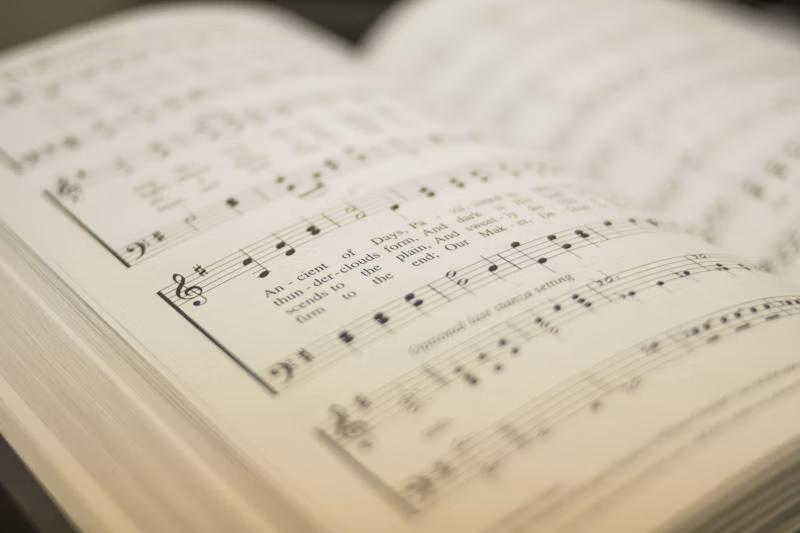

The format he refused to compose in, and the format his most famous score actually reached people in for twelve years. Photos: Unsplash
Four Notes
Which brings us back to the High Court.
In 1987, in a case brought as EMI Music Publishing v Papathanasiou, the Greek musician Stavros Logarides claimed that the Chariots of Fire theme had been lifted from his own composition, “The City of Violets,” written for a Greek television series in the mid-seventies.
The experts narrowed it to four notes. F–G–A–G — a small ornamental figure called a turn — appearing between two bars in one piece and two bars in the other. That was the case. Four notes, an Oscar, and a reputation, all balanced on a musical gesture roughly the length of a sigh.
Vangelis had two answers. The first was ordinary and legal: he had had no opportunity to hear the other piece. The second was that the figure was common property, and that he had used it himself years earlier, in “Wake Up,” recorded with Aphrodite’s Child before “The City of Violets” existed.
He could have left that to the lawyers and the transcribers. Instead he had a pair of synthesizers set up in the courtroom, and demonstrated — in front of the court, in real time — how a piece of music actually arrives when the person making it does not work from a page.
Then he played.
He won. The judge ordered the claimants to pay his costs, around £200,000. A man who had spent his life refusing to write music down defended himself in the one venue on earth built entirely out of documents, and did it by making the thing happen again in front of witnesses.

The direction he kept pointing in. Two space agencies and the International Astronomical Union eventually pointed back. Photo: Unsplash
The Asteroid
Space kept claiming him, and he kept letting it. NASA used his Mythodea as the theme for the 2001 Mars Odyssey mission. He wrote music for the European Space Agency’s Rosetta, timed to the Philae lander touching down on a comet in November 2014, and released the album two years later. In 1995 the International Astronomical Union named a minor planet after him: 6354 Vangelis. His twenty-third and final studio album, Juno to Jupiter, arrived in 2021 and was, inevitably, about a spacecraft.
He died in Paris on 17 May 2022, of heart failure, at 79.
If you only know the Chariots of Fire titles, the interesting listening is elsewhere: Heaven and Hell (1975) for the piece Carl Sagan borrowed, Blade Runner for the score that took twelve years to arrive legally, and 666 if you want to hear a hit band drive itself off a cliff on purpose and produce a classic on the way down. Fair warning on that last one — it is a double album about the apocalypse, and it commits.
Back to the Chair
The reason this story has stayed with me is not the Oscar or the asteroid. It is the shape of the problem.
Every institution he met wanted proof in the format it was built to read. The schools wanted notation. The label wanted a follow-up single. The court wanted a document. And the thing he actually possessed — the ability to hear something complete and put his hands on it — existed in none of those formats, which meant that as far as each institution was concerned it did not quite exist at all.
I wrote a while ago about how much of any creative work is borrowed, and separately about the skills that vanish because nobody ever wrote them down. The Vangelis trial sits precisely where those two lines cross. Four notes that belong to everybody, in the hands of a man whose method could not be filed.
I am not going to pretend the parallel to my own work is grand. Nobody is suing me over four notes, and my studio is a room in Brasschaat with one chair and good light. But I do know what it is to hold a skill that lives in the hands and evaporates on the way to the page. Every hairdresser does. So does every cook, every mechanic, every nurse who can tell something is wrong before the monitor agrees.
And when someone genuinely wants to know how it works, there is still only one honest answer available, which Vangelis gave to a High Court judge
The Salon California Journal is a space for ideas, culture, and conversation from my chair in Brasschaat, Belgium. I write about beauty, technology, society, and the intersections between them.