
Different Metric
The Town That Built a Ski Jump With Money Designed to Rot
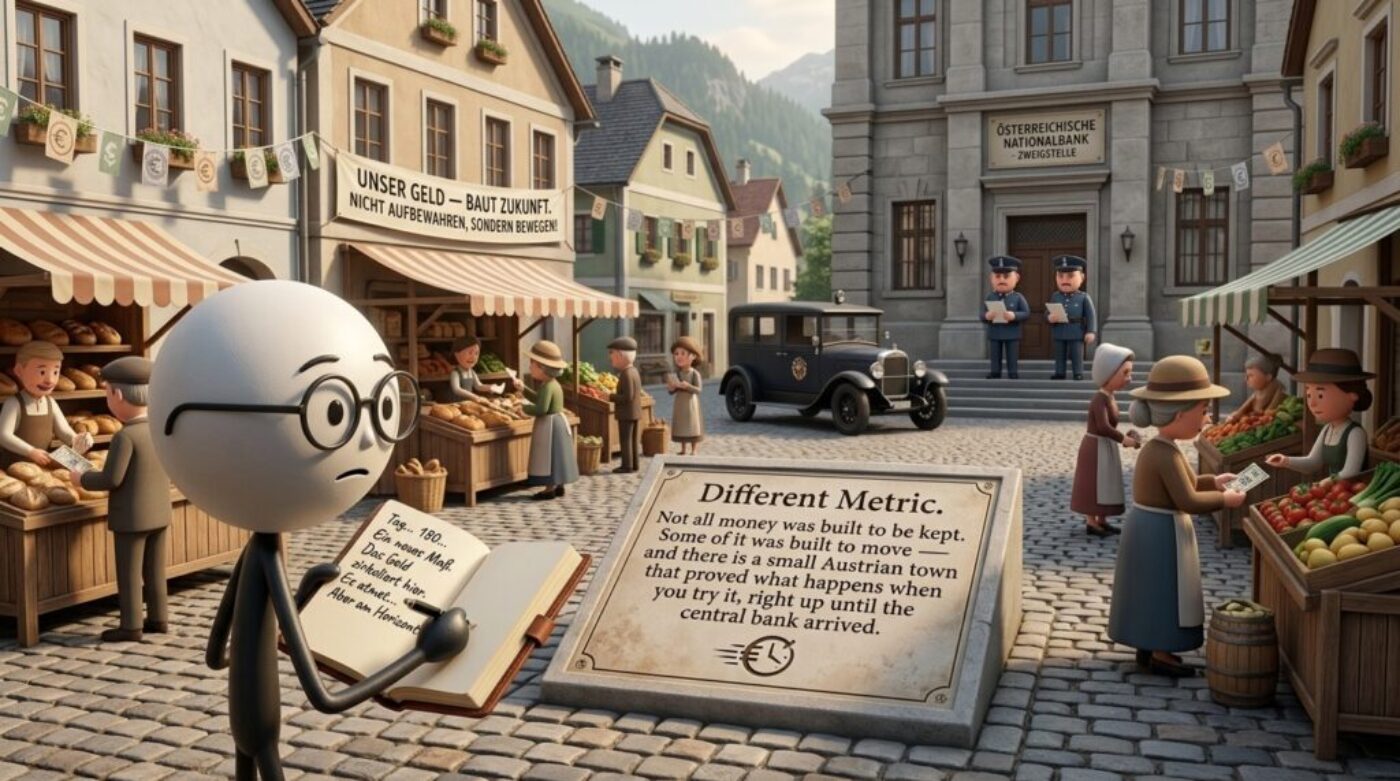
Not all money was built to be kept. Some of it was built to move — and there is a small Austrian town that proved what happens when you try it, right up until the central bank arrived.
I sell something that cannot be stored.
You cannot stockpile haircuts. You cannot buy six in January against a difficult spring. Whatever I do today begins undoing itself immediately, at roughly a centimetre a month, and in six weeks the person is back in the chair and we do it again. My entire trade is a subscription to entropy.
For most of my working life I thought of that as the weakness of the business. Nothing accumulates, there is no inventory, and you cannot bank a single hour of it. I have watched friends in other trades build something they could eventually sell, and I have built a very long series of afternoons.
Lately I have started to wonder whether that might be the healthiest thing about it.
Because money did not always work the way ours does either.
1932 the year an Austrian town issued its own money, deliberately designed to lose value if you held it
30% the unemployment rate it returned to once the central bank shut the experiment down
1 Sept 1933 the date that happened, on the grounds that only central government may issue currency
1 ski jump, built in the meantime, along with a bridge and a new water system
Money That Rotted
We live in a pyramidal civilisation optimised for savings and growth. That is not a natural law. It is a design choice, and other choices have been made.
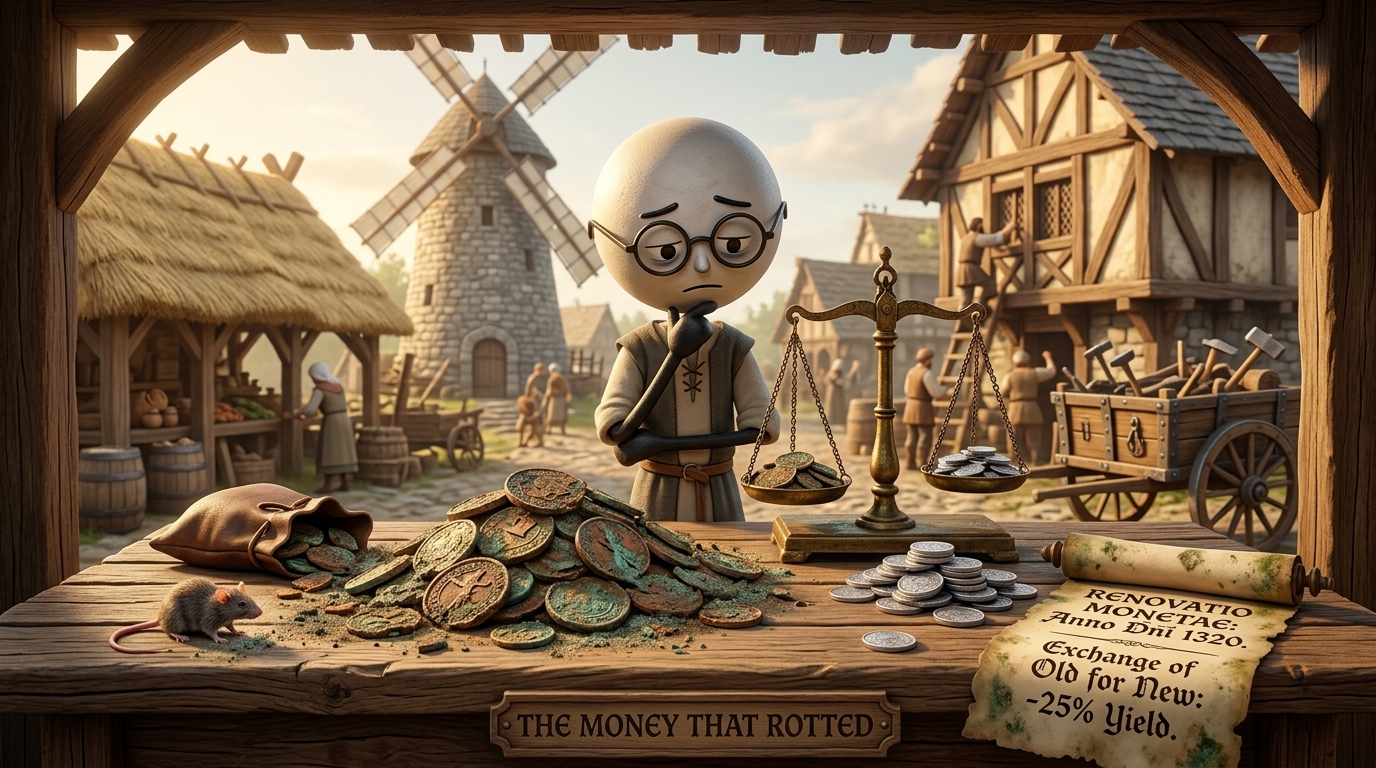
Across parts of medieval Europe, local coinage operated under something called renovatio monetae. Periodically — often annually, sometimes more — the authorities would recall the coins and reissue new ones, and you would hand in your old money and receive back rather less than you gave. Holding currency cost you something. Spending it did not.
It was, in other words, a wealth tax. But an unusually honest one: it arrived on a known date, in person, in your hand, and at no point did it describe itself as inflation.
Where money was tied to a commodity, the same logic arrived by itself. A receipt for stored grain loses value over time, because grain is being eaten by rats and paid for in storage fees, and everyone in the chain knows it. Money of that kind decays, in the way that everything else in an agricultural economy decays.
The effect on behaviour is the interesting part. If your money will be worth less next year simply for having sat still, you do not hoard it. You spend it, lend it, or put it into something durable — a roof, a mill, a wall, a piece of equipment that will still be useful in twenty years. Currency designed to rot pushes people towards building things that don’t.
Money built to support flow, in other words. Exchange, respiration, circulation. It did not get stuck, because getting stuck was expensive.
The Man Keynes Praised
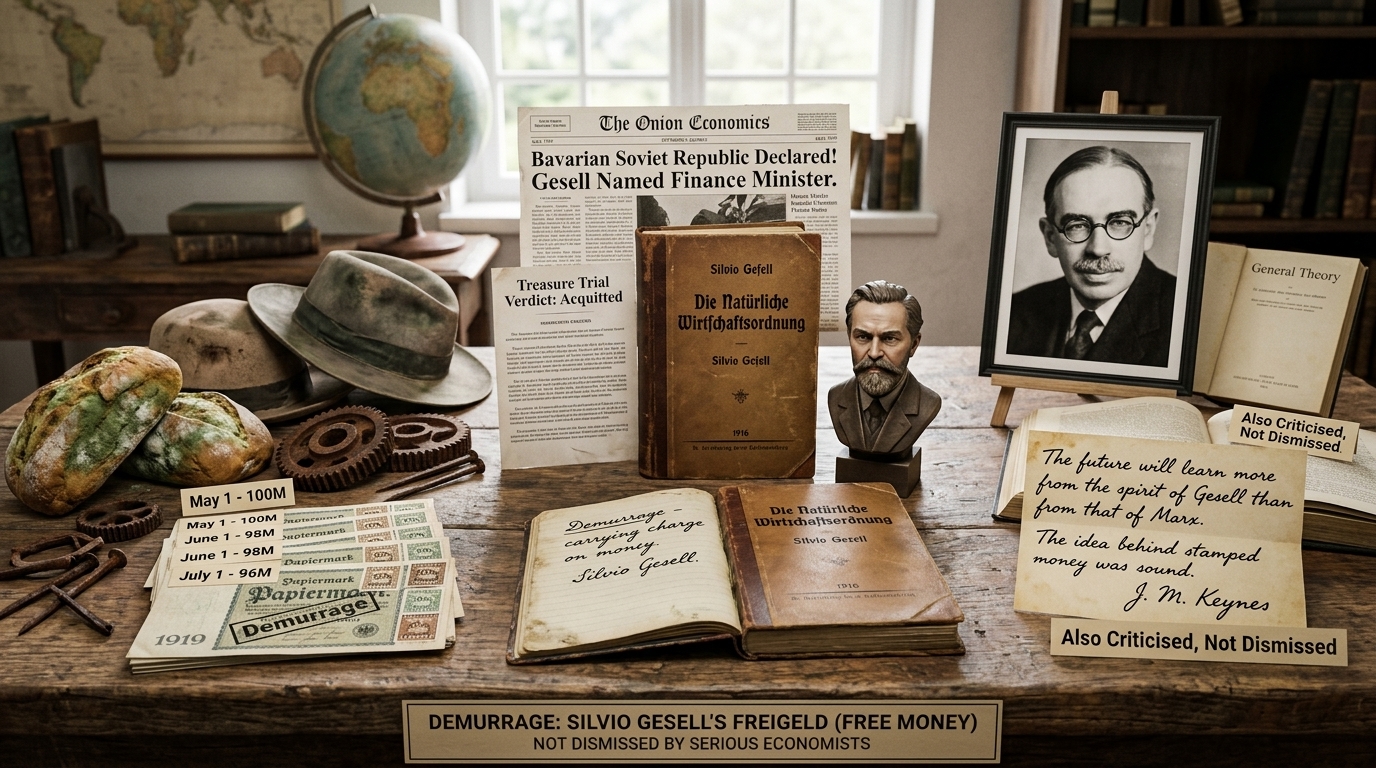
This has a name and a theorist. The name is demurrage — a carrying charge on money itself — and the theorist was Silvio Gesell, a German-Argentine merchant turned economist who published his scheme in 1916 and called it Freigeld: free money. Free, as in freed from hoarding.
Gesell’s argument was that money enjoys an unfair advantage over every other good. Bread goes stale, iron rusts, a shop’s stock goes out of fashion, and labour offered today cannot be stored until tomorrow. Money alone sits perfectly still and loses nothing, which means its holder can always afford to wait while everybody else cannot. Charge money rent for standing still, he said, and the advantage disappears.
It is easy to file this under crank economics, and plenty of people did — helped along by the fact that in April 1919 Gesell spent roughly a week as finance minister of the Bavarian Soviet Republic, and was subsequently tried for treason and acquitted. Not every economist’s CV has that on it, and the ones that do tend to be read with a certain caution.
Except that John Maynard Keynes read him carefully, built on him in developing liquidity preference, and wrote that the future would learn more from the spirit of Gesell than from that of Marx. Keynes also said, plainly, that the idea behind stamped money was sound.
He criticised the scheme as well, and I am not going to pretend otherwise. But “dismissed by serious economists” is not what happened here.
The Town That Tried It
Which brings me to Wörgl, a town in the Austrian Tyrol of a few thousand people, in the pit of the Great Depression.
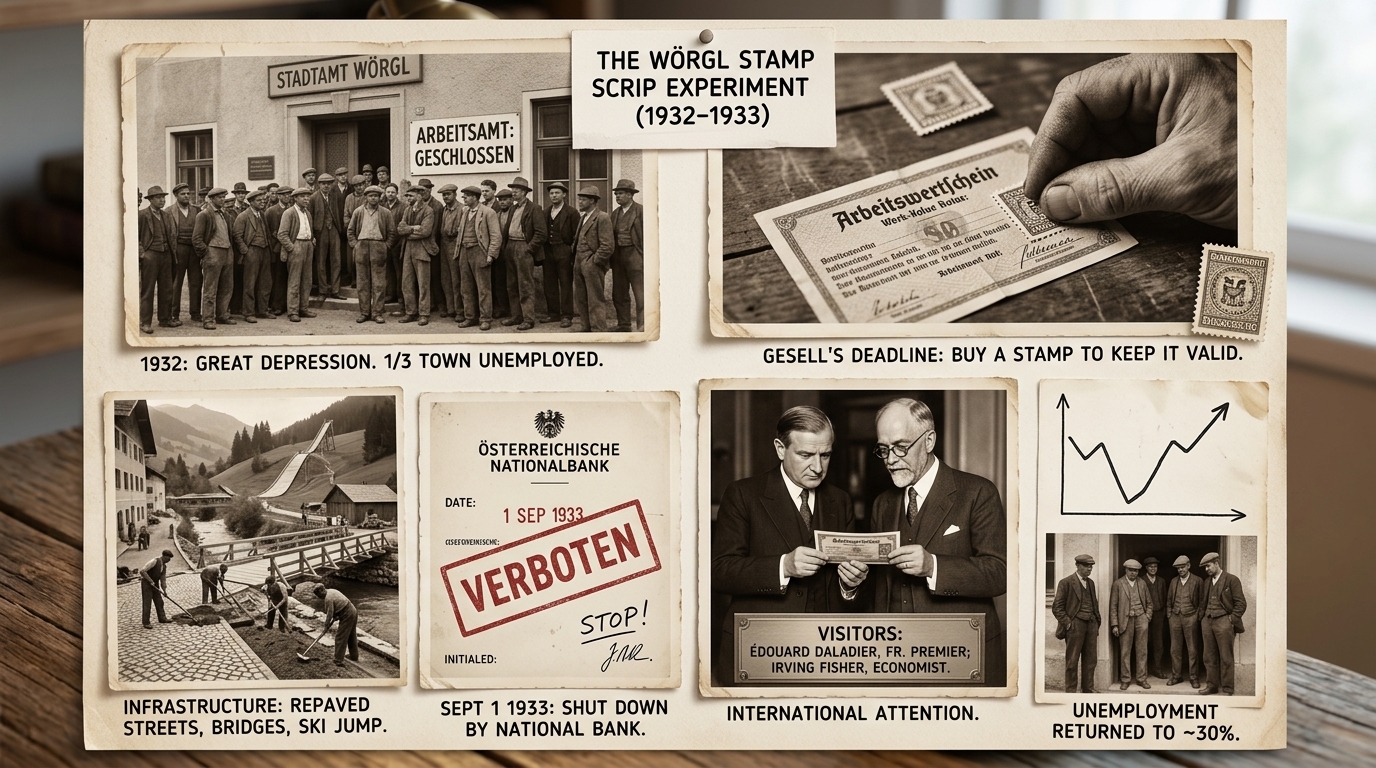
On 31 July 1932, with a third of the town out of work and the council effectively broke, Wörgl began issuing its own currency — certified compensation bills, known generally as stamp scrip. The design was pure Gesell. Each note lost one percent of its value every month, and you kept it valid by buying a small stamp and sticking it on the back.
One percent a month is not a great deal of money. It is, however, a deadline — and a deadline is the most powerful force in economics that nobody puts in the textbook. Nobody wanted to be the one holding a note on the thirty-first. So the money moved, quickly, and it kept moving, and every time it moved somebody got paid.
The town repaved its streets. It rebuilt the water system. It built houses, a bridge, and — because this is Austria — a ski jump. Unemployment fell while it rose everywhere else in the country. Wörgl became the first Austrian town to make a real dent in Depression-era unemployment, and people came to look: the French premier Édouard Daladier, and the economist Irving Fisher, who thought it was the most important monetary experiment of its time.
Neighbouring towns began preparing to copy it. Which is, of course, when it ended.
On 1 September 1933 the Austrian National Bank shut the experiment down, on the entirely correct legal grounds that issuing currency is the prerogative of central government. The bills were withdrawn. Unemployment in Wörgl went back to about thirty percent.
Nobody disputes the facts. People have argued ever since about what they mean.
“You don’t hold your breath to get more powerful. You exhale and inhale to become more alive.” — Wörgl’s money was designed to be exhaled. That is the entire mechanism.
And We Have Already Tried the Modern Version
Here is the part that surprises people who assume this is a fringe idea.
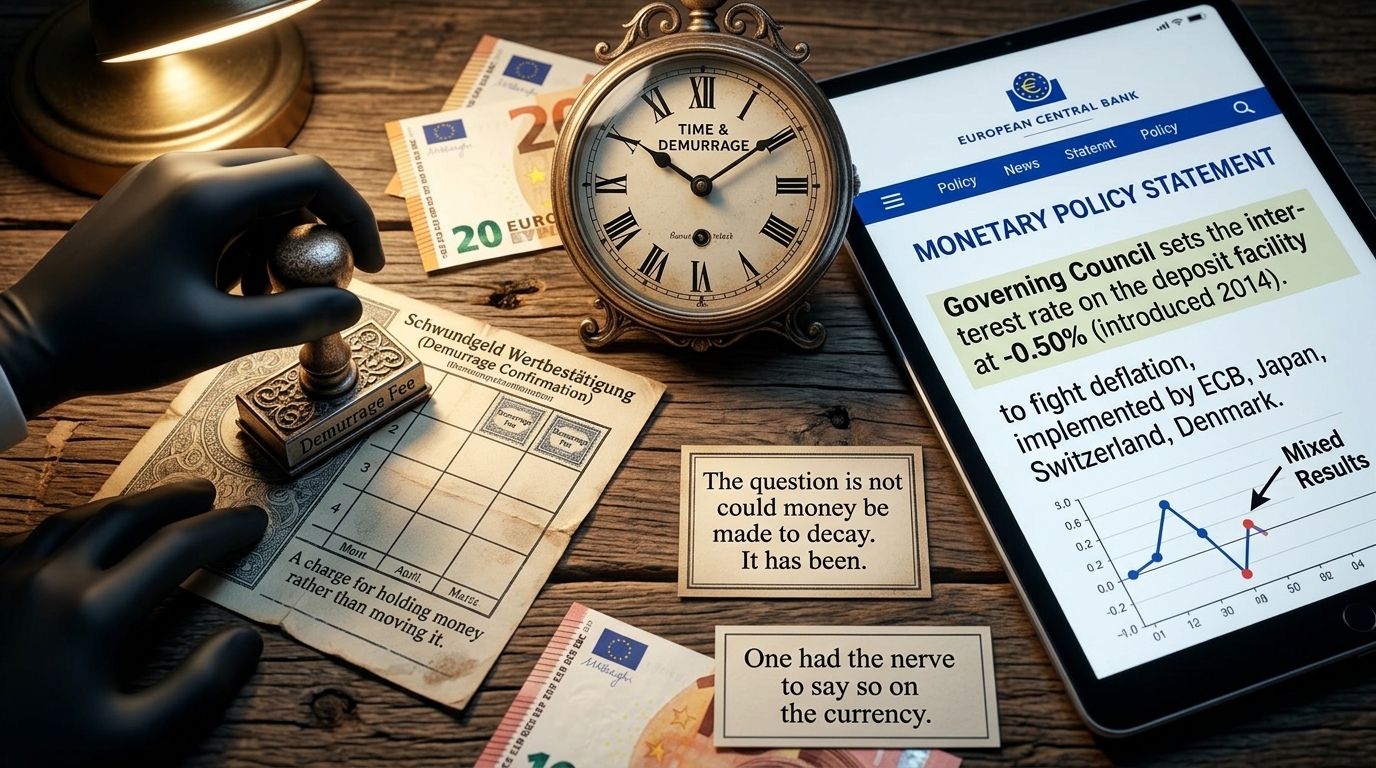
A negative interest rate is demurrage. That is precisely what it is — a charge for holding money rather than moving it. And the European Central Bank ran negative rates on bank deposits from 2014 until 2022. Japan did it. Switzerland and Denmark did it, for longer.
Gesell’s crank idea was eurozone monetary policy within the last four years. It applied to banks rather than households, and it was introduced to fight deflation rather than to promote conviviality, but the mechanism is identical.
The real difference is presentational. Wörgl printed the charge on the back of the note, where you stuck the stamp on yourself and watched your money get smaller. The ECB put it in a policy statement, at a negative sign in front of a decimal, where almost nobody would have to look at it. Same idea. One of them had the nerve to say so on the currency.
The results were mixed and economists are still arguing about them, which is the honest summary of nearly everything in this field. But it does mean that the question is not could money be made to decay. It has been. The question is who it should decay for, and what we would want that to accomplish.
Where the Romance Breaks
Now the corrections, because this story attracts a certain amount of lovely nonsense and I would rather hand you the weak points myself.
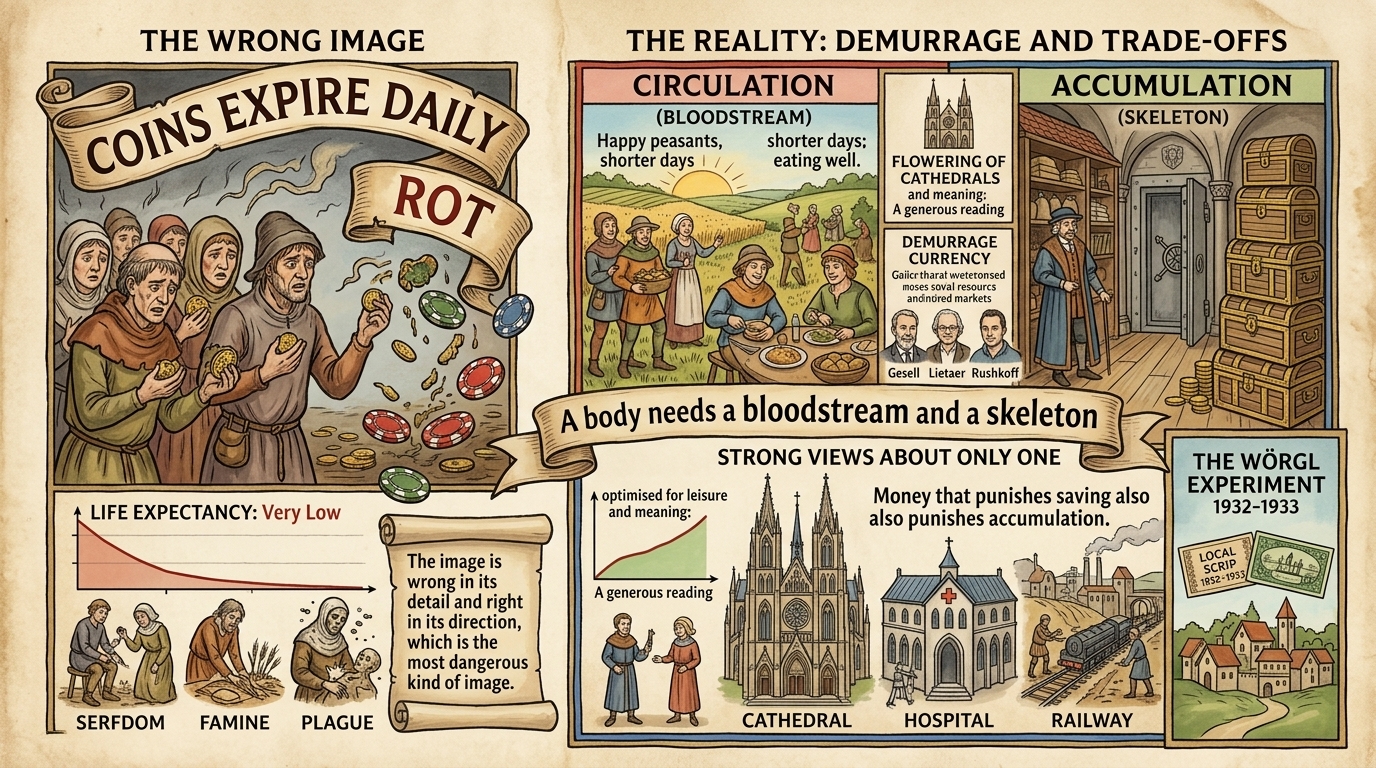
Medieval money did not expire daily. No currency worked like poker chips collected at the end of the night. The real mechanism was slower and duller — periodic recall and reminting, a tax on holding rather than an expiry date. The image is wrong in its detail and right in its direction, which is the most dangerous kind of image.
The medieval golden age is contested. There is a popular telling in which demurrage currencies produced a flowering of cathedrals, short working years and well-fed peasants. Some of it holds up; a great deal of it is argued over by economic historians who point out that the same centuries contained serfdom, famine, plague and a life expectancy that makes “optimised for leisure and meaning” a generous reading. People were not living well because their coins rotted. Some things were better than we assume and most things were considerably worse.
And the trade-off is real. Money that punishes saving also punishes accumulation, and accumulation is how anything gets built that takes longer than a season. You do not get a cathedral, a hospital or a railway without somebody being able to pile up resources first.
A body needs a bloodstream and a skeleton. Most arguments about money are conducted by people who have strong views about only one of them.
Back to the Chair
So what do you actually do with this? You cannot mint your own currency; Wörgl established that fairly conclusively.
I am also aware that “measure your life in conversations rather than in euros” is advice that sounds considerably better coming from somebody who has already paid off a mortgage, and I would treat any version of it from a man with a shop window with the suspicion it deserves.
Still. You can notice which metric you are quietly running your life on, and you can choose a different one. Time spent with friends. The depth of a conversation rather than the number of them. Ideas you actually understood rather than articles you saved. Instruments played badly, in front of people who were kind about it. Meals cooked for other people. None of these can be accumulated, charted, benchmarked against a peer group or left to your heirs, which is precisely what makes them useless to the pyramid and therefore worth having.
And when you do use money — and you will, constantly, because bills are not optional — you can at least prefer the version of it that moves. Spend it where it stays in the neighbourhood. Pay the person directly. Buy the thing that gets repaired instead of replaced.
I’ve written before about Germany’s refusal to give up cash, and about how nobody is really anti-growth. This is the same argument standing on its head: not how much, but how fast it moves, and through whose hands.
Which returns me to the chair, and the one professional consolation of selling something with a shelf life.
Nothing I make lasts. Six weeks, at the outside. There is no back catalogue, no archive, no accumulated body of work anyone can inherit. Every single thing I have done in 51 years has grown out and been cut off again, most of it by me.
For a long time I found that faintly depressing. Now I think it is the reason people keep coming back, and the reason the room stays full, and possibly the reason I still like the job.
You don’t hold your breath to get more powerful.
The Salon California Journal is a space for ideas, culture, and conversation from my chair in Brasschaat, Belgium. I write about beauty, technology, society, and the intersections between them.