Modern Crisis
And It’s Not Even 9 a.m.
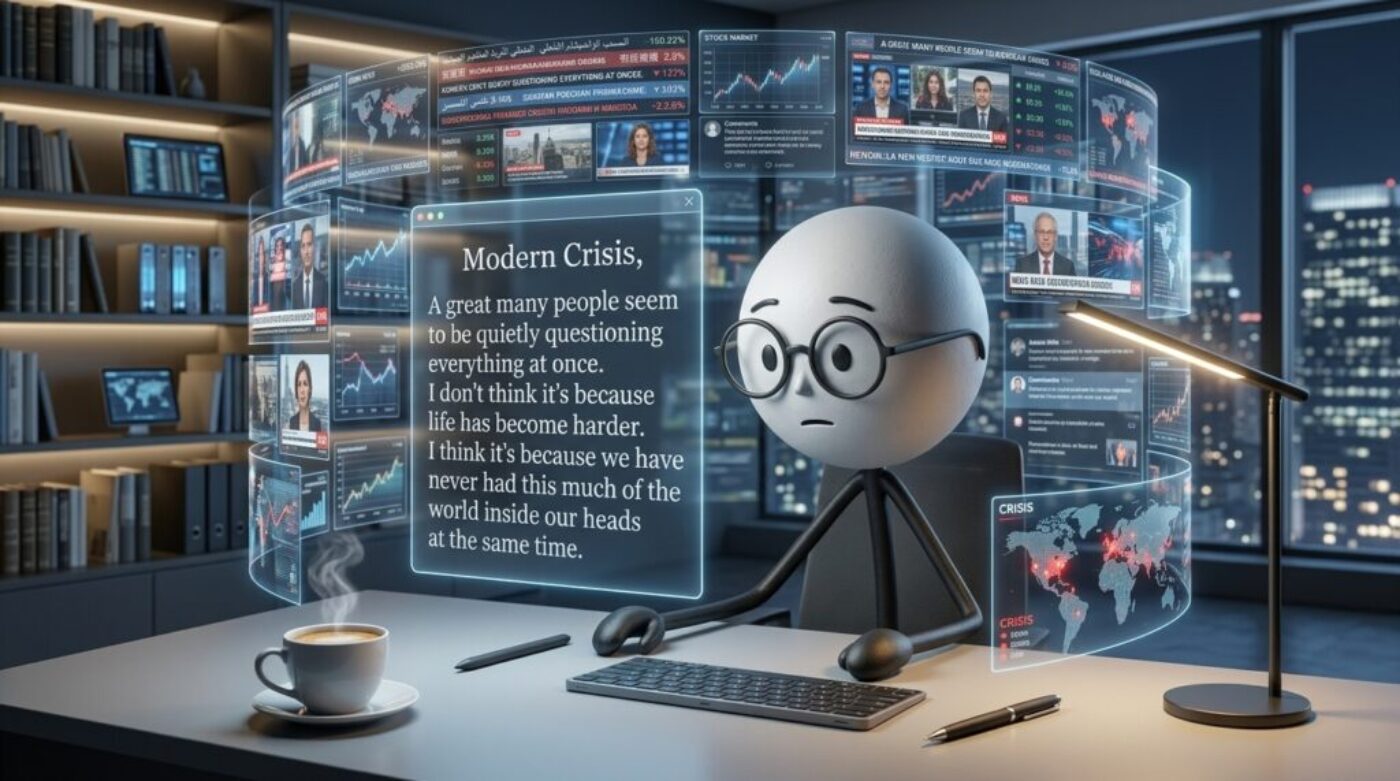
A great many people seem to be quietly questioning everything at once. I don’t think it’s because life has become harder. I think it’s because we have never had this much of the world inside our heads at the same time.
There is a peculiar feature of my job that I have never managed to explain properly to anyone who does not do it. A client sits down, I stand behind them, and for the next forty minutes neither of us has to look the other in the eye. We talk to each other’s reflections.
That small geometric accident — two people facing the same direction, addressing a mirror rather than a face — does something to a conversation. It is the same reason people say more in a car than across a dinner table. Nobody is being examined. You can say a difficult sentence and watch it land at a safe distance, in glass.
Thirty-odd years of that, in three countries, and what you accumulate is not a set of opinions. It is something closer to a barometer.
Which is why I want to write about something I think a lot of us are going through at the moment. And I mean it seriously.
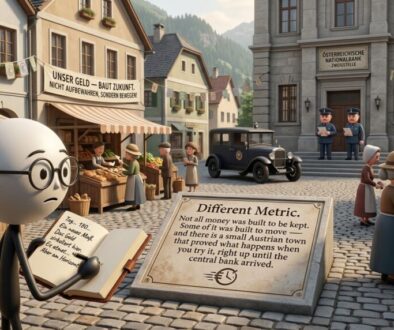
1932 the year an Austrian town issued its own money, deliberately designed to lose value if you held it
30% the unemployment rate it returned to once the central bank shut the experiment down
1 Sept 1933 the date that happened, on the grounds that only central government may issue currency
1 ski jump, built in the meantime, along with a bridge and a new water system
Questioning Everything
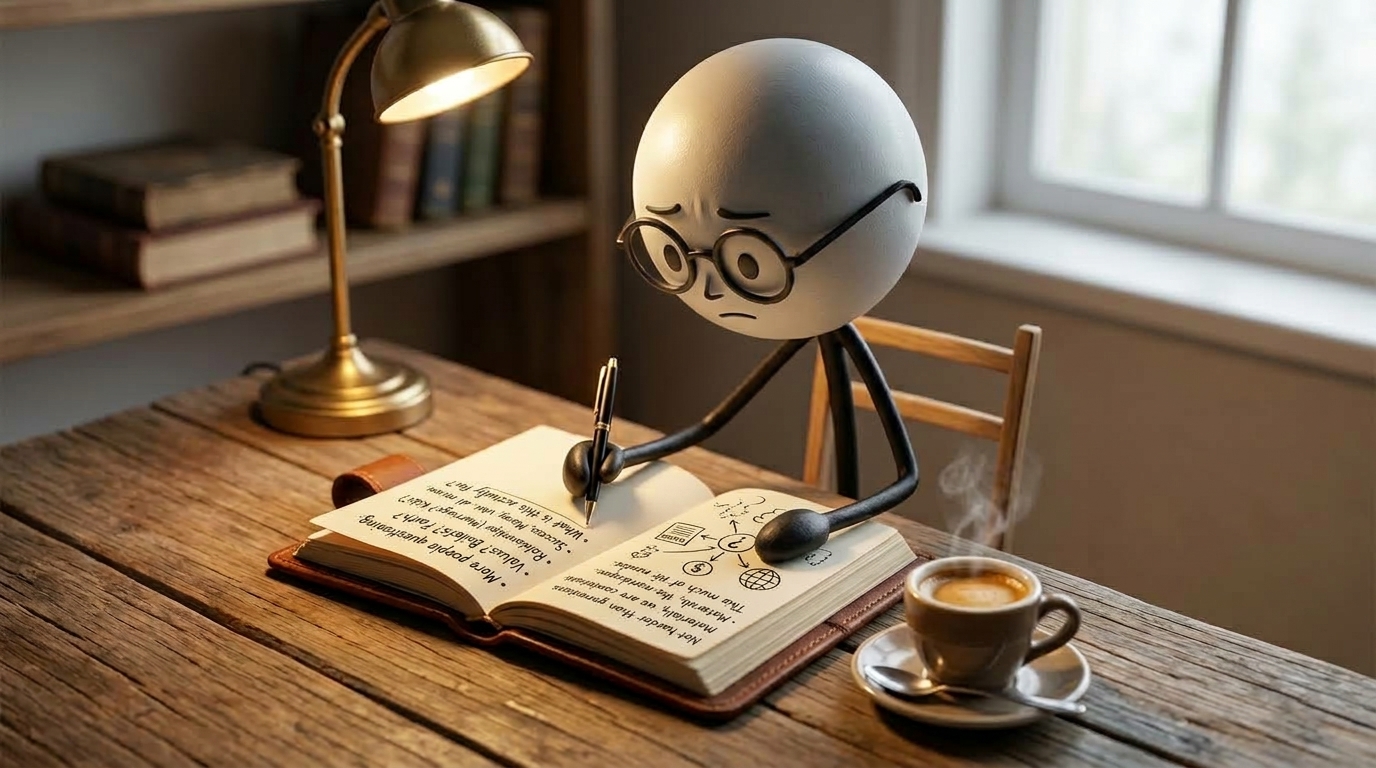
More and more, people seem to be questioning things they never imagined they would question. Values. Beliefs. Faith. Relationships. Marriage, children, success, money, work — and underneath all of it, the larger question of what any of this is actually for.
I don’t think it’s because our lives are necessarily harder than those of the generations before us. Every generation has had its wars, its losses, its uncertainty. Human beings have always had difficult things to survive, and by most material measures a great many of us are surviving them more comfortably than anyone in history.
But I don’t know that we have ever had this much of the world inside our heads at the same time.
Before Nine in the Morning
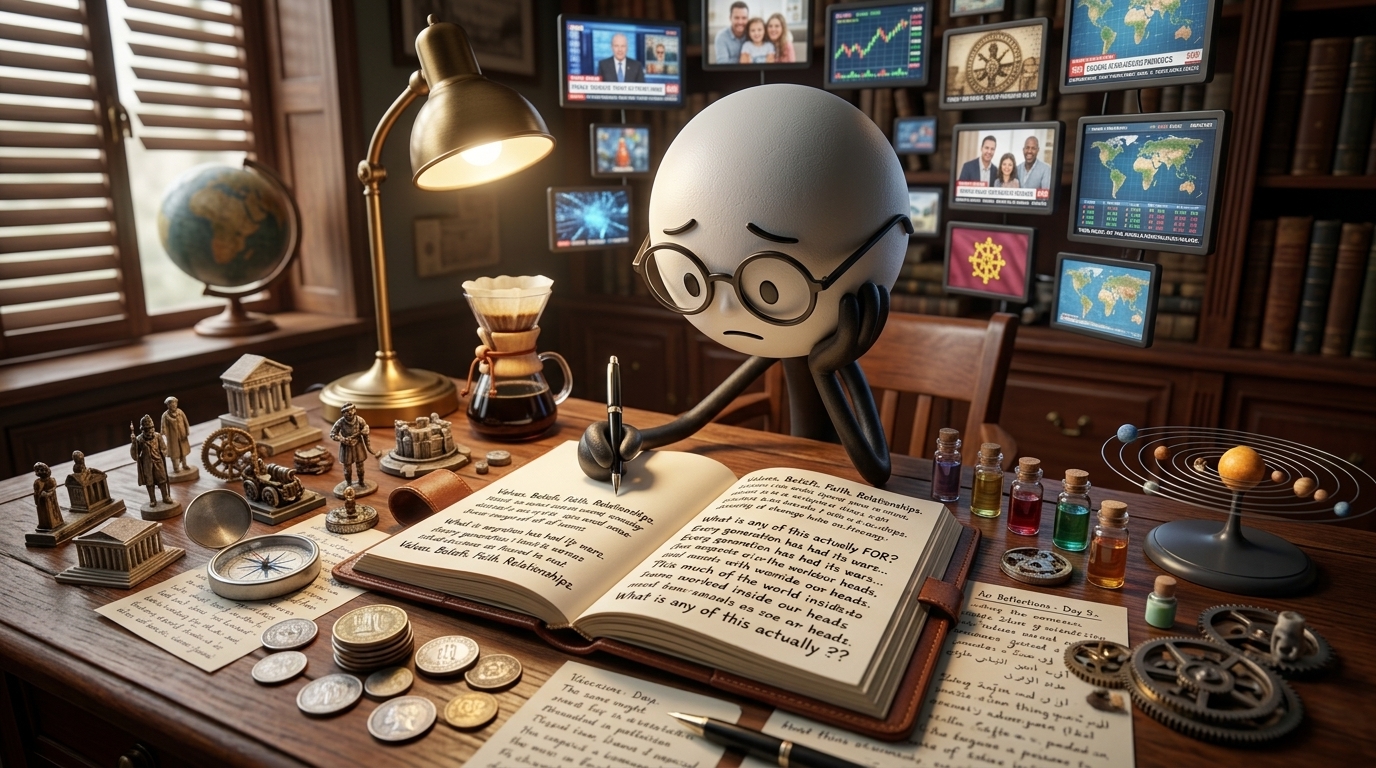
Think about what happens before most of us have got out of bed.
You wake up and within minutes you have watched people die in a country you have never visited. You have seen a political argument. You have watched a seventeen-year-old become a millionaire. You have been told that everything you believe about relationships is wrong. You have watched a machine do something you were fairly sure only a person could do. And you have seen somebody living the exact life you once thought would make you happy, explaining to camera that they are miserable.
And it is not even nine in the morning.
Then we get up, make coffee, go to work, answer emails, have conversations, run errands, and carry on with the day as though our brains have not just absorbed all of that.
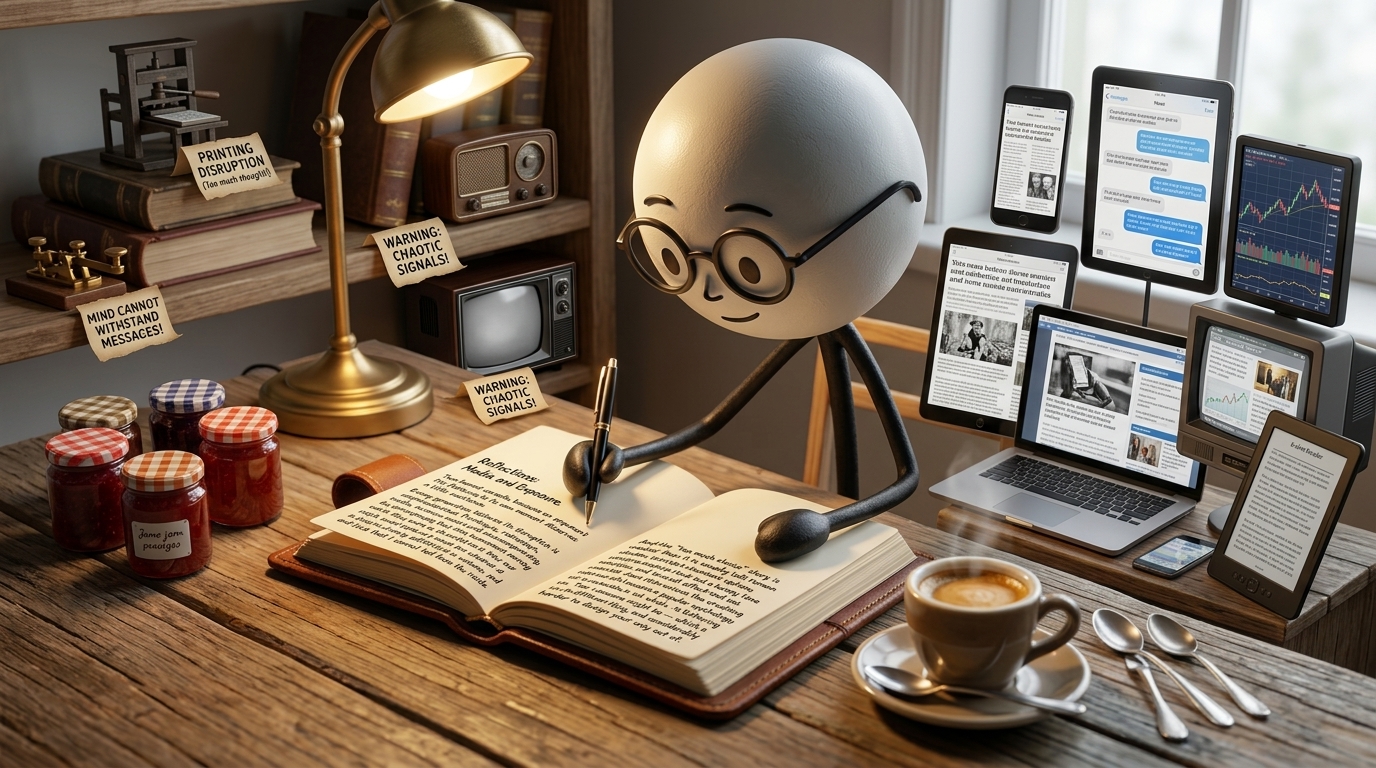
So perhaps it is not surprising that we are questioning everything. We have access to more opinions, lifestyles, beliefs, tragedies, possibilities and perspectives than any human being in history could have encountered. And there is something psychologically strange about being shown every possible way of living.
Eventually you start questioning your own.
There Is Already a Word For It
Here is the thing I find genuinely comforting, and I offer it in that spirit rather than as a correction.
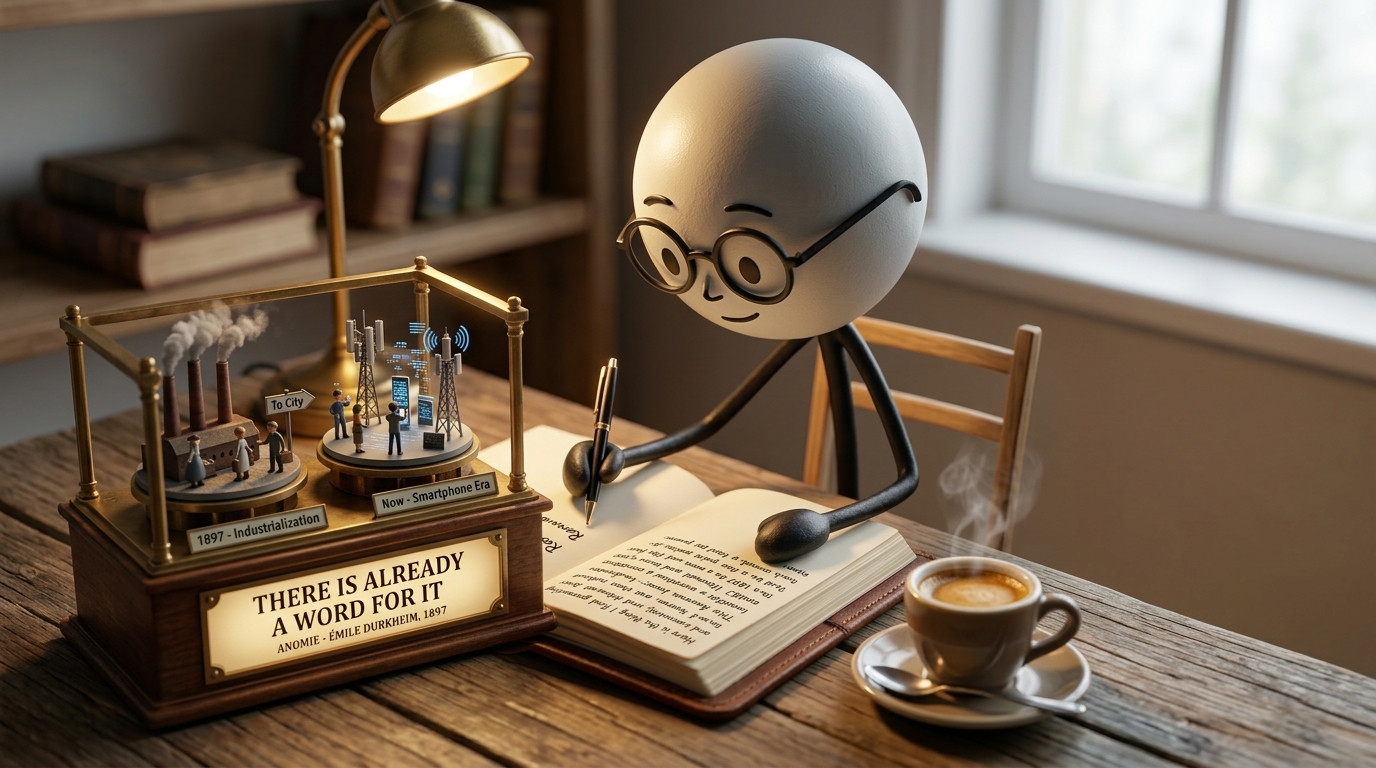
This has a name, and it is a hundred and thirty years old.
In 1897 the French sociologist Émile Durkheim described a condition he called anomie — literally, normlessness. He was watching industrialisation tear through European society, moving people off land their families had worked for centuries and into cities, dissolving the frameworks that had told everybody what a life was for. His observation was that the damage was not primarily material. People were often better fed than their grandparents. What they had lost was the sense that the rules still applied to them, and that loss produced a specific kind of disorientation that looked, from the outside, like people inexplicably falling apart in a period of rising prosperity.
That is not a perfect description of now. But it is a great deal closer than “nobody has ever felt this before.”
Which reframes the whole thing usefully. What we are living through is not a unique catastrophe of the smartphone era. It is the standard human response to the frameworks moving faster than the people inside them — and it has happened before, and people came out the other side, and somebody wrote it down.
A Hundred and Fifty People
The scale point is worth having too.
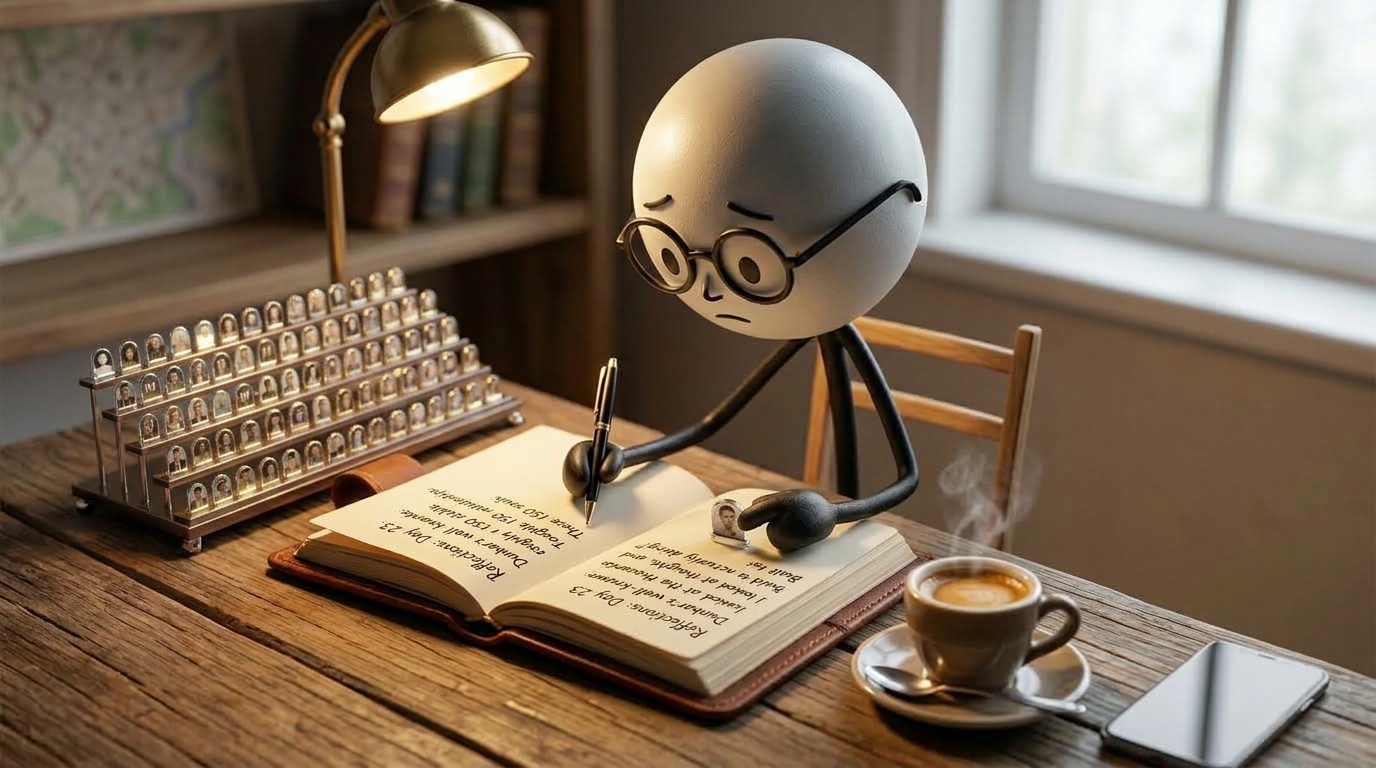
The anthropologist Robin Dunbar’s well-known estimate is that human beings can maintain roughly 150 stable relationships — a number that turns up with suspicious regularity in village sizes, military units and the address books of people who have not yet discovered social media.
Whatever the precise figure, the shape of the claim is sound: we were built to hold a manageable number of other lives in mind. Not thousands. Not an infinite scroll of them, each one edited, each one apparently going better than yours.
Maybe the beliefs you inherited without ever examining them now have questions attached. Maybe the things you thought would make you successful have stopped impressing you. Maybe you looked around recently and thought, what am I actually doing?
I suspect far more people are having that moment than we realise. Not one generation. All of us, more or less simultaneously, and mostly in private.
“For generations we fought to gain access to the whole world. Now that we have it, the harder part turns out to be keeping the whole world from getting inside us.” — Nobody warned us that access and absorption were different problems.
Where I’d Argue With Myself
Two honest caveats, because an argument this flattering to its own moment deserves a little resistance.
Every generation believes its disruption is unprecedented. Printing, railways, telegraph, radio, television — each arrived accompanied by serious people warning that the human mind could not withstand it. They were not entirely wrong and they were not remotely as right as they sounded. Some humility is in order about whether our version is genuinely different in kind or merely different in volume, and I notice that I cannot tell from the inside.
And the “too much choice” story is weaker than it is usually told. The famous studies showing that abundant options paralyse people have had a bumpy time in replication, and the overall effect looks small and inconsistent rather than the crushing force it became in popular psychology. Too much choice is probably not what is bothering us. Too much exposure might be — which is a different thing, and considerably harder to design your way out of.
Back to the Chair
Back to the mirror, then, and the barometer.
I won’t pretend to hard data, and anybody claiming to read a society from a salon chair should be treated with suspicion. But there is one change I would put money on. People used to arrive in my chair with a problem: a job, a house, a relationship, a decision with two options. Something with edges.
What arrives now, more often, has no edges at all. It is not that something has gone wrong. It is that nothing has, and it is somehow still not right, and the person cannot name what is missing because from the outside nothing is.
That is a harder thing to sit with than a problem. A problem can be solved. This mostly needs to be admitted out loud to somebody who is not looking directly at you.
I’ve written before about how little anyone is actually watching you, and about what our devices are doing to the way we relate to each other. This is the third side of the same room.
We have more information than ever. More choices than ever. More access than ever. And somehow we are less certain than ever.
Maybe that is the real crisis. For generations we fought to gain access to the whole world. Now that we finally have it, the harder part is figuring out how to keep the whole world from getting inside us.
Forty minutes in a chair, talking to a mirror, is not a solution to any of that. But it is forty minutes in which nobody is scrolling, and I have come to think that is less trivial than it sounds.
The Salon California Journal is a space for ideas, culture, and conversation from my chair in Brasschaat, Belgium. I write about beauty, technology, society, and the intersections between them.