

Awareness
Take Me Somewhere Nice
Before you try to change your life, there is a duller and far more useful question waiting underneath it: what exactly has been creating the life you are already living?
What do you actually want to achieve in your life?
Seriously. Do you know?
Not what your parents wanted for you. Not what society told you to want. Not what looks impressive on Instagram. And not “I just want to be happy,” which is lovely, but about as useful as telling a taxi driver, “Take me somewhere nice.”
Where are you actually trying to go?
Most people struggle to answer that clearly. And then they wonder why they feel lost, disconnected, frustrated or stuck.
It is like getting into a car, driving around for twenty years, and eventually complaining: I have no idea how I ended up here.
Well. You did have the steering wheel.
95% of people who believe they are self-aware, across a research programme of nearly 5,000 participants
10–15% who actually met the criteria when the same researcher measured it
43% of daily behaviour performed in the same place, on autopilot, while thinking about something else
1 the number of people holding the steering wheel, for the entire journey, without exception

Awareness
That is why I believe every meaningful transformation begins with one thing.
Awareness of where you are. Awareness of where you want to go. Awareness of what is keeping you where you are.
And, most importantly, awareness of how your own mind is operating.
Because this is the part people tend to skip. They want to change their life without understanding what has been creating their current life. They want different results while repeating the same behaviours. They want a new reality while carrying around the same thoughts, emotions, habits, beliefs and identity that produced the old one.
It is a little like changing the wallpaper and declaring you have renovated the house.
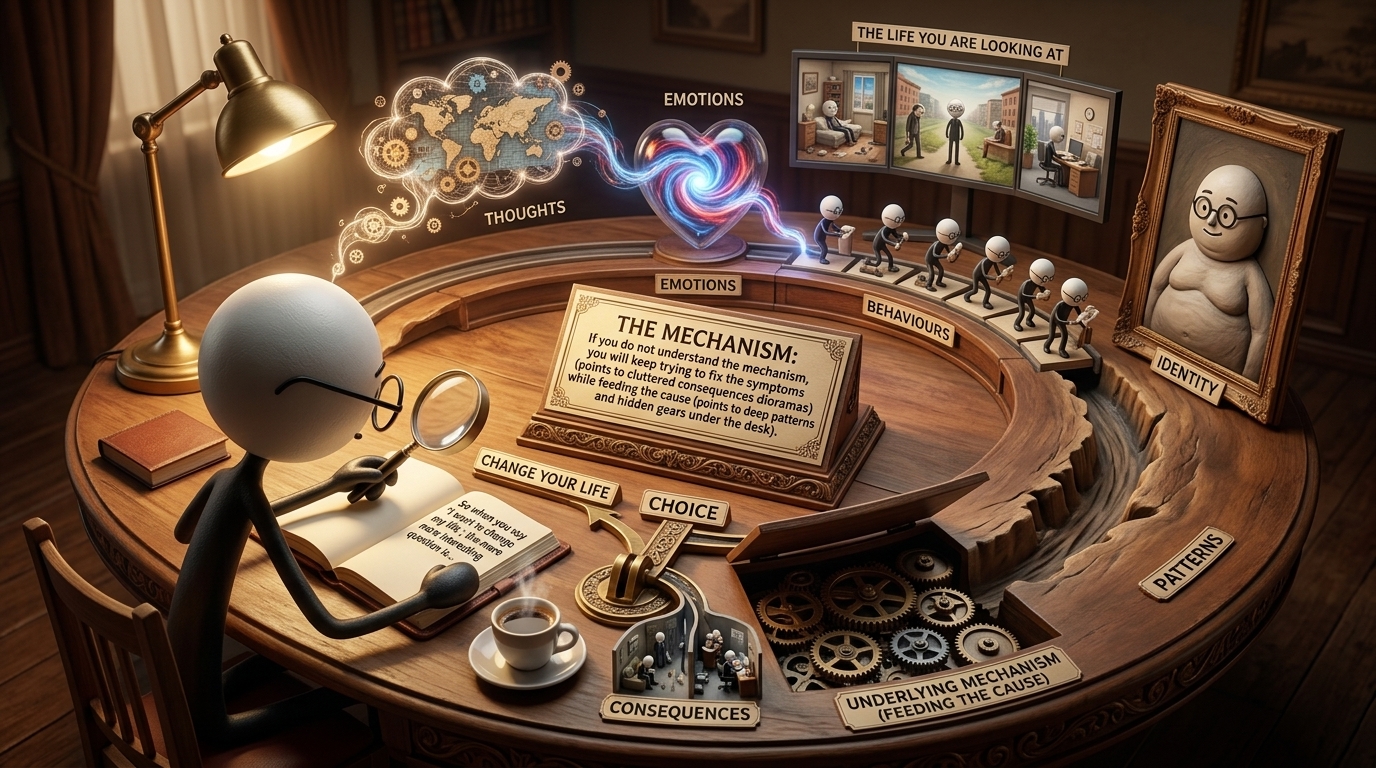
The Mechanism
Your thoughts influence your emotions.
Your emotions influence your behaviour.
Your repeated behaviours become patterns.
Your patterns reinforce your identity.
And your identity influences the choices you keep making.
Then those choices create consequences. And those consequences become the life you are looking at.
So when you say “I want to change my life,” the more interesting question is: what exactly has been creating the life I am living?
Because if you do not understand the mechanism, you will keep trying to fix the symptoms while feeding the cause.

Almost Everyone Thinks They Have Already Done This
Here is the humbling part, and I include it because it happens to be measurable.
The organisational psychologist Tasha Eurich ran a research programme across roughly 5,000 people, having first worked through some 800 existing studies to pin down what self-awareness actually means. About 95 percent of people believed they were self-aware. Between 10 and 15 percent actually were.
Which means the overwhelming likelihood, for you and for me both, is that we are in the first group while feeling entirely like the second. There is no internal sensation that distinguishes them. That is rather the point.
Eurich also separates two things we tend to lump together: how clearly you see your own values and reactions, and how accurately you understand the way you land on other people. They are different skills. Plenty of people have one and almost none of the other, and the ones who are strong on the first and weak on the second are, in my experience, the most confident people in any room.
“It is a little like changing the wallpaper and declaring you have renovated the house.” — The thoughts, the habits and the identity all came with the building.

Awareness Is the Entry Ticket, Not the Destination
Now the honest complication, because I would rather you had it from me.
Awareness on its own frequently changes nothing at all. Everyone reading this can name a pattern they see perfectly clearly and repeat anyway, on schedule, having watched themselves approach it.
The psychologist Wendy Wood spent decades on why. When researchers had people log what they were actually doing hour by hour, roughly 43 percent of daily behaviour turned out to be habit — performed in the same location, at roughly the same time, while the mind was somewhere else entirely. The location does the remembering for you. The behaviour runs before the conscious part arrives.
Which means insight is not the opponent of a habit. Context is. You can understand a pattern completely and still walk into the room that triggers it, and the room will win, because the room is not arguing with you. It is simply the room.
That does not make awareness useless. It makes it the first move rather than the whole game. You see the pattern, and then you change something physical about the situation that produces it — the time, the place, the route, the people, what is within reach. Insight tells you where to point. It does not do the moving.

The Pause
And that is where awareness becomes powerful.
Awareness creates a pause between who you have been and what you choose to do next.
You start noticing the thought before believing it. The emotion before obeying it. The pattern before repeating it. The old identity before automatically stepping back into it.
And that changes everything — because you cannot consciously transform something you have not first learned to see. You cannot change a pattern you are completely unaware of. You cannot choose a new direction if you have not noticed you are going in circles.
Back to the Chair
I have made exactly one decision in my life that would qualify as a genuine change of direction, and I am not going to pretend it was the product of careful self-examination.
In 2009 I closed a salon in La Jolla that I had opened in 1991 and run for eighteen years, left California, and started again in Belgium in a language I did not yet work in, at an age when most people are consolidating rather than beginning. The year after that, I opened a room in Brasschaat with my name on nothing and a client list of nobody.
What I can tell you is that the decision itself took very little time and the awareness took years — and that they arrived in that order, which is not the order the self-help shelf promises. I understood what I had actually done, and why, considerably later than I did it. Some of the patterns I brought with me across the Atlantic came through customs entirely undeclared and were unpacked before the boxes were.
So before you try to change your life, stop for a moment.
Look at where you are. Look at where you are going. And then, perhaps most importantly, look at what inside you keeps taking you there.
Because transformation does not begin when you finally become someone else.
It begins when you become aware of who you have been.
The Salon California Journal is a space for ideas, culture, and conversation from my chair in Brasschaat, Belgium. I write about beauty, technology, society, and the intersections between them.